6. Inspect the House for Small Openings
Snakes can exploit surprisingly small openings.
Inspect:
- Door thresholds
- Foundation cracks
- Crawl-space entrances
- Garage doors
- Vents
- Pipe openings
- Gaps around utility lines
- Spaces underneath steps
- Openings around sheds and outbuildings
Seal appropriate gaps with suitable building materials, while ensuring that necessary ventilation remains functional.
Extension guidance recommends closing gaps and crevices that can serve as entry points for snakes and other small animals.
A properly fitted door sweep can also help close the gap underneath exterior doors.
7. Pay Attention to Birdhouses and Nesting Areas
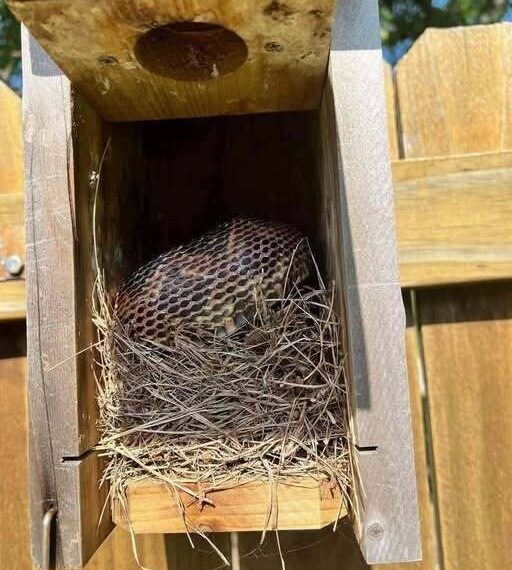
The photograph is a good reminder that wildlife can make use of structures that were originally intended for other animals.
If a snake is found inside or around a birdhouse, don’t immediately assume the birdhouse itself is the problem. The snake may simply have discovered an existing shelter or followed prey into the structure.
If you maintain birdhouses:
- Position them appropriately for the intended bird species.
- Inspect them periodically from a safe distance.
- Keep surrounding vegetation manageable.
- Avoid placing them directly beside dense piles of debris.
- Don’t attempt to reach inside if you suspect a snake is present.
Never put your hand into a dark cavity simply because you cannot see anything inside.
The same principle applies to boxes, sheds, piles of wood and other concealed spaces.
8. Be Careful With Popular “Snake Repellents”
Many products and home remedies are promoted online as natural snake deterrents, including sulfur, mothballs and various strongly scented substances.
However, extension specialists caution that these products should not be relied upon as an effective snake-control strategy. Utah State University Extension specifically advises against snake repellents, sulfur and mothballs, noting that mothballs can be toxic and are not effective for this purpose.
Likewise, there is no need to scatter potentially hazardous chemicals around a garden where children, pets or wildlife may encounter them.
The more reliable strategy is simple:
Remove shelter. Reduce food sources. Seal entry points. Keep the landscape manageable.
9. Don’t Use Glue Traps Outdoors
Glue traps may seem like an easy solution, but they can capture animals other than the intended target and cause prolonged suffering.
For outdoor snake problems, habitat modification and exclusion are much safer approaches. Extension specialists specifically discourage the use of outdoor sticky traps.
The objective should be to make your property less attractive to snakes rather than creating a situation where wildlife becomes trapped.
10. Consider Snake-Exclusion Fencing Where Necessary
If snakes are a persistent problem, physical exclusion can sometimes be more practical than chemical deterrents.
Specialized fencing can use small openings and be installed around particularly sensitive areas, such as:
- Poultry enclosures
- Children’s play areas
- Certain garden areas
- Small animal enclosures
- Frequently used outdoor spaces
USU Extension describes rigid mesh with very small openings as one possible approach, with the fencing partially buried and designed to discourage snakes from climbing over it.
The exact design should depend on the snake species and local conditions.
What to Do If You Actually See a Snake
The safest response is usually distance rather than confrontation.
Don’t:
- Grab it.
- Corner it.
- Hit it.
- Try to identify it by getting close.
- Put your hands near it.
- Allow children or pets to approach it.
Many snake bites occur when people attempt to handle, disturb or kill snakes. If the snake is outside and not trapped in a dangerous location, giving it space may allow it to leave on its own.
If professional wildlife removal is available in your area, contacting a qualified local service can be the safest option, particularly when the species is unknown or potentially venomous.
What If a Snake Is Inside the House?
If you discover a snake indoors, don’t try to catch it with your hands.
Move people and pets away from the area and, if possible, isolate the room by closing interior doors. If the species is unknown or potentially dangerous, contact an appropriately qualified wildlife professional.
After the animal has been safely removed, investigate how it entered.
Look for:
- Door gaps
- Foundation openings
- Garage gaps
- Crawl-space openings
- Unscreened vents
- Gaps around pipes and cables
Removing the animal without addressing the entry point may simply allow another one to enter later.
A Simple Residential Snake-Prevention Routine
You don’t need to transform your entire garden.
A regular inspection can make a major difference.
Once a week
✔ Walk around the house
Look for gaps, debris and areas of dense vegetation.
✔ Check for rodents
Look for droppings, holes, gnaw marks and scattered food.
✔ Keep grass manageable
Especially around paths and frequently used areas.
✔ Check outdoor food sources
Don’t leave pet food or spilled birdseed lying around.
Once a month
✔ Inspect foundations and doors
Look for newly developed cracks or gaps.
✔ Clear unnecessary debris
Remove accumulated branches, leaves and unwanted materials.
✔ Check sheds and outbuildings
Pay particular attention to dark, undisturbed spaces.
✔ Trim vegetation
Maintain a visible perimeter around the home.
The Bigger Picture: Create a Less Attractive Habitat
The most effective long-term approach isn’t about finding a substance that snakes supposedly hate.
It’s about changing the environment.
Think of your property as a combination of:
Food + Water + Shelter + Access
If all four are readily available, wildlife has a reason to remain nearby.
If you reduce those opportunities, encounters can become less frequent.
This habitat-modification approach is consistently recommended by university extension specialists as a practical way of reducing snake activity around homes.
Final Thoughts
A snake appearing around your home doesn’t necessarily mean that your property is infested or unsafe. In many cases, it is simply an animal moving through the landscape in search of food, shelter or suitable conditions.
The best long-term strategy is prevention rather than confrontation.
Keep vegetation manageable, remove piles of debris, control rodent attractants, secure food sources, reduce unnecessary water accumulation and seal potential entry points. These simple measures can make your home and garden considerably less appealing to snakes while also improving overall cleanliness and wildlife management.
And when you encounter a snake, remember the most important rule:
Give it space, keep people and pets away, and avoid trying to handle it.
A secure home doesn’t require eliminating every wild animal from the surrounding environment. It means creating sensible boundaries between your living space and the wildlife that naturally shares the landscape.