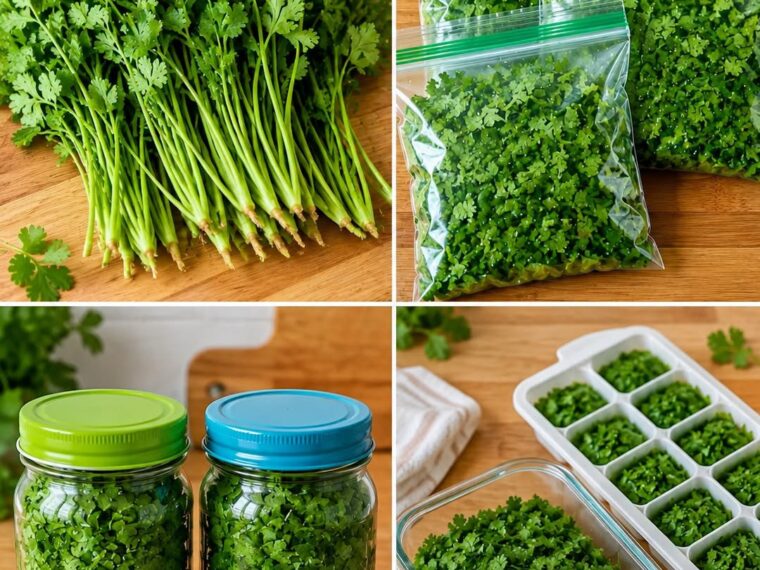
You buy a beautiful, fresh bunch of parsley, use a few sprigs for dinner, and then a few days later you find the rest sitting in the refrigerator looking wilted, yellow, or slimy.
Sound familiar?
Parsley is one of those herbs that can transform an ordinary meal with very little effort. A handful can add freshness to soups, sauces, salads, roasted vegetables, meat, fish, pasta, and countless other dishes.
The problem is that fresh parsley can deteriorate surprisingly quickly when it is stored incorrectly.
The good news is that you don’t need expensive equipment or complicated techniques to extend its freshness.
The secret is understanding one simple principle:
Parsley needs the right balance of moisture, airflow, and cold temperature.
Too little moisture and it wilts.
Too much moisture and it begins to rot.
So, how can you keep parsley fresh for much longer?
🌿 Why Does Fresh Parsley Wilt So Quickly?
Parsley contains a large amount of water. After it is harvested, the leaves and stems continue to lose moisture.
When that moisture loss becomes excessive, the leaves become limp and the stems start to bend.
But there is another problem.
If you wash parsley and immediately seal it inside a plastic bag while it is still covered in water droplets, that moisture becomes trapped around the leaves.
The result can be:
- Yellowing leaves
- Brown spots
- Slimy texture
- Unpleasant odors
- Mold
That’s why the goal isn’t simply to keep parsley “wet.”
The goal is to keep it hydrated without allowing excess moisture to accumulate on the leaves.
👨🍳 Method 1: Store Parsley Like a Bouquet of Flowers
One of the simplest ways to keep whole parsley fresh is to treat it like a small bouquet.
Start by removing any leaves that are already yellow, damaged, or beginning to decay.
Trim a small amount from the bottom of the stems if they look dry.
Then place the stems in a glass or jar containing a small amount of fresh water.
The important part is that the stems—not the leaves—should sit in the water.
You can loosely cover the parsley with a clean plastic bag and place the arrangement in the refrigerator.
The stems can absorb water while the leaves remain relatively dry.
Check the water regularly and replace it when necessary.
This method is particularly useful if you like using fresh parsley throughout the week for garnishing dishes.
🧻 Method 2: Use Paper Towels to Control Moisture
Another popular method is to wrap parsley in paper towels before placing it in the refrigerator.
This is especially useful when you want to store the parsley in a container or storage bag.
First, inspect the bunch and remove damaged leaves.
If you wash the parsley, dry it thoroughly.
You can use a salad spinner, a clean kitchen towel, or paper towels to remove excess surface water.
Once the parsley is reasonably dry, wrap it gently in paper towels.
Place the wrapped parsley inside a suitable storage bag or container and refrigerate it.
The paper towel helps absorb excess moisture before it can accumulate around the leaves.
If the paper towel becomes noticeably wet, replace it.
💧 The Small Detail That Makes a Big Difference
One of the most common mistakes is storing freshly washed parsley while it is still dripping wet.
Washing the herb isn’t the problem.
Trapped moisture is.
If water droplets remain between the leaves, the enclosed environment can become excessively humid.
That can accelerate deterioration.
So if you wash your parsley before storing it, take a few extra minutes to dry it properly.
You don’t want to completely dehydrate the herb.
You simply want to remove excess water from the surface.
🫙 Method 3: Chop the Parsley Before Storing It
The image also shows another practical technique: chopping parsley before storing it.
This can be particularly convenient if you cook frequently.
Instead of washing, drying, and chopping parsley every time you prepare a meal, you can do the work once and have it ready to use.
Start by:
- Sorting the parsley.
- Removing damaged leaves.
- Washing it if necessary.
- Drying it thoroughly.
- Chopping it finely.
- Placing it in a clean storage container.
Keep the container refrigerated and monitor the parsley regularly.
If you notice excessive moisture collecting inside the container, address it rather than allowing the parsley to sit in condensation.
❄️ Method 4: Freeze Parsley for Long-Term Storage
If you’ve bought far more parsley than you can use in the next several days, freezing is an excellent way to reduce waste.
The process is simple.
Step 1: Sort the parsley
Remove yellow, damaged, or deteriorating leaves.
Step 2: Wash it
Rinse the parsley thoroughly if needed.
Step 3: Dry it
This step is extremely important.
Remove as much surface moisture as possible before freezing.
Step 4: Chop it
Finely chop the parsley so that it will be easy to use later.
Step 5: Divide it into portions
Instead of freezing the entire amount together, divide it into small portions.
An ice cube tray is particularly convenient for this.
Once the portions are frozen solid, transfer them to a freezer-safe bag or container.
Now you’ll have individual portions ready whenever you need them.
🧊 Why Are Small Portions So Convenient?
Imagine you’re preparing a soup.
You don’t need to take out an entire bunch of parsley, chop it, and put the rest back into the refrigerator.
Instead, simply grab one frozen portion and add it to the dish.
Frozen parsley works particularly well in:
- Soups
- Sauces
- Stews
- Casseroles
- Roasted vegetables
- Marinades
- Omelets
- Fish dishes
- Meat dishes
- Pasta sauces
This makes frozen parsley especially useful for everyday cooking.
🌿 Is Frozen Parsley as Good as Fresh Parsley?
TO CONTINUE READING THE ARTICLE PLEASE SEE PAGE 2