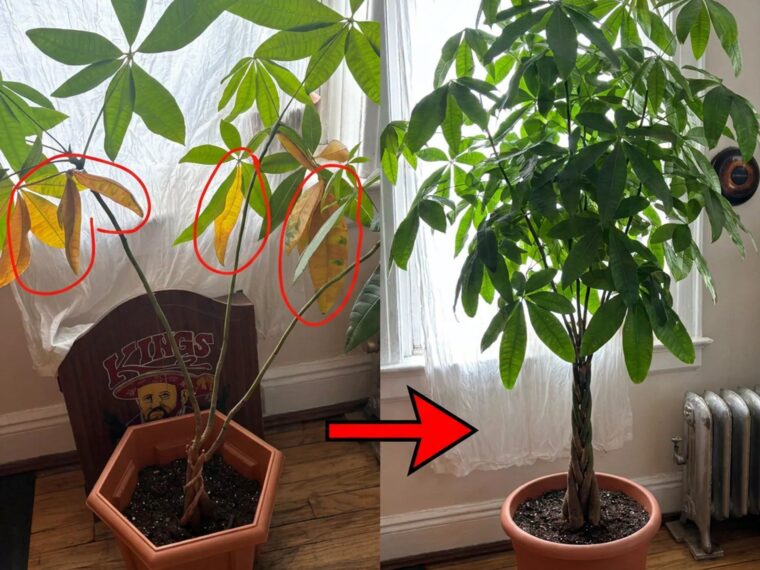
If your Money Tree has started developing yellow, brown, or drooping leaves, don’t panic. The plant in the photo shows a problem that many plant parents eventually encounter—and in many cases, the tree can recover with a few simple changes.
The Money Tree, scientifically known as Pachira aquatica, is one of the most popular indoor plants because of its attractive braided trunk, distinctive umbrella-shaped leaves, and relatively forgiving nature. But “easy to care for” doesn’t mean it can survive every watering mistake or poor growing condition.
The good news is that yellowing leaves are often your plant’s way of telling you that something in its environment needs attention.
The image shows a dramatic before-and-after transformation: a sparse Money Tree with numerous yellowing and dying leaves on the left and a much fuller, healthier-looking tree on the right. While every plant responds differently, the transformation illustrates an important lesson: consistent care matters more than complicated care.
Here’s how to give your Money Tree the conditions it needs to thrive.
First, Understand What Yellow Leaves Are Telling You
Yellow leaves don’t automatically mean your Money Tree is dying.
A few older leaves turning yellow and eventually dropping can be completely normal. Plants naturally replace older foliage as they grow.
The problem is when many leaves begin turning yellow at once, especially when the yellowing is accompanied by:
- Soft or mushy stems
- Brown or black spots
- Drooping leaves
- A consistently wet potting mix
- An unpleasant smell from the soil
- Sudden leaf loss
- Slow or stalled growth
These symptoms can indicate that something is wrong with the plant’s growing conditions.
One of the most common causes is watering too frequently.
Secret No. 1: Don’t Water on a Schedule
This may be the most important Money Tree care secret.
Don’t automatically water your plant every Sunday, every five days, or according to a calendar.
Instead, check the soil first.
Money Trees prefer moisture but don’t like sitting in constantly saturated soil. If the roots remain wet for too long, they can become stressed and, in severe cases, develop root problems.
Before watering, insert your finger a couple of inches into the potting mix. If the upper portion is still noticeably moist, wait.
If the soil has dried considerably, it’s time to water.
When you do water, water thoroughly enough that some excess drains from the bottom of the container. Then empty any water collected in a saucer or decorative cachepot.
The goal is not:
“Keep the soil wet.”
The goal is:
“Give the roots water, then allow excess moisture to drain away.”
Secret No. 2: Drainage Is Just as Important as Water
You can have the perfect watering routine and still run into problems if your pot doesn’t drain properly.
A Money Tree should ideally be planted in a container with drainage holes.
Those holes allow excess water to escape rather than accumulating around the roots.
A decorative pot without drainage may look beautiful, but it can create a hidden reservoir of water beneath the plant.
That’s especially dangerous because the surface of the soil can look dry while the lower part of the pot remains extremely wet.
If your Money Tree repeatedly develops yellow leaves despite careful watering, check what’s happening beneath the surface.
Secret No. 3: Give It Bright, Indirect Light
Money Trees generally perform best in bright, indirect light.
The tree shown in the healthier half of the image is positioned near a large window, providing plenty of natural illumination.
That’s a useful clue.
If your Money Tree is sitting in a dark corner far from windows, it may struggle to produce vigorous growth. Low light can also slow the rate at which the soil dries, meaning that frequent watering becomes even more problematic.
On the other hand, placing a plant suddenly in intense, hot direct sunlight can cause leaf scorching.
The sweet spot is usually a bright location where the plant receives plenty of natural light without being exposed to harsh, prolonged afternoon sun.
If your tree is growing toward the window, rotate the pot occasionally so that different sides receive light.
This can help encourage more balanced growth.
Secret No. 4: Don’t Move It Constantly
Money Trees appreciate consistency.
Plant parents sometimes respond to a problem by moving the plant from one room to another every few days:
“Maybe it needs more sun.”
Then:
“Maybe that’s too much sun.”
Then:
“Maybe the bathroom is better.”
Constant changes can make it difficult to determine what is actually helping.
Instead, choose a suitable location with good light and stable temperatures, then give the plant time to adjust.
If you move it from a low-light location into significantly brighter conditions, make the transition gradually when possible.
Secret No. 5: Protect Your Money Tree From Temperature Extremes
Money Trees are tropical plants, so they generally appreciate warm, stable indoor conditions.
Avoid placing them directly beside:
- Cold drafts
- Frequently opened exterior doors
- Air-conditioning vents
- Strong heating vents
- Very hot radiators
- Extremely cold windows during winter
A plant can be perfectly watered and still struggle if it is repeatedly exposed to uncomfortable temperature fluctuations.
The radiator visible beside the healthier tree in the photo is a reminder to pay attention to placement. Being near a window is useful, but being directly next to a strong heat source may not be.
Secret No. 6: Use a Well-Draining Potting Mix
Your Money Tree’s soil plays a major role in its health.
You don’t want a heavy mixture that remains saturated for long periods.
A well-draining indoor potting mix can help provide the roots with both moisture and access to air.
Many plant parents improve drainage by incorporating materials such as perlite into their potting mix.
The exact mixture isn’t as important as the result:
Water should be able to move through the soil rather than remaining trapped around the roots.
Secret No. 7: Don’t Ignore the Roots
TO CONTINUE READING THE ARTICLE PLEASE SEE PAGE 2