Secret No. 7: Don’t Ignore the Roots
If your Money Tree continues losing leaves despite improvements to light and watering, it’s worth investigating the roots.
Healthy roots are generally firm and light-colored. Roots that have been damaged by prolonged waterlogging may become soft, dark, or unpleasant-smelling.
If severe root damage is present, simply watering less may not be enough.
The plant may need to be removed from its container, damaged roots carefully addressed, and the tree replanted into fresh, well-draining mix.
This is one reason catching the problem early is so valuable.
A few yellow leaves are much easier to deal with than a completely collapsed root system.
Secret No. 8: Don’t Remove Every Yellow Leaf Immediately
It can be tempting to grab the scissors as soon as a leaf begins changing color.
But first ask why the leaf is yellow.
If the plant is stressed because of watering, light, temperature, or another environmental issue, removing leaves won’t fix the underlying problem.
Instead, correct the growing conditions first.
Once a leaf has become completely yellow, brown, damaged, or dead, it can generally be removed cleanly with clean scissors or pruning shears.
Removing genuinely dead foliage also makes it easier to see new growth and monitor the plant.
Secret No. 9: Pruning Can Encourage a Fuller Appearance
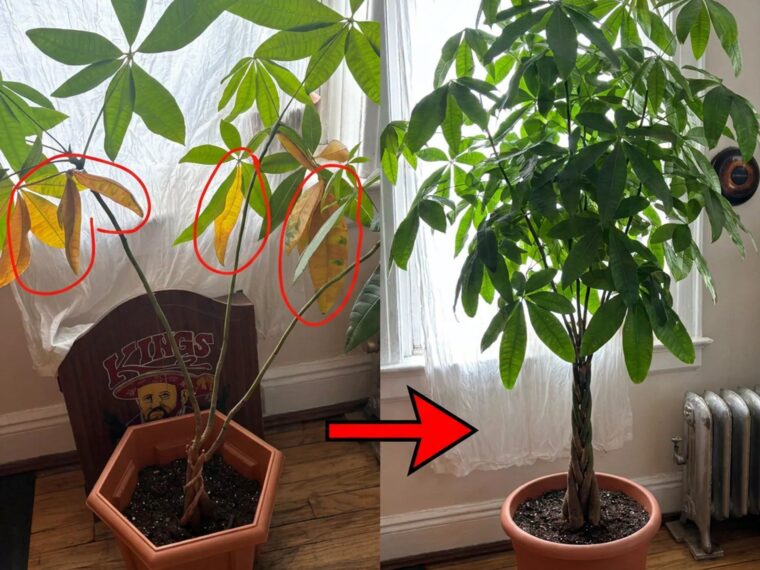
Look closely at the dramatic difference between the sparse Money Tree and the fuller plant shown in the image.
A Money Tree can become tall and somewhat leggy when it doesn’t receive enough light or when growth isn’t managed.
Strategic pruning can help create a more compact appearance.
If a branch has become excessively long or sparse, pruning it can encourage new growth from lower points on the stem.
Always use clean, sharp pruning tools.
And don’t remove huge amounts of healthy growth simply because you’re trying to make the plant look fuller overnight.
Plants need leaves for photosynthesis, so pruning should be deliberate.
Secret No. 10: Rotate Your Tree
Here’s a tiny habit that can make a surprisingly noticeable difference.
Rotate the pot every week or two.
Indoor plants naturally grow toward their strongest light source.
If you never rotate your Money Tree, one side may become much fuller than the other.
A gentle rotation helps expose different parts of the plant to the available light and can encourage a more balanced silhouette.
This is particularly useful when the tree is positioned beside a large window.
Secret No. 11: Feed It—But Don’t Overdo It
Money Trees benefit from nutrients during active growth.
A balanced houseplant fertilizer can be used according to its label directions during the growing season.
But more fertilizer does not mean more growth.
Overfertilizing can damage roots and lead to salt accumulation in the potting mix.
If your Money Tree is already stressed, severely yellowing, or suffering from root problems, focus on correcting those issues before trying to force new growth with extra fertilizer.
Healthy roots and appropriate light come first.
Secret No. 12: Watch for Pests
Yellowing or distorted leaves aren’t always caused by watering.
Indoor plants can also develop pest problems.
Check your Money Tree regularly for signs such as:
- Fine webbing
- Tiny insects
- Sticky residue
- Speckled leaves
- Distorted new growth
- Cottony white clusters
- Small bumps on stems or leaves
Inspect the undersides of leaves as well as the stems.
Catching an infestation early is much easier than trying to control a serious infestation after it has spread throughout the plant.
The Braided Trunk Has a Secret Too
One of the reasons Money Trees are so recognizable is their braided trunks.
Many commercially sold Money Trees actually consist of several young stems that have been braided together while flexible.
As they mature, the trunks become thicker and more woody.
If you have a braided Money Tree, don’t assume that the braid itself means the plant requires special care. The same basic principles still apply:
light, water, drainage, temperature, nutrition and pest monitoring.
If you notice the trunks becoming tightly constricted by ties or other materials, inspect them carefully. Anything that restricts growing stems can become problematic as the plant gets larger.
Why Does a Money Tree Drop Leaves?
Leaf drop can happen for several reasons.
Some possibilities include:
Too much water:
One of the most common concerns, especially when the soil stays wet for long periods.
Too little water:
A severely dry plant can also lose leaves.
Insufficient light:
Low light can weaken growth and contribute to poor foliage retention.
Sudden environmental changes:
Moving a plant, changing its lighting dramatically, or exposing it to temperature fluctuations can cause stress.
Pests:
Certain insects can damage foliage and cause leaves to deteriorate.
Natural aging:
Older leaves eventually decline and are replaced.
The key is to look at the whole plant, not one yellow leaf.
A Simple Money Tree Recovery Routine
If your Money Tree looks like the struggling plant shown on the left side of the image, don’t immediately assume it’s beyond saving.
Start with a simple assessment.
Step 1: Check the soil
Is it constantly wet?
Or is it extremely dry?
This gives you an important clue about your watering habits.
Step 2: Check the pot
Make sure the container has drainage holes and that they aren’t blocked.
Step 3: Check the roots if necessary
If the soil stays wet for an unusually long time or the plant has severe symptoms, inspect the root system for signs of damage.
Step 4: Improve the lighting
Move the plant to a brighter location with suitable indirect light.
Step 5: Remove dead foliage
Trim completely dead or badly damaged leaves with clean tools.
Step 6: Stabilize its environment
Keep the plant away from strong drafts, extreme temperatures, and direct blasts from heating or cooling systems.
Step 7: Be patient
This is perhaps the hardest step for impatient plant parents.
A damaged Money Tree won’t transform overnight.
Give the roots time to recover and the plant time to produce new growth.
The Biggest Money Tree Mistakes to Avoid
If you want a healthy Money Tree, avoid these common mistakes:
❌ Watering because the calendar says it’s time
Check the soil instead.
❌ Leaving the pot sitting in water
Drain excess water after watering.
❌ Keeping it in a dark corner
Bright, suitable light is essential for strong growth.
❌ Fertilizing a stressed plant excessively
More fertilizer isn’t a cure for poor lighting or root problems.
❌ Constantly moving the plant
Find a good location and give it time to adapt.
❌ Ignoring yellow leaves
One yellow leaf isn’t necessarily alarming, but widespread yellowing deserves investigation.
❌ Assuming every problem requires more water
This is one of the most common houseplant mistakes.
How to Know Your Money Tree Is Happy
A healthy Money Tree should generally show signs of active, balanced growth.
Look for:
🌿 Firm, green leaves
🌿 New leaves emerging from growing points
🌿 Strong stems
🌿 Healthy-looking roots
🌿 Soil that drains properly
🌿 No persistent foul odor from the pot
🌿 Gradual growth over time
Don’t worry if your plant isn’t perfect.
A leaf here and there may naturally yellow and fall.
The goal isn’t to maintain a plant with absolutely zero imperfections. The goal is to create conditions in which the plant can consistently produce healthy new growth.
The Real Secret to a Beautiful Money Tree
The transformation shown in the image might make it seem as though there is one mysterious trick that suddenly turns a struggling Money Tree into a lush indoor tree.
In reality, the secret is much less dramatic.
Healthy Money Trees are usually the result of consistent basic care.
Give the roots proper drainage.
Water according to the plant’s needs rather than a fixed schedule.
Provide bright, suitable light.
Keep temperatures reasonably stable.
Feed appropriately during active growth.
Watch for pests.
Prune when necessary.
And most importantly, pay attention to what your plant is telling you.
Yellow leaves, drooping foliage, slow growth, and leaf drop aren’t simply cosmetic problems. They’re signals.
Once you learn to read those signals, caring for a Money Tree becomes much easier.
And with the right conditions and a little patience, even a sparse-looking Money Tree can develop into the lush, impressive houseplant that every plant parent hopes to grow.