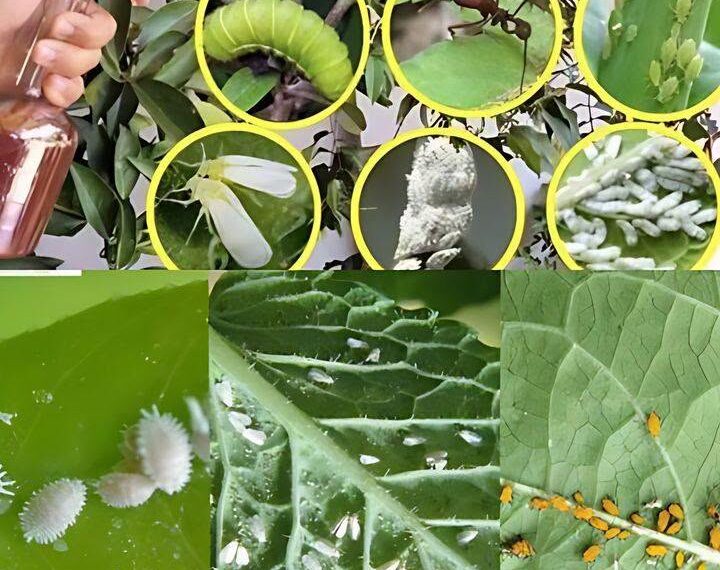
Garden pests can appear almost overnight. One day your plants are healthy and full of new growth; the next, you may notice holes in the leaves, tiny white insects flying when you touch the plant, ants moving along stems, or caterpillars hiding underneath the foliage.
This is why homemade pest-control solutions have become so popular. They are inexpensive, easy to prepare, and can be useful for certain garden insects when applied correctly.
However, there is one important point to understand:
There is no single homemade spray that reliably eliminates every type of pest—including caterpillars, ants, whiteflies, and bed bugs.
These insects have very different biology, so the most effective approach is to identify the pest first and then choose the least aggressive method that fits the problem. Integrated pest management, or IPM, follows exactly this principle: prevention and targeted control first, with pesticides used only when necessary.
🌿 Why identifying the pest matters
Not every insect on a plant is harmful.
Some insects are beneficial predators that actually help control pests. Others may simply be passing through.
Before spraying anything, examine the plant carefully.
Look underneath the leaves, along the stems, around new growth, and near the soil.
Different signs can provide useful clues:
- Large irregular holes in leaves: caterpillars or other chewing insects
- Tiny white insects flying away when disturbed: whiteflies
- Clusters of small insects on young shoots: often aphids or other sap-feeding insects
- Lines of ants traveling up stems: possible ant activity associated with honeydew-producing insects
- Bites or blood spots indoors: potentially bed bugs, which require a completely different approach
Correct identification can save you from applying unnecessary treatments.
🐛 1. Dealing With Caterpillars
Caterpillars can cause impressive amounts of damage surprisingly quickly.
They chew directly through leaves, creating holes, ragged edges, or sometimes leaving only the leaf veins behind.
The easiest solution for a small garden infestation is often surprisingly simple:
Pick them off by hand.
Inspect the undersides of leaves and remove visible caterpillars and egg masses.
For a few affected plants, this can be more effective than spraying the entire garden.
You can also remove heavily infested leaves and dispose of them away from the garden.
Encourage natural predators
Birds and beneficial insects can help keep caterpillar populations under control.
Instead of trying to eliminate every insect in the garden, a better long-term strategy is to create an environment where natural predators can contribute to pest control.
This is one of the fundamental ideas behind integrated pest management.
🪴 2. Whiteflies: The Tiny White Clouds on Your Plants
Whiteflies are among the most frustrating garden pests.
They are tiny, pale insects that often gather on the undersides of leaves.
When you disturb an affected plant, you may see a small cloud of white insects suddenly take flight.
They feed by sucking plant sap.
Heavy infestations can cause:
- Yellowing leaves
- Weak growth
- Leaf drop
- Reduced plant vigor
- Sticky residue on leaves
One useful first step is a strong stream of water directed toward the undersides of leaves.
This can physically dislodge many insects.
For some soft-bodied garden pests, insecticidal soap products can also be useful when the product is specifically labeled for the plant and pest involved. The important point is that these treatments generally work through direct contact, so thorough coverage of the affected areas is important.
Never assume that more soap means better pest control.
Too-concentrated mixtures can damage foliage.
🧼 A Simple Soap-Based Garden Spray
A common home approach for certain soft-bodied garden pests is a mild soap solution.
However, there is an important distinction between insecticidal soap formulated for plants and household detergents.
Dishwashing detergents can contain ingredients that are much harsher on plant tissue.
For that reason, a commercially formulated insecticidal soap labeled for garden use is generally preferable to improvising a highly concentrated detergent mixture.
If you use any garden pest-control product, follow its label carefully and test it on a small portion of the plant first.
Some plants are much more sensitive than others.
🐜 3. What About Ants?
TO CONTINUE READING THE ARTICLE PLEASE SEE PAGE 2