What About Dry Lips?
Petroleum jelly is also commonly used on dry lips.
A thin layer can provide a protective barrier against environmental conditions such as:
- Cold air
- Wind
- Dry indoor air
- Frequent licking
- General environmental exposure
If your lips are persistently cracked, painful, bleeding, or unusually inflamed, however, it’s better to investigate the underlying cause rather than relying only on a cosmetic product.
The Important Warning About Lemon and Lime
This is the part that deserves the most attention.
Although lemon and lime are common ingredients in DIY beauty recipes, fresh citrus juice can irritate the skin.
Citrus contains compounds that can make skin more sensitive to sunlight. Certain citrus exposures can also cause a skin reaction after subsequent ultraviolet exposure, known as phytophotodermatitis.
This can result in redness, irritation, blistering, or dark marks.
Therefore, applying fresh lime or lemon juice to the skin and then going outside into strong sunlight is not a good idea.
This is particularly important for:
- The face
- Neck
- Hands
- Arms
- Other areas exposed to sunlight
Should You Put Lime Juice on Your Face?
This is where I would be cautious.
DIY recipes containing fresh lime or lemon juice are often promoted online as natural ways to brighten or improve the skin.
But natural does not necessarily mean gentle.
The face is particularly sensitive, and citrus juice can cause:
- Stinging
- Burning
- Redness
- Dryness
- Irritation
- Increased sensitivity
If your goal is to improve uneven skin tone or dark spots, there are products specifically formulated for facial skin that are generally more predictable than applying kitchen citrus directly to your face.
A Safer Way to Enjoy the Benefits of Vaseline
If the main goal is softer, more moisturized skin, you don’t actually need to add citrus.
Try this simple routine instead:
Step 1: Clean the area
Wash the skin gently.
Step 2: Leave the skin slightly damp
Don’t completely dry it out.
Step 3: Apply a small amount of Vaseline
Use only enough to create a thin protective layer.
Step 4: Massage gently
Spread the product evenly.
Step 5: Repeat when necessary
Use it regularly on areas that become particularly dry.
This approach takes only a few minutes and avoids unnecessary exposure to citrus.
Can You Use Vaseline Every Day?
For most people, petroleum jelly can be used regularly on suitable areas of the skin.
It is particularly useful as a protective moisturizer for dry skin.
However, everyone’s skin is different.
Some people may find heavy occlusive products uncomfortable, particularly on areas prone to acne or clogged pores.
If you are using it on your face, start with a small amount and pay attention to how your skin responds.
What About Mixing Vaseline With Lime Zest?
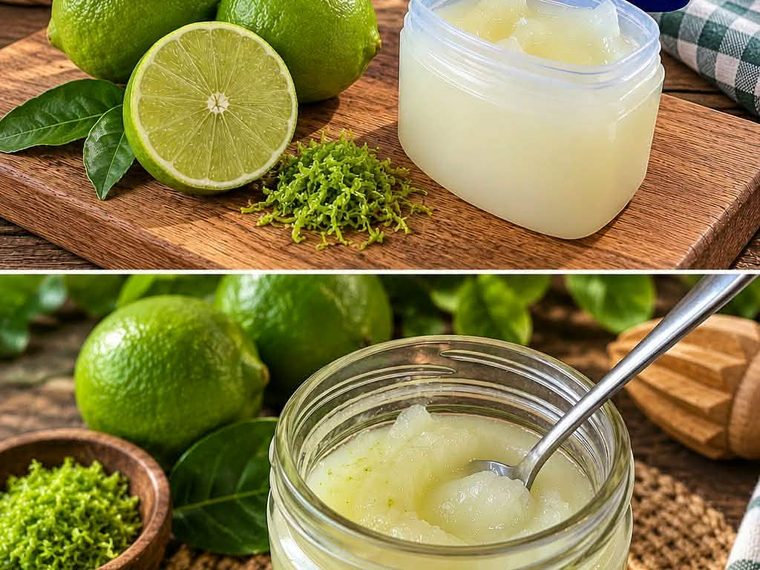
The image appears to show citrus zest being incorporated into a petroleum-jelly-like mixture.
It may look attractive and natural, but there is an important distinction between using citrus as an ingredient in a food recipe and applying citrus material directly to your skin.
Citrus peel contains aromatic oils and other compounds that may irritate sensitive skin.
For that reason, homemade mixtures containing fresh citrus peel or juice should be approached cautiously.
If your purpose is simply to moisturize your skin, plain petroleum jelly is the more straightforward option.
Always Do a Patch Test With DIY Skin Recipes
If you decide to experiment with any homemade topical mixture, don’t immediately apply it over a large area.
Instead, test a very small amount on a limited area of skin first.
Wait and observe how your skin reacts.
Stop using the mixture if you experience:
- Burning
- Itching
- Redness
- Swelling
- Rash
- Significant discomfort
A patch test isn’t a guarantee that a product will never cause a reaction, but it can help you identify obvious sensitivity before applying the mixture more widely.
Don’t Apply Citrus to Broken or Irritated Skin
This is another important rule.
Avoid putting fresh lemon or lime juice on:
- Cuts
- Scratches
- Sunburn
- Eczema flares
- Cracked skin
- Freshly shaved or waxed skin
- Areas with an active rash
Acidic citrus juice can sting significantly when applied to damaged skin.
If your skin barrier is already compromised, keeping the routine simple is generally preferable.
Does Vaseline Whiten or Bleach the Skin?
This is an important misconception to address.
Vaseline does not bleach or permanently lighten your natural skin color.
It can make dry skin look smoother and healthier because the surface becomes more hydrated and reflective.
That can sometimes create the impression that the skin has become “brighter.”
But petroleum jelly is fundamentally a protective moisturizing product, not a skin-bleaching treatment.
Similarly, you shouldn’t expect a homemade Vaseline-and-lime mixture to safely or permanently change your natural skin tone.
Can This Trick Remove Dark Spots?
You should be skeptical of claims that a mixture of Vaseline and lemon or lime will erase dark spots.
Dark marks can have many different causes, including:
- Previous acne
- Sun exposure
- Skin irritation
- Inflammation
- Hormonal changes
- Minor injuries
- Certain skin conditions
The appropriate treatment depends on the cause.
In fact, irritating the skin with citrus can sometimes make pigmentation problems more noticeable, particularly after inflammation and sun exposure.
So if pigmentation is your concern, aggressive DIY treatments may actually work against your goal.
What Makes Vaseline So Popular?
There is a reason petroleum jelly has remained popular for so long.
It is:
- Affordable
- Widely available
- Long-lasting
- Simple
- Versatile
- Easy to apply
- Useful for many dry-skin situations
You don’t need to mix it with a dozen ingredients to make it useful.
Sometimes the simplest beauty routine is the easiest one to maintain consistently.
An Easy Overnight Vaseline Routine
One of the simplest ways to use petroleum jelly is as an overnight treatment for dry areas.
For hands
Apply a thin layer before bed and, if desired, wear lightweight cotton gloves.
For feet
Apply petroleum jelly to dry heels and wear clean cotton socks.
For lips
Apply a small amount before going to sleep.
For cuticles
Massage a tiny amount around dry cuticles.
The goal isn’t to cover yourself in a thick layer.
A little can go a long way.
Why the Image Is So Appealing
The image accompanying this topic is designed around a classic “simple ingredients” beauty concept.
It shows:
- Fresh green limes
- Citrus zest
- A creamy-looking mixture
- A small container
- A spoon
- A natural outdoor setting
Visually, it communicates the idea that an inexpensive homemade preparation can replace complicated commercial beauty products.
That message is part of why DIY skincare recipes are so popular on social media.
However, attractive presentation isn’t proof that a recipe is safe or effective.
When trying a homemade beauty recipe, it’s always worth separating the visual appeal and traditional claims from what the ingredients are actually known to do.
A Better Way to Think About the “Vaseline Trick”
Instead of thinking:
“Vaseline plus lime is a miracle beauty treatment.”
Think:
“Vaseline is a useful occlusive moisturizer, while fresh citrus requires caution when applied to skin.”
That’s a much more accurate way to understand the recipe.
If your goal is soft, comfortable skin, petroleum jelly can already accomplish a lot on its own.
There is no need to add potentially irritating ingredients simply because a social-media recipe says they make the treatment more powerful.
Simple Alternatives for Different Skin Concerns
For dry skin
Use a fragrance-free moisturizer and/or a thin layer of petroleum jelly to help reduce moisture loss.
For dry lips
Use plain petroleum jelly or another suitable lip balm.
For rough heels
Moisturize regularly and consider products formulated with ingredients such as urea for persistent roughness.
For dark spots
Focus on sun protection and products specifically formulated for pigmentation rather than using undiluted citrus juice.
For sensitive skin
Keep your routine simple and avoid unnecessary fragrances, acids, and homemade combinations.
Final Thoughts
The popularity of the Vaseline beauty trick is easy to understand. Petroleum jelly is inexpensive, versatile, and genuinely useful for protecting dry skin.
However, the citrus component deserves more caution than many viral recipes suggest.
Lime and lemon juice are acidic and can irritate the skin. Citrus exposure can also create problems when followed by sunlight. For these reasons, applying fresh citrus juice or zest directly to the face or other exposed skin isn’t something to treat casually.
If your goal is simply to keep your skin soft and moisturized, you can skip the complicated mixture.
Clean skin, a suitable moisturizer, and a thin layer of petroleum jelly can be all you need.
And perhaps that’s the real lesson behind this old-fashioned beauty trick: sometimes the inexpensive product sitting quietly in the bathroom cabinet is already useful enough on its own.