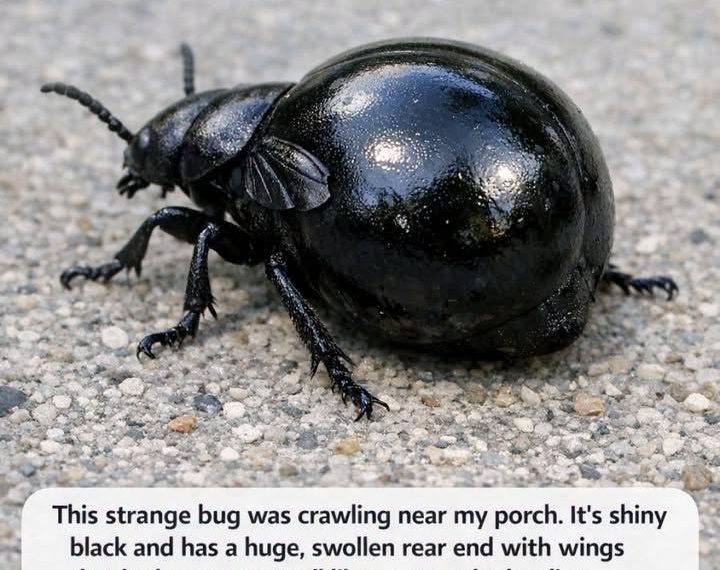
3. Is the Oil Beetle Dangerous to Humans?

Oil beetles generally do not attack people, and there is no need to panic if you discover one near your house. However, they have a defense mechanism that deserves attention.
When threatened or handled roughly, some oil beetles can release an oily fluid containing cantharidin, a chemical that can cause skin blistering.
For that reason, it is best not to pick one up with your bare hands.
If you find an oil beetle near your porch, follow these precautions:
- Keep children and pets from touching it.
- Avoid crushing or squeezing the insect.
- If it is outdoors, leave it alone whenever possible.
- If it enters your home, use a container and a piece of stiff paper to move it without direct contact.
- Wash your hands after handling anything that may have contacted the insect.
If its defensive secretion gets onto your skin, wash the area thoroughly with soap and water. Avoid touching your eyes or mouth, and seek medical advice if blistering or significant irritation develops.
The important point is that oil beetles are best observed rather than handled.
4. Its Life Cycle Is Even Stranger Than Its Appearance

One of the most fascinating things about oil beetles is how their young survive.
Female oil beetles lay eggs in small burrows in the soil. When the eggs hatch, the tiny larvae, known as triungulins, climb onto nearby vegetation and wait for a solitary bee to visit.
Their survival strategy is unusual:
- Step 1: The female lays a large number of eggs in the ground.
- Step 2: The tiny larvae hatch and climb onto flowers or other vegetation.
- Step 3: They attempt to attach themselves to visiting solitary bees.
- Step 4: A larva travels with a bee back to its underground nest.
- Step 5: Inside the nest, it feeds on the bee’s stored pollen and nectar provisions and, in many species, the bee’s egg or young.
- Step 6: The developing beetle passes through further stages before eventually emerging as an adult.
This complicated life cycle explains why oil beetles depend on solitary bees, even though adult beetles are often spotted walking alone across the ground.
It is a remarkable example of how insects develop specialized relationships to survive.
5. What Do Adult Oil Beetles Eat?

Adult oil beetles are often found among grasses, leaves, and flowers. Depending on the species, they feed on plant material, including leaves and flower petals.
Their diet differs from that of their larvae, which depend on the provisions inside solitary bee nests.
This distinction is important: although the larvae have a specialized relationship with bees, adult oil beetles are not typically predators that hunt people or household pets.
Their presence is part of the natural ecosystem, where insects interact with plants, soil, and other wildlife.
6. Why Did This Beetle Appear Near Your Porch?

Finding an unusual beetle near your front door does not automatically mean you have an infestation.
There are several possible explanations.
Nearby plants and flowers: Gardens and planted borders can provide food and shelter for adult beetles.
Suitable soil: Female oil beetles need appropriate soil in which to dig burrows and lay eggs.
Seasonal activity: Adults may become more visible during particular periods of the year, depending on the species and local climate.
Nearby solitary bees: Since the larvae depend on solitary bee nests, oil beetles may occur in places where suitable bee habitats exist.
If you find one near your porch, simply observe it and allow it to move away naturally if possible. There is usually no reason to apply insecticides because of a single beetle.
7. How Can You Tell Whether It Is an Oil Beetle?

Look for the combination of features rather than relying on color alone.
| Feature | Typical oil beetle |
|---|---|
| Color | Shiny black or blue-black, sometimes violet |
| Abdomen | Large and swollen |
| Wing covers | Very short |
| Flight | Adults generally cannot fly |
| Movement | Usually walks across soil or vegetation |
| Defense | Some species release cantharidin-containing fluid |
| Larval development | Closely associated with solitary bee nests |
Other dark beetles can look similar, so an accurate identification may require a clear photograph of the head, antennae, thorax, and wing covers.
The precise species also depends on the region where the insect was found.
8. Should You Remove It From Your Garden?
In most cases, there is no need to take special action.
If the beetle is outside, leaving it undisturbed is usually the easiest solution. Avoid handling it directly, and do not crush it.
If it has entered your home, you can gently guide it into a container and release it outdoors, taking care not to touch its body.
Maintaining flowering plants and suitable outdoor habitats can also support the solitary bees and other insects that contribute to local biodiversity.
The key is to avoid unnecessary contact while allowing the insect to continue its natural life cycle.
Final Thoughts
The strange, shiny black bug with a huge, swollen rear end and tiny wing covers in your photograph may be an oil beetle belonging to the Meloe genus.
Its unusual body shape is natural, and its life cycle is surprisingly complex. Although it is not generally aggressive toward humans, its defensive chemicals mean that handling it is best avoided.
If you discover one near your porch again, there is no need to panic. Keep your distance, observe its distinctive features, and let it move away naturally.