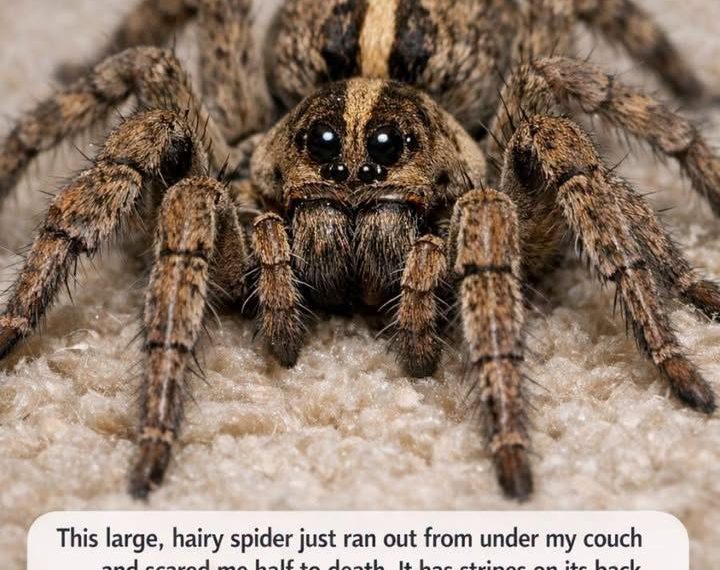
Finding a large, hairy spider suddenly running across your living room is enough to make anyone jump out of their seat. And when it disappears underneath the couch, the situation can become even more unsettling. Its thick, hairy legs, dark markings, and incredibly fast movements make it look like something straight out of a horror movie.
But before reaching for a shoe or worrying about your pets, there is something important to know: not every large, frightening-looking spider is dangerous.
The spider shown in the photograph has several features that resemble a wolf spider, a group of ground-hunting spiders known for their hairy bodies, distinctive markings, excellent eyesight, and impressive speed.
Wolf spiders are commonly found around homes, gardens, garages, and other places where insects are available. Although their appearance can be intimidating, most are not considered medically dangerous to humans or household pets.
So, what exactly might this spider be? Why does it suddenly appear inside the house? Can it bite your cat or dog? And what should you do if you find one hiding under your furniture?
Let’s take a closer look.
1. What kind of spider is hiding under your couch?
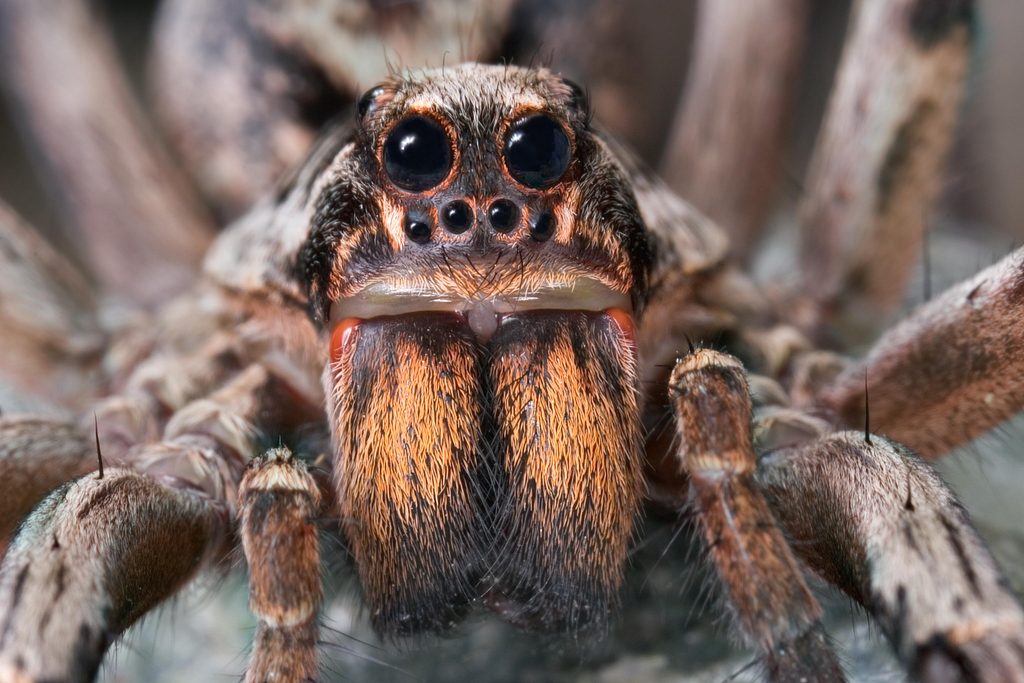
Based on its brown coloration, hairy legs, robust body, and longitudinal stripes, the spider in the photograph could be a wolf spider (family Lycosidae).
However, it is important not to identify a spider with complete certainty from one photograph. Other large hunting spiders and house spiders can have a very similar appearance.
Wolf spiders have several recognizable characteristics:
- A relatively large, hairy body.
- Brown, gray, or dark coloration.
- Stripes or contrasting markings along the back.
- Eight eyes arranged in three distinctive rows.
- Strong legs that allow them to run quickly across the ground.
One particularly interesting feature is their eyesight. Wolf spiders have two noticeably large eyes that help them detect movement and locate prey.
Unlike many familiar spiders, they do not build large webs to catch insects. Instead, they actively hunt their food, which explains why they can move so quickly across floors and furniture. apps.extension.umn.edu+2
2. Is this spider dangerous to cats and dogs?
This is probably the biggest concern for pet owners.
The reassuring news is that wolf spiders are generally not considered dangerous to cats and dogs. Although they possess venom, they are not among the spider groups commonly associated with serious poisoning.
A wolf spider would generally prefer to escape rather than confront a much larger animal.
However, that does not mean a bite is impossible.
A curious cat might try to catch the spider with its paws, while a dog might attempt to investigate it with its nose or mouth. If the spider feels trapped or threatened, it may bite in self-defense.
Possible reactions to a spider bite include:
- Localized redness.
- Mild swelling around the affected area.
- Tenderness or discomfort.
- Excessive licking or scratching.
- Temporary irritation.
Most suspected bites from ordinary household spiders do not result in serious complications, but the exact species and the animal’s reaction matter.
An important warning: Some spiders, particularly widow spiders (Latrodectus) and recluse spiders (Loxosceles), can cause medically significant envenomation. Never assume that every large brown or striped spider is harmless. Merck Veterinary Manual+1
If your pet has been bitten and develops severe pain, muscle tremors, weakness, vomiting, unusual behavior, or difficulty breathing, contact a veterinarian immediately.
Do not wait for symptoms to become worse.
3. Why do these large spiders suddenly appear inside the house?
Many people assume that finding a spider indoors means there must be a nest somewhere in the house.
Fortunately, this is not necessarily true.
Wolf spiders are outdoor hunters that sometimes wander inside buildings while searching for food or shelter.
There are several reasons why one might suddenly appear in your living room.
They are searching for food.
Spiders feed on insects and other small invertebrates. If your home has flies, mosquitoes, cockroaches, or other insects, it may provide an attractive hunting environment.
They are looking for shelter.
Dark, quiet spaces provide excellent hiding places. The area underneath a couch, behind furniture, inside storage boxes, or near baseboards can offer protection.
They may enter through small openings.
Gaps beneath doors, cracks around windows, damaged screens, and openings around pipes can provide easy access.
They may be searching for a mate.
In some spider species, adult males become more mobile during the breeding season as they search for females. This can explain why people suddenly notice more wandering spiders indoors.
Wolf spiders are particularly associated with ground-level hiding places, garden debris, stones, and other sheltered areas. OSU Extension Service+2
4. Why is the spider moving so incredibly fast?
One of the most frightening things about encountering a large spider is watching it disappear in a fraction of a second.
But its speed is actually an important part of its hunting strategy.
Unlike web-building spiders that wait for insects to become trapped, wolf spiders actively chase their prey.
Their long, powerful legs help them move quickly across the ground, change direction, and capture small insects.
This is also why they can be difficult to catch when they enter a home.
When disturbed, a wolf spider will often run toward the nearest hiding place rather than remain exposed.
So if you saw one disappear underneath your couch, it was probably trying to find somewhere dark and protected, not preparing to attack you or your pets. Virginia Tech+2
5. What should you do if you find one underneath your couch?
TO CONTINUE READING THE ARTICLE PLEASE SEE PAGE 2