What About Propagating Snake Plants in Water?
Water propagation is possible and can be an interesting way to observe root development.
Place the bottom portion of the leaf cutting in water, making sure that only the lower section is submerged. Change the water regularly and keep the cutting in bright, indirect light.
However, soil propagation can be simpler for snake plants because it avoids the need to transition newly rooted cuttings from water to soil.
If you do use water, watch carefully for soft, dark, or slimy tissue, which can indicate rot.
A Very Important Warning About Variegated Snake Plants
This is something many propagation guides fail to mention.
If you have a variegated snake plant, leaf cuttings may not always produce a plant identical to the parent.
Some variegated cultivars can produce new growth that is predominantly green when propagated from leaf sections.
This means that if you have a particularly valuable or highly variegated snake plant, division or offsets/pups may be preferable when you want to preserve the characteristics of the mother plant.
So don’t be disappointed if a cutting from a beautiful variegated plant eventually produces greener foliage.
Common Mistakes to Avoid
❌ Planting the cutting immediately after cutting it
Fresh wounds can be more susceptible to rot.
❌ Keeping the soil constantly wet
Snake-plant cuttings don’t need soggy soil.
❌ Using a container without drainage
Excess water needs somewhere to escape.
❌ Planting the cutting upside down
Always mark the bottom before cutting multiple sections.
❌ Giving it strong direct sunlight
New cuttings can become stressed or dehydrated.
❌ Checking for roots every few days
Disturbing the cutting repeatedly can interfere with root development.
❌ Giving up after two weeks
Snake plants are generally slow growers. Propagation is a patience game.
How Long Does It Take to Grow a New Snake Plant?
There isn’t one exact timetable because propagation speed depends on temperature, light, moisture, the health of the cutting, and the particular cultivar.
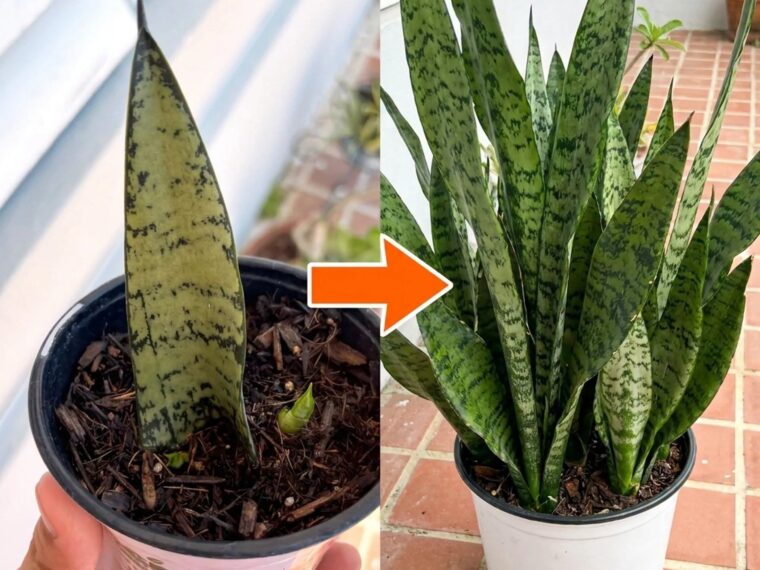
In favorable conditions, roots may begin developing after several weeks, while visible new shoots can take considerably longer.
Think of snake-plant propagation as a long-term project rather than an overnight gardening trick.
The good news is that once established, snake plants are generally low-maintenance and can live for many years with relatively little attention.
Why Grow Snake Plants From Leaves?
There are several reasons gardeners enjoy this technique:
🌱 It’s inexpensive: You can create new plants without buying additional specimens.
🌱 It’s simple: You only need a healthy leaf, a container, and a suitable growing medium.
🌱 It’s a great gardening experiment: Watching roots and eventually new shoots develop is incredibly satisfying.
🌱 You can multiply a mature plant: One large leaf can potentially provide several cuttings.
🌱 It’s beginner-friendly: Although slow, the technique doesn’t require sophisticated equipment.
Final Thoughts
Growing a snake plant from a leaf isn’t a magic trick—it is a slow but fascinating form of plant propagation. The most important ingredients are a healthy cutting, correct orientation, a dry healing period, excellent drainage, appropriate light, careful watering, and plenty of patience.
If your first cutting doesn’t succeed, don’t be discouraged. Try several healthy sections rather than relying on just one. With the right conditions, those seemingly ordinary pieces of leaf can eventually produce roots and, with time, brand-new snake-plant pups.
And that’s the best part: a single leaf can be the beginning of an entirely new plant collection.