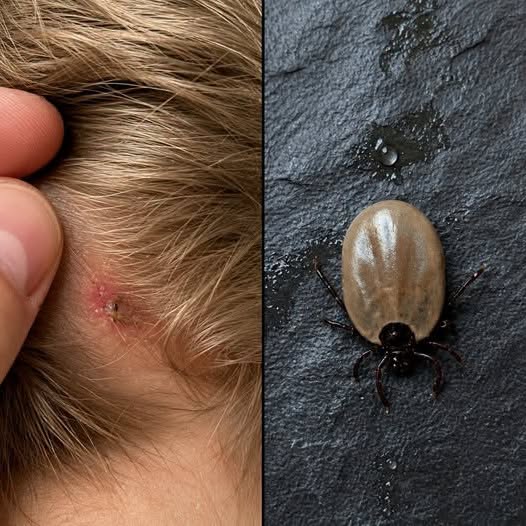
Follow these steps:
- Separate the hair around the tick.
- Make sure you have good lighting.
- Use clean, fine-tipped tweezers.
- Grasp the tick as close to the skin as possible.
- Pull upward slowly and steadily.
- Avoid squeezing the tick’s body.
- After removal, clean the bite area with soap and water or an appropriate antiseptic.
Try to avoid twisting, crushing, or jerking the tick during removal.
What If Part of the Tick Remains in the Skin?
Sometimes a small part of the tick’s mouthparts may remain attached, particularly when the tick is very small or difficult to grasp.
Don’t dig deeply into your child’s skin with a needle or other sharp object.
If you cannot easily remove the remaining material with tweezers, ask a healthcare professional for advice.
Creating a larger wound while trying to remove a tiny fragment can cause unnecessary injury.
What Should You Do After Removing the Tick?
Once the tick has been removed, clean the area.
It can also be helpful to record:
- The date of the bite
- Where the tick was attached
- Where your child had been outdoors
- Approximately how long the tick may have been attached
- What the bite area looked like immediately afterward
If possible, taking a clear photograph of the tick can also be useful if you later need to speak with a healthcare professional.
Should You Keep the Tick?
You don’t necessarily need to keep every tick for testing.
Depending on where you live and the circumstances, a healthcare professional may have specific recommendations.
A clear photograph can sometimes be useful for identification.
If you want to preserve the tick temporarily for identification, ask a healthcare professional or local health service how they recommend doing so.
Is a Small Red Mark After a Tick Bite Normal?
A small amount of redness can occur after a tick has been removed.
The area may be:
- Slightly red
- Mildly swollen
- Tender
- Irritated
A small local reaction that gradually improves isn’t necessarily a sign of infection.
That’s why it’s important to pay attention to how the area changes over time, rather than assuming that every small red mark means your child has an infection.
Watch for a Rash That Gets Larger
One important sign associated with Lyme disease is erythema migrans, a rash that can develop after an infected tick bite.
It typically expands outward from the original bite area.
It doesn’t always look like the classic “bull’s-eye” image commonly shown online.
The rash can have different appearances and may be relatively uniform in color.
If a red area continues to expand after a tick bite, contact a healthcare professional.
Don’t wait for it to develop a perfect target-like appearance.
What Other Symptoms Should You Watch For?
After a tick bite, pay attention to unusual symptoms.
Depending on the infection involved, symptoms can include:
- Fever
- Headache
- Unusual tiredness
- Muscle aches
- Joint pain
- Chills
- Swollen lymph nodes
- Skin rash
- General feeling of being unwell
Young children may not always be able to describe what they are experiencing.
You might notice that your child seems unusually tired, irritable, or less active than normal.
These symptoms can obviously have many causes, including ordinary childhood illnesses. However, unusual symptoms occurring after a tick bite should be discussed with a healthcare professional.
When Should You Contact a Doctor?
Seek medical advice if your child develops:
- An expanding rash
- Persistent or significant fever
- Unusual weakness
- Significant or worsening illness
- Severe pain
- Neurological symptoms
- A concerning change in behavior or activity
- Any symptoms that worry you
If your child develops difficulty breathing, loses consciousness, has a seizure, or appears seriously ill, seek emergency medical care immediately.
Does Every Tick Bite Require Antibiotics?
No.
A tick bite does not automatically mean that antibiotics are necessary.
Whether preventive antibiotics are appropriate depends on factors such as:
- The geographic area
- The type of tick
- How long the tick was attached
- The likelihood of infection in that area
- The child’s age
- The circumstances of the bite
- Whether symptoms have developed
In certain high-risk situations, a healthcare professional may consider preventive antibiotic treatment.
However, don’t give your child leftover antibiotics or start medication without medical advice.
Should You Get Your Child Tested Immediately?
Not necessarily.
Testing immediately after a tick bite doesn’t always provide a useful answer because some infections take time before they can be reliably detected.
A healthcare professional can determine whether testing is appropriate based on:
- The type of exposure
- The geographic location
- The child’s symptoms
- The amount of time that has passed
In many cases, monitoring the child’s health is more useful than immediately searching for a test.
Why Is the Scalp Easy to Miss?
Hair can make a tick surprisingly difficult to spot.
When children return from playing outdoors, parents often check:
- Arms
- Legs
- Clothing
- Hands
But the scalp can easily be overlooked.
After spending time in an area where ticks are common, take a few extra minutes to check:
- The scalp
- Behind the ears
- The hairline
- The neck
- The back of the head
Good lighting makes the inspection much easier.
How to Check Your Child’s Scalp for Ticks
Have your child sit somewhere with good lighting.
Separate the hair into small sections using your fingers or a comb.
Pay particular attention to:
- Behind the ears
- Around the hairline
- The base of the skull
- The back of the neck
- Areas where the hair is especially thick
A tick may look like a tiny unusual bump attached firmly to the skin.
If you’re unsure what you’re looking at, don’t immediately pull at it.
Take a clear photograph if possible and ask a healthcare professional for advice.
Could It Be Something Other Than a Tick?
Yes.
Not every bump or small object found in a child’s hair is a tick.
It could be:
- A head louse
- A scab
- A small skin bump
- A mole
- Another type of insect
- A piece of plant material
A tick that is attached to the skin will often have a clearly defined attachment point, and its legs may be visible.
If you’re unsure, professional advice is preferable to relying solely on an online photograph.
How Can You Reduce the Risk of Tick Bites?
Prevention is especially useful for children who spend a lot of time outdoors.
After a hike, camping trip, forest walk, or playing in tall grass:
1. Check clothing
Inspect clothing before or after coming indoors.
2. Check the child’s body
A quick inspection can help you find ticks before they remain attached for an extended period.
3. Don’t forget the hair
Check the scalp, hairline, behind the ears, and neck.
4. Shower after outdoor activities
Showering after spending time outdoors can help remove ticks that have not yet attached.
5. Handle outdoor clothing appropriately
Follow local guidance for washing or drying clothing used in areas where ticks are common.
Can Clothing Help Prevent Tick Bites?
Yes.
When children are walking through areas where ticks are present, clothing that covers more of the skin can reduce opportunities for ticks to reach exposed skin.
Depending on the conditions, this can include:
- Long pants
- Socks
- Closed-toe shoes
- Long sleeves
Certain tick repellents or treated clothing may also be appropriate in some circumstances.
When using repellents on children, always follow the product’s instructions and age restrictions carefully.
What About Dogs and Cats?
Pets can also carry ticks.
Dogs and cats that spend time outdoors may bring ticks into the home.
Ask your veterinarian about appropriate tick prevention for your pet.
Checking pets after outdoor activities can also help reduce the chance of ticks entering the household.
What Should You Never Do When Removing a Tick?
When you discover a tick on your child, avoid improvised methods.
Don’t burn the tick.
Never use a match, lighter, or other source of heat.
Don’t cover it with oil or Vaseline.
This is not the recommended method of removal.
Don’t crush the tick.
This can make removal more difficult.
Don’t dig into the skin.
Trying to remove tiny remaining pieces by cutting or digging into the skin can cause unnecessary injury.
Don’t give medication without medical advice.
A tick bite does not automatically require antibiotics or other medication.
Does a Large Tick Mean the Situation Is More Dangerous?
Not necessarily.
Ticks can vary considerably in size depending on their species, developmental stage, and whether they have fed.
A tick that appears swollen may have been attached for some time, but its appearance alone cannot tell you whether an infection was transmitted.
Other factors are more important, including the local risk of tick-borne disease, the type of tick, the likely duration of attachment, and whether symptoms develop.
Does a Tick Bite Mean My Child Has Lyme Disease?
No.
This is one of the most important things for parents to understand.
A tick bite does not equal Lyme disease.
For Lyme disease to develop, an infected tick must transmit the bacteria responsible for the infection.
Many tick bites do not result in Lyme disease or another tick-borne infection.
Nevertheless, because some ticks can transmit infections, it is sensible to take the bite seriously and monitor your child.
The Best Response: Quick, Calm, and Careful
When you discover a tick on your child’s scalp, remember these basic steps:
1. Remove the tick correctly.
2. Clean the bite area.
3. Record the date and circumstances.
4. Monitor your child and the bite area.
5. Contact a healthcare professional if symptoms develop or you are concerned.
This is much more useful than panicking or trying several home remedies.
Final Thoughts
Finding a tick attached to your child’s scalp can be alarming, particularly when it is hidden among the hair or appears swollen. But a tick bite does not automatically mean that your child will become sick.
The most important thing is to remove the tick promptly and correctly using fine-tipped tweezers, then clean the area and monitor your child.
Avoid methods such as oil, Vaseline, heat, or chemicals. If you’re unable to remove the tick properly or you’re unsure about what you’ve found, contact a healthcare professional.
Over the following days and weeks, watch for symptoms such as an expanding rash, fever, unusual fatigue, or other changes in your child’s health.
And remember prevention: after outdoor activities, check the entire body—including the scalp, hairline, neck, and behind the ears.
With the right precautions and a calm response, finding a tick doesn’t have to become a frightening experience.