Finding a tick attached to your child’s scalp can be frightening, especially when you discover it hidden among the hair. Because ticks can transmit certain infections, including Lyme disease in areas where it occurs, it is important to take the situation seriously—but there is no need to panic.
The most important steps are to remove the tick correctly, clean the area, and monitor your child afterward.
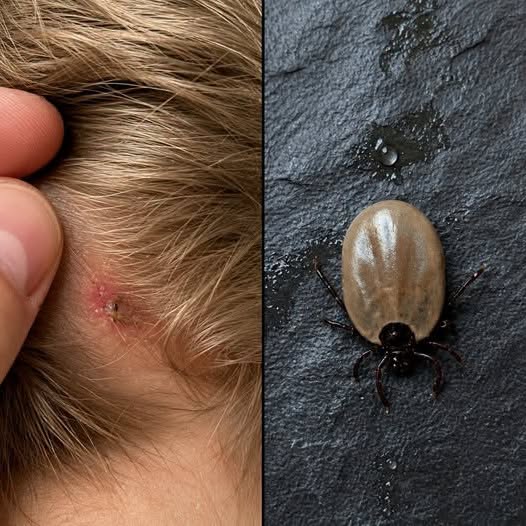
The image accompanying this article shows a tick attached near the scalp, along with a close-up of a tick. It highlights why checking a child’s hair and scalp after outdoor activities can be so important.
Here is what parents should know.
What Is a Tick?
A tick is a small arachnid that feeds on the blood of animals and humans.
Ticks are commonly found in places such as:
- Wooded areas
- Tall grass
- Bushes
- Gardens
- Forest trails
- Areas where wild animals live
Ticks don’t typically jump from trees onto people. Instead, they often wait on vegetation close to the ground and attach themselves when a person or animal brushes against them.
Once on the body, a tick may crawl around looking for a suitable place to attach.
In children, ticks may be found on:
- The scalp
- Behind the ears
- The neck
- The hairline
- Armpits
- Groin
- Behind the knees
That’s why checking the entire body after outdoor activities can be useful.
Is a Tick on the Scalp Dangerous?
Finding a tick does not automatically mean that your child will become sick.
The main concern is that certain ticks can transmit infections.
The risk depends on several factors, including:
- The geographic region
- The species of tick
- Whether the tick was carrying an infectious organism
- How long the tick was attached
- Whether transmission actually occurred
Lyme disease is one of the best-known tick-borne infections in parts of Europe and North America.
However, not every tick carries the bacteria that causes Lyme disease, and not every tick bite results in infection.
First: Don’t Panic
Your first reaction may be to immediately grab the tick with your fingers or try to make it fall off.
Instead, take a moment and proceed carefully.
The most important thing is to remove the tick promptly and properly.
For some tick-borne infections, the likelihood of transmission increases the longer an infected tick remains attached.
Don’t Try to Make the Tick Fall Off With Oil
There are many traditional home remedies for removing ticks.
You may hear people recommend:
- Oil
- Vaseline
- Alcohol
- Nail polish
- Chemicals
- Heat
These aren’t recommended methods for tick removal.
The preferred approach is mechanical removal using a suitable fine-tipped tool.
How to Remove a Tick From Your Child’s Scalp
A fine-tipped pair of tweezers can be used.
The goal is to grasp the tick as close to the skin as possible and remove it steadily.
Follow these steps:
TO CONTINUE READING THE ARTICLE PLEASE SEE PAGE 2