Be especially careful with “black salve” products
Some online skin-removal products have contained substances such as bloodroot and zinc chloride.
The FDA has warned about products containing these corrosive substances because they can indiscriminately destroy healthy and diseased tissue and cause tissue necrosis.
That’s a very different situation from a medically controlled procedure.
A dermatologist knows:
- what the lesion is;
- how deep it is;
- where it is located;
- how much tissue needs to be treated;
- how to control bleeding;
- and how to manage the wound afterward.
A homemade corrosive preparation doesn’t have that precision.
Does wart remover work on skin tags?
Not necessarily—and this is another common mistake.
Warts and skin tags are different lesions.
The AAD specifically warns that using wart remover on a skin tag can damage the surrounding skin and cause irritation or scarring.
So seeing a product labeled “wart remover” and assuming it can safely be used on a skin tag is not a good idea.
What about acids?
This deserves particular attention because some viral recipes recommend concentrated acids.
The FDA has warned consumers about unapproved chemical-peel products containing high concentrations of substances such as:
- trichloroacetic acid (TCA);
- salicylic acid;
- glycolic acid;
- lactic acid.
These products can cause serious chemical burns, infection, pigment changes and permanent scars when used improperly.
The FDA has also stated that there are no legally marketed over-the-counter drugs for treating conditions such as moles and skin tags and has warned about products containing concentrated acids that can cause permanent scarring.
So “it’s natural” or “it’s an acid found in nature” doesn’t make a treatment safe.
Concentration matters enormously.
So what actually works?
There are several established medical approaches for removing confirmed skin tags.
According to dermatology references, these include:
1. Snip removal
A dermatologist can numb the area and remove the skin tag using sterile surgical scissors or a blade.
This is particularly useful for suitable pedunculated lesions.
2. Cryotherapy
The dermatologist freezes the lesion using a very cold substance such as liquid nitrogen.
The treated tissue may blister or form a scab before the lesion disappears.
3. Electrosurgery/electrodesiccation
A small instrument delivers electrical energy to destroy the lesion.
A scab forms and subsequently heals.
4. Ligation
In selected cases, a clinician can tie off the stalk so that the blood supply is interrupted.
DermNet lists ligation among established removal methods.
Is there research on freezing skin tags?
Yes.
A prospective randomized comparative clinical trial published in Dermatology and Therapy evaluated a cryogenic device for home treatment of benign skin tags.
The study included 56 healthy volunteers with skin tags and compared one cryogenic device with another marketed device. The researchers assessed efficacy as well as safety and tolerability.
This is interesting because it shows that cryotherapy itself has a scientific basis for skin-tag removal.
But that doesn’t mean every freezing product or internet method is equally safe.
The specific device, application, diagnosis and technique matter.
What about removing a skin tag at home?
This is where medical advice becomes particularly important.
The AAD explicitly states that products marketed for at-home skin-tag removal are not recommended and notes that the FDA has not approved these products.
The risks include:
- infection;
- bleeding;
- scarring;
- skin damage;
- incorrect treatment of the wrong lesion;
- and delayed diagnosis of skin cancer.
The AAD describes home removal as essentially performing a small surgical procedure on yourself, with potentially serious consequences.
What if the skin tag becomes dark?
A skin tag can become darker or redder when irritated.
For example, friction from clothing, jewelry or shaving can cause irritation.
A skin tag can also become painful or bleed if repeatedly traumatized.
But a new or changing dark lesion should not automatically be assumed to be a skin tag.
That’s especially important when a social-media post is encouraging people to apply a chemical or other substance to the lesion.
When should you have a raised bump checked?
It’s worth getting professional advice if the lesion:
- changes rapidly;
- bleeds without obvious trauma;
- becomes painful;
- develops an unusual color;
- has an irregular appearance;
- grows substantially;
- doesn’t look like your other skin tags;
- or you aren’t sure what it is.
The AAD emphasizes that people can mistake other lesions—including skin cancer—for a skin tag, which is one reason professional assessment can be important before removal.
The neck deserves special attention
The neck is one of the classic locations for skin tags because of repeated friction.
Collars, necklaces, hair, skin folds and movement can all contribute to irritation.
That’s why seeing several small, soft, stalk-like growths around the neck is not unusual.
But the location alone does not prove that a lesion is a skin tag.
Appearance and clinical examination matter.
One of the biggest myths: “If it falls off, it was harmless”
This is not necessarily true.
A lesion disappearing after a corrosive treatment doesn’t prove that the original diagnosis was correct.
In fact, destroying a lesion before it is properly evaluated can make subsequent diagnosis more difficult.
This is particularly relevant to pigmented or changing lesions.
The FDA warns that self-treatment of moles and other suspicious growths can delay the diagnosis of skin cancer.
What about natural remedies?
This is where scientific evidence is particularly limited.
A 2018 publication specifically titled “Home remedies for skin tags: Not recommended!” highlighted concerns surrounding these approaches.
There is an important lesson here:
Anecdotal success is not the same as clinical evidence.
Someone posting a before-and-after photograph online doesn’t tell you:
- what the lesion actually was;
- what else they used;
- whether the image was edited;
- whether the lesion returned;
- whether scarring occurred later;
- or whether the same method is safe for another person.
That is why controlled clinical evidence is so important.
What should you do instead?
If you have a small, typical-looking skin tag that doesn’t bother you, you don’t necessarily need to do anything.
Skin tags are generally benign and often require removal only for cosmetic reasons or when they become irritated or troublesome.
If it catches on jewelry, clothing or a razor, a dermatologist can usually remove it quickly.
If you dislike its appearance, professional removal is also an option.
Skin tags: the evidence at a glance
| Claim | What the evidence says |
|---|---|
| Skin tags are common | Yes |
| They are usually benign | Yes |
| They commonly occur on the neck | Yes |
| Friction may contribute | Yes |
| They are associated with obesity/metabolic problems | Evidence supports an association |
| A skin tag proves diabetes | No |
| Vinegar or another home remedy is proven to safely remove them | No convincing clinical evidence |
| Strong acids can remove tissue | Yes—but they can also burn healthy skin |
| Dermatologists can remove skin tags | Yes |
| Cryotherapy is an established treatment | Yes |
| Cutting or burning a lesion yourself is risk-free | Absolutely not |
What the research really tells us
The most interesting scientific finding isn’t actually about a miracle cream.
It’s about recognizing what you’re looking at.
Research supports the fact that skin tags are common and benign and that they are associated with several metabolic risk factors.
Clinical evidence supports professional techniques such as cryotherapy, snip removal and electrosurgery.
Research has also investigated specific cryogenic devices, including randomized comparative clinical trials.
On the other hand, medical authorities warn against unapproved home-removal products because of burns, infection, scarring and the possibility of treating the wrong lesion.
That is a much stronger evidence-based conclusion than saying that one mysterious ingredient can “melt away” every raised bump.
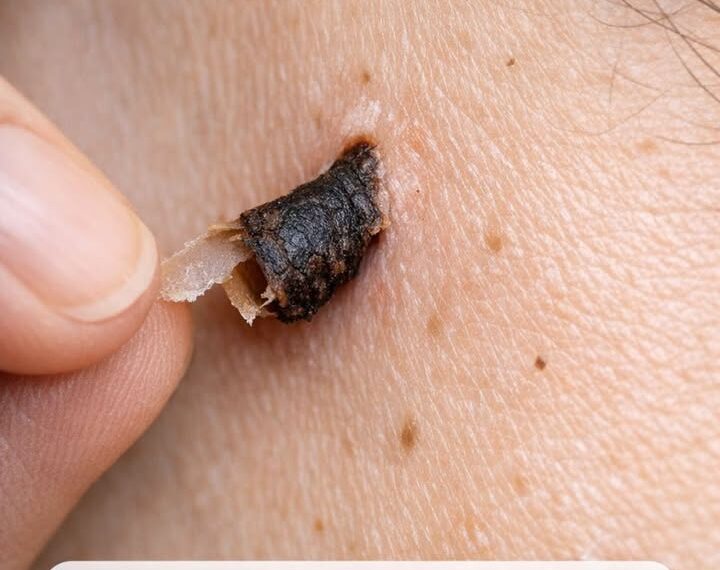
🛑 The bottom line about the image
The image is effective because it suggests a dramatic transformation:
apply one solution → lesion turns dark → bump disappears → smooth skin.
But the photograph alone cannot establish that the treatment is safe, effective, or even appropriate for the lesion shown.
If the product or recipe is corrosive, the darkening may simply represent tissue injury or scabbing, not a selective medical treatment.
And if the growth isn’t actually a skin tag, treating it blindly could delay the correct diagnosis.
The safest evidence-based approach is therefore:
Identify the lesion first. Remove it professionally if removal is desired. Avoid unproven corrosive remedies.
For a confirmed skin tag, professional removal is usually straightforward, and the AAD notes that dermatologists can often remove one or more during a single office visit.
Most importantly, don’t use the substance shown or implied in a viral post on your neck simply because a photograph appears to show a successful result.
Your skin is not a laboratory.
What looks like a harmless little bump may be harmless—but the first step should be knowing what it actually is.