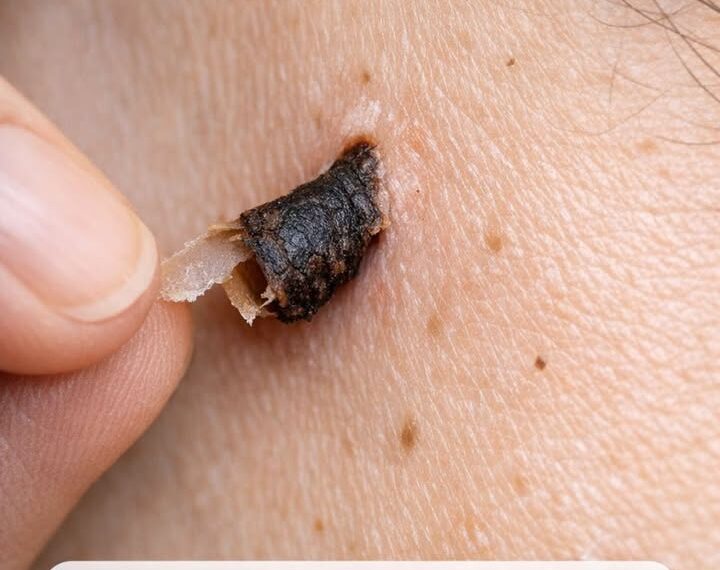
A growth on the neck may indeed be a skin tag (acrochordon), but it could also be a wart, seborrheic keratosis, mole, or another type of skin lesion. These conditions can look similar to an untrained eye. Dermatology references specifically warn that lesions resembling skin tags can include other conditions, and the American Academy of Dermatology (AAD) recommends professional evaluation when there is uncertainty.
So before reaching for a homemade solution, it is worth understanding what skin tags actually are, what the studies show, and which treatments have real medical evidence behind them.
What exactly is a skin tag?
A skin tag is medically called an acrochordon.
It is a common, benign growth made up of connective tissue, blood vessels and an overlying layer of skin. Skin tags are often soft and may hang from the skin on a small stalk.
They commonly appear on areas where skin rubs against skin, clothing or jewelry, including:
- the neck;
- armpits;
- groin;
- eyelids;
- beneath the breasts;
- and other skin folds.
They can be skin-colored, pink, brown or darker and can range from tiny lesions to considerably larger growths.
One review reports that approximately 50–60% of adults develop at least one skin tag during their lifetime.
In other words, if you have one, you are certainly not alone.
Why do skin tags appear?
There isn’t one single proven cause.
Researchers believe several factors can contribute.
Friction
Repeated rubbing between skin surfaces, clothing or jewelry is thought to play an important role.
This explains why the neck, armpits and groin are common locations.
Age
Skin tags become more common with age, particularly after the fourth decade of life.
Genetics
Some people appear to be more prone to developing them, and having relatives with skin tags is associated with increased likelihood.
Metabolic factors
Skin tags have also been associated with obesity, insulin resistance, diabetes and metabolic syndrome.
However, this does not mean that having a skin tag proves you have diabetes.
It is an association—not a diagnosis.
What do studies say about skin tags and insulin resistance?
This is one of the more interesting areas of research.
A cross-sectional study published in 2010 examined adults with multiple skin tags and found that the presence of multiple lesions was strongly associated with insulin resistance. The study used the HOMA-IR measure and found an association even after adjustment for several other risk factors.
Another study examining the metabolic profile of patients with skin tags found higher rates of overweight/obesity, dyslipidemia, hypertension and insulin resistance among the participants with skin tags.
A systematic review has also examined skin tags among several skin signs associated with diabetes and prediabetes.
But here’s the important part:
A skin tag is not a diabetes test.
One or two ordinary skin tags are extremely common.
If someone suddenly develops many skin tags, particularly alongside other risk factors or symptoms, discussing general health and metabolic screening with a healthcare professional may be reasonable.
The AAD also advises that suddenly developing many skin tags can occasionally signal that something else is going on and recommends professional assessment.
What about the lesion shown in the image?
This is where caution is especially important.
The image appears to show a dark, raised lesion being manipulated or removed from the skin.
It is not possible to reliably diagnose the lesion from this photograph alone.
And that’s important because not every raised bump is a skin tag.
A lesion that resembles a skin tag could instead be:
- a wart;
- seborrheic keratosis;
- mole;
- another benign growth;
- or, less commonly, a lesion requiring medical evaluation.
DermNet specifically notes that seborrheic keratoses, viral warts and molluscum can resemble skin tags.
That’s one reason the statement “just rub this on it” can be dangerous.
You need to know what you’re treating first.
🚨 The biggest problem with viral “skin tag remover” recipes
Social-media posts frequently recommend ingredients such as:
- apple cider vinegar;
- essential oils;
- acids;
- iodine;
- baking soda mixtures;
- toothpaste;
- garlic;
- bloodroot;
- or concentrated chemical preparations.
The fact that an ingredient can irritate or burn tissue does not mean it selectively removes a skin tag.
That’s a crucial distinction.
A corrosive substance may damage the skin tag—but it can also damage the healthy skin surrounding it.
Why “burning it off” isn’t the same as treating it
Imagine putting a strong chemical on a small raised lesion.
If the chemical causes the tissue to turn black and form a scab, it may look as though the treatment is “working.”
But what is actually happening?
Potentially, tissue injury.
The body can respond to chemical injury by forming inflammation, a scab and eventually new tissue.
The result can include:
- burns;
- infection;
- prolonged inflammation;
- discoloration;
- permanent scarring.
The FDA specifically warns that unapproved products marketed for removing moles and skin lesions can cause irritation, injuries and scarring.
Be especially careful with “black salve” products
TO CONTINUE READING THE ARTICLE PLEASE SEE PAGE 2