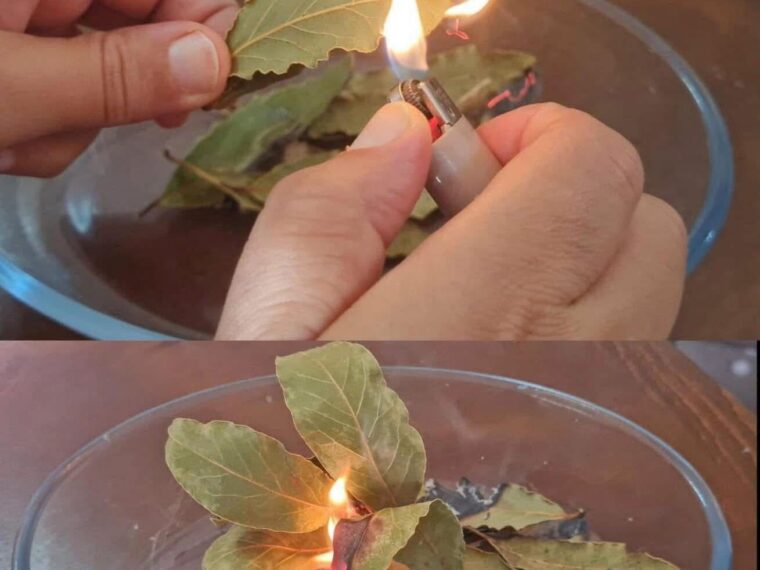
6. Bay Leaves Show Antimicrobial Activity
Bay leaves have also attracted attention because extracts and essential oils have demonstrated activity against certain microorganisms in laboratory studies.
Researchers have reported antibacterial and antifungal properties associated with Laurus nobilis extracts and essential oil.
This makes sense when you consider that plants produce many chemical compounds as part of their natural defense systems.
Bay leaf essential oil contains numerous volatile substances that researchers continue to investigate for potential applications in food, cosmetics and pharmaceutical research.
But there is a crucial limitation:
Burning a bay leaf should not be considered a reliable way to disinfect a room.
Laboratory antimicrobial activity of an extract or essential oil cannot automatically be applied to smoke produced by burning the leaves.
If you want to keep your home hygienic, ordinary cleaning and ventilation are much more reliable methods.
7. The Aroma May Help Create a Relaxing Atmosphere
This final benefit is perhaps the most subjective.
Many people enjoy the smell of herbs because aromas can influence our perception of a space and become associated with relaxation, cooking, memories and comfort.
Bay laurel contains aromatic compounds such as 1,8-cineole and linalool, which contribute to its characteristic fragrance.
Some research has investigated potential sedative or calming properties of bay-laurel compounds, but clinical evidence supporting a sleep-inducing effect remains limited.
So if someone says:
“I love the smell of burning bay leaves because it helps me relax.”
That’s a personal experience.
But claiming that bay-leaf smoke treats anxiety or insomnia would go beyond the available evidence.
🔥 Why Are People Burning Bay Leaves in the First Place?
The modern trend combines several different traditions.
Bay laurel has a long cultural history and has been associated with purification, protection, honor and ritual in different societies. It has also been widely used as an aromatic culinary herb.
Today, social media has given the practice a new audience.
Videos often claim that burning a bay leaf can:
- remove negative energy
- reduce stress
- purify a room
- improve sleep
- clear the air
- eliminate bacteria
- improve breathing
- attract prosperity
Some of these claims come from traditional beliefs, while others appear to be interpretations of laboratory research.
They should not all be treated as scientifically proven benefits.
🧪 What Does Science Actually Tell Us?
This is where the subject becomes especially interesting.
Scientists have found that Laurus nobilis contains a diverse mixture of biologically active substances. Extracts and essential oils have demonstrated antioxidant, antimicrobial and anti-inflammatory activity in various experimental studies.
There are also some preliminary human studies.
But there is currently a major gap between research on:
bay-leaf extracts → laboratory experiments → limited human studies
and the claim:
burning bay leaves → inhaling smoke → receiving seven health benefits.
These are not equivalent.
In fact, the available literature specifically notes that evidence for many traditional medicinal applications remains limited.
⚠️ Is It Safe to Burn Bay Leaves?
This is perhaps the most important part of the article.
Even though bay leaves are a common culinary herb, burning them produces smoke.
Smoke from burning plant material contains particulate matter and combustion products that can irritate the eyes, nose and respiratory tract.
For that reason, you should never deliberately inhale bay-leaf smoke deeply.
If someone chooses to burn a small amount for its fragrance, sensible precautions include:
Use a heat-resistant container
The photograph shows leaves burning in a glass dish. However, not every glass container is designed to withstand direct flame or high temperatures.
A container specifically designed to tolerate heat is preferable.
Keep it away from flammable materials
Keep burning leaves away from:
- curtains
- paper
- furniture
- fabrics
- children
- pets
Maintain ventilation
Don’t fill a small, poorly ventilated room with smoke.
Never leave the flame unattended
A small burning leaf can unexpectedly ignite surrounding material.
Stop if the smoke irritates you
If you experience coughing, eye irritation, throat irritation, wheezing or breathing discomfort, move away from the smoke and ventilate the room.
People who are particularly sensitive to smoke should avoid the practice.
🌿 A Better Way to Enjoy Bay Leaves
If your goal is to enjoy the plant rather than create smoke, there are several alternatives.
Add it to cooking
This is the traditional use.
Bay leaves can add depth to:
- soups
- stews
- sauces
- rice dishes
- beans
- lentils
- marinades
- meat dishes
- vegetable dishes
Remember to remove whole bay leaves before serving because they remain tough and can be unpleasant or hazardous to swallow.
Make the room smell herbal without burning
Instead of creating smoke, you can place dried bay leaves in an open bowl or use them with other dried herbs as a natural aromatic decoration.
This allows you to enjoy the fragrance without combustion.
🚨 One More Important Warning: Not Every “Bay Leaf” Is the Same
Correct identification matters.
The culinary bay leaf generally referred to in scientific literature is Laurus nobilis, commonly known as bay laurel or sweet bay.
However, plants with similar common names can belong to completely different botanical groups. The chemical composition can vary considerably between species and even between different growing conditions.
Therefore, never assume that a random leaf from a garden plant is safe simply because it resembles a culinary bay leaf.
If you’re collecting bay leaves yourself, make sure the plant has been correctly identified.
🍃 What About Drinking Bay-Leaf Tea?
Bay-leaf tea is another popular traditional practice, but it should not automatically be considered risk-free simply because the plant is used as a culinary herb.
A small human study investigated bay-leaf infusion for 10 days, but that does not establish long-term safety or therapeutic effectiveness.
More importantly, a recent published case report described probable herb-induced liver injury in a woman who regularly consumed Laurus nobilis leaf infusions; her condition improved after stopping the tea. This is a single case report and does not establish that ordinary culinary use is dangerous, but it is a useful reminder that “natural” does not automatically mean risk-free.
Anyone considering concentrated herbal preparations, particularly for a medical condition or alongside medications, should discuss them with a qualified healthcare professional.
🌿 The Bottom Line
So, why is everyone burning bay leaves?
Because this simple Mediterranean herb has a fascinating combination of aroma, history, tradition and interesting scientific chemistry.
Research suggests that bay leaves contain compounds with:
- Antioxidant activity
- Potential anti-inflammatory activity
- Antimicrobial properties
- Interesting metabolic effects under investigation
- Potentially useful aromatic compounds
- A long history of traditional use
- Potential calming or sensory benefits that are still being studied
But there’s an important distinction.
These properties come primarily from research on the plant, extracts, essential oils or traditional preparations—not from clinical evidence showing that burning bay leaves and inhaling their smoke produces the same effects.
So enjoy bay leaves for what they are: an aromatic and fascinating plant with a long culinary and cultural history.
And if you decide to try the viral burning trend, treat it as an aromatic ritual rather than a medical treatment, use very little, keep the area well ventilated, and never deliberately inhale the smoke.
Sometimes, the most interesting thing about a common kitchen ingredient is not that it is a miracle cure—but that there is far more science and history behind it than we ever realized.