Common mallow is a familiar wild plant that often grows quietly along roadsides, gardens, fields, paths, and disturbed ground. Despite its modest appearance, plants in the Malva genus have a long history of use as both food and traditional herbal remedies.
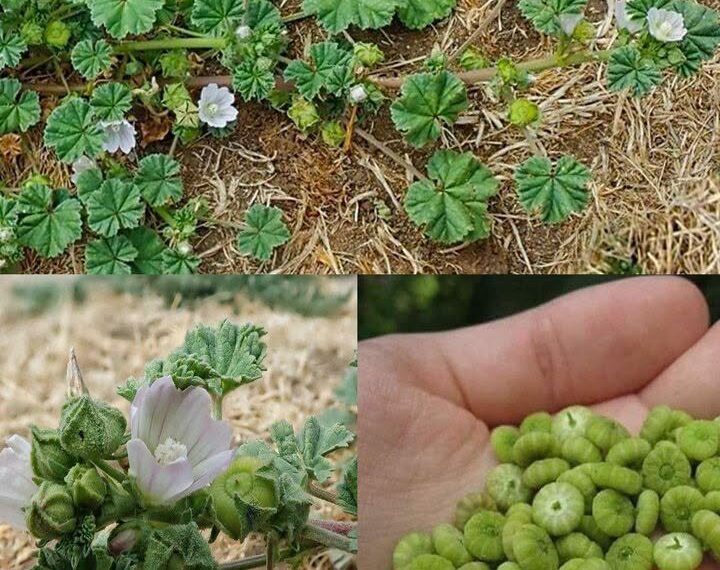
The plant shown in the image appears to be a mallow (Malva species), possibly Malva neglecta or a closely related species. However, an exact botanical identification cannot be guaranteed from a photograph alone. This distinction is important because several Malva species look very similar and can have overlapping traditional uses.
Research on Malva sylvestris, commonly called common mallow, has identified mucilage, flavonoids, phenolic compounds and other phytochemicals that may help explain some of its traditional applications.
🌿 What Is Common Mallow?
Common mallow belongs to the Malvaceae family, the same botanical family that includes plants such as hibiscus and okra.
Depending on the species, mallow can be an annual, biennial, or perennial plant. It generally has:
- Rounded or kidney-shaped leaves
- Soft, slightly hairy foliage
- Small pink, purple, or pale flowers
- A creeping or upright growth habit
- Distinctive round, segmented fruits that resemble small wheels
M. sylvestris is widespread in Europe, North Africa, and parts of Asia and has been used traditionally for generations.
Interestingly, mallow is not simply regarded as a medicinal herb. In Mediterranean traditions, certain Malva species have also been consumed as vegetables and wild edible plants.
1. 🌱 Rich in Natural Mucilage
One of the most interesting characteristics of mallow is its mucilage content.
Mucilage consists largely of complex plant polysaccharides that become slippery or gel-like when exposed to water. Malva species are particularly associated with these substances.
This explains why mallow has traditionally been valued for its soothing and protective properties.
When used traditionally as a preparation, the mucilage may help provide a coating effect over irritated tissues, particularly in the mouth and throat.
This is one of the better-established traditional reasons for using mallow.
2. 🌬️ Traditionally Used for the Throat and Dry Cough
Mallow has a long history of traditional use for coughs, colds and throat irritation.
The European Medicines Agency recognizes preparations made from mallow flowers for traditional use in relieving irritation of the mouth or throat and associated dry cough. It also recognizes traditional use for mild stomach and intestinal discomfort.
The important word here is traditional.
This does not mean that mallow has been proven to cure respiratory infections. Rather, its mucilage and soothing properties provide a plausible explanation for its traditional role in relieving irritation.
For someone experiencing a persistent cough, difficulty breathing, fever, chest pain, or other significant symptoms, mallow should not replace medical evaluation.
3. 🫖 May Soothe Digestive Discomfort
Mallow has also traditionally been used for digestive complaints.
Historical and ethnobotanical records describe the use of Malva preparations for problems such as:
- Mild stomach discomfort
- Digestive irritation
- Constipation
- Diarrhea
- Intestinal discomfort
The plant’s mucilage may contribute to a soothing effect on mucous membranes, while its traditional use as a mild laxative has also been documented.
The European Medicines Agency similarly recognizes traditional use of mallow flower preparations for mild gastrointestinal discomfort.
However, severe, persistent, or unexplained digestive symptoms should always be investigated rather than treated indefinitely with herbal remedies.
4. 🛡️ Contains Antioxidant Compounds
Another reason scientists are interested in mallow is its phytochemical composition.
Research has identified compounds belonging to several groups, including:
- Flavonoids
- Phenolic compounds
- Anthocyanins
- Mucilage polysaccharides
- Terpenoids
- Tannins
- Coumarins
- Sterols
Some of these compounds demonstrate antioxidant activity in laboratory studies.
Antioxidants are compounds capable of helping neutralize certain reactive molecules known as free radicals.
However, laboratory antioxidant activity should not automatically be interpreted as proof that eating mallow prevents disease in humans. Human clinical evidence remains much more limited.
5. 🔥 Potential Anti-Inflammatory Properties
Traditional herbal medicine has frequently used mallow for inflammatory and irritated tissues.
Modern laboratory and animal research has also investigated the plant’s potential anti-inflammatory activity. Reviews describe promising findings associated with extracts and compounds from Malva sylvestris.
Flavonoids and phenolic compounds are among the substances researchers believe may contribute to these effects.
Nevertheless, most of the evidence comes from preclinical research, meaning laboratory experiments or animal studies rather than large human clinical trials.
Therefore, it is more accurate to say that mallow shows anti-inflammatory potential rather than claiming that it is a proven treatment for inflammatory diseases.
6. 🧴 Traditional Benefits for the Skin
TO CONTINUE READING THE ARTICLE PLEASE SEE PAGE 2