Few houseplants make a statement quite like a Monstera deliciosa. With its large, glossy leaves, dramatic splits and natural climbing habit, it can transform an ordinary indoor corner into a lush tropical display.
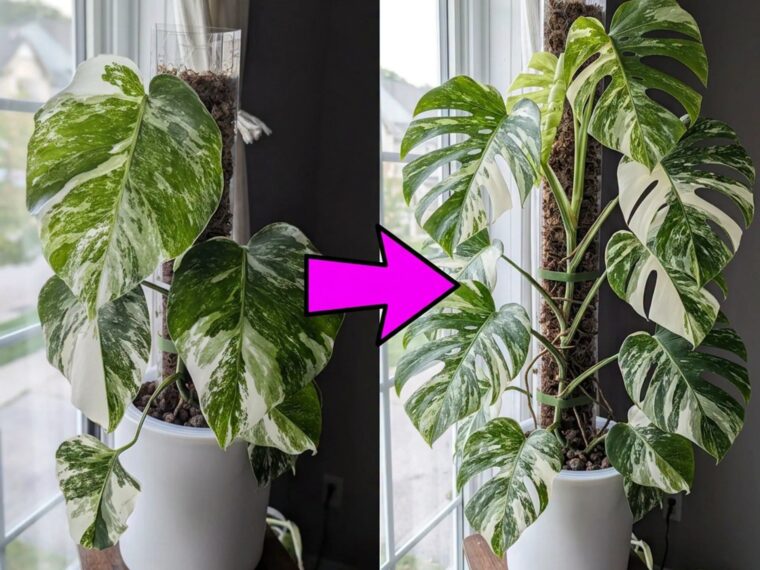
The variegated Monstera shown in your image is particularly striking. Its white-and-green leaves are beautiful, but variegated plants generally need a little more attention because the white portions of the leaves contain less chlorophyll. With the right balance of light, water, humidity and support, however, a Monstera can become a spectacular long-term houseplant.
Here’s how to keep yours healthy and encourage larger, more attractive foliage.
🌿 What Makes Monstera So Special?
Monstera deliciosa, commonly called the Swiss cheese plant, is a tropical climbing plant native to Central America, including southern Mexico and areas farther south. In nature, it climbs trees using aerial roots and can eventually become very large.
Its characteristic holes and splits are called fenestrations. Mature plants grown in suitable conditions are much more likely to develop the dramatic perforated leaves that make Monstera so popular.
Interestingly, young Monstera plants often have smaller leaves with few or no holes. As the plant matures—and particularly when it receives adequate light—the foliage can become increasingly impressive.
☀️ 1. Give Your Monstera the Right Light
Light is probably one of the most important factors in growing a beautiful Monstera.
The goal is:
Bright, indirect light
Place the plant near a bright window where it receives plenty of natural light without being exposed to strong, prolonged direct sunlight.
For the variegated Monstera in your photograph, this is especially important. The white portions of the leaves are more susceptible to sun damage, so intense direct sunlight can cause brown or scorched patches.
A good location could be:
- Near an east-facing window
- Near a bright north-facing window
- A few feet from a sunny south- or west-facing window
- Behind a sheer curtain that filters strong sunlight
Avoid putting the plant in a dark corner simply because Monstera is often described as a “low-light” plant.
It may survive in lower light, but survival and vigorous growth are not the same thing.
Insufficient light can result in slower growth, smaller leaves and less impressive fenestration. Variegated plants may also struggle to maintain attractive coloration when light levels are inadequate.
💧 2. Don’t Water on a Strict Schedule
One of the most common Monstera mistakes is watering automatically every few days.
Instead, check the soil.
Allow the upper portion of the potting mix to dry before watering thoroughly. The exact interval depends on:
- temperature
- humidity
- pot size
- type of potting mix
- season
- amount of light
- plant size
The RHS recommends allowing the compost to dry somewhat between waterings and emphasizes that Monstera should be grown in moist but well-drained conditions.
A simple routine:
- Put your finger into the soil.
- Check whether the upper layer has dried.
- If it’s still noticeably wet, wait.
- When it’s sufficiently dry, water thoroughly.
- Allow excess water to drain away.
- Never leave the pot sitting in stagnant water.
Why is overwatering dangerous?
Constantly wet soil reduces the amount of oxygen available around the roots and can encourage root problems.
Yellowing leaves, persistently wet soil, unpleasant-smelling roots and sudden decline can all be warning signs that the plant is being kept too wet.
🪴 3. Drainage Is Just as Important as Water
A beautiful Monstera can still struggle if its roots are trapped in a pot that doesn’t drain properly.
Choose a container with drainage holes.
A good potting mix should retain some moisture while allowing excess water to escape.
For indoor Monstera, the RHS recommends a well-drained, loam-based growing medium.
You can create an airy houseplant mix using materials such as:
- quality potting mix
- orchid bark
- perlite or pumice
The objective isn’t to create a complicated recipe. The important thing is to avoid dense soil that stays saturated for long periods.
🌱 4. Give It Something to Climb
This is one of the biggest differences between an ordinary-looking Monstera and a spectacular one.
Monstera deliciosa is naturally a climbing plant.
In its native environment, it climbs trees and uses aerial roots to help support its growth.
Indoors, you can recreate this habit with:
🌿 A moss pole
or
🌿 A coir pole
or
🌿 A sturdy trellis
Gently attach the stems to the support using soft plant ties.
Don’t tie the stems so tightly that they become damaged.
With proper support, the plant can grow upward instead of sprawling across the floor or furniture. Missouri Botanical Garden also notes that unsupported plants tend to grow horizontally, while a pole or trellis can encourage climbing.
🌿 5. Don’t Cut Off Aerial Roots Just Because They Look Strange
New Monstera owners sometimes see long roots emerging from the stems and assume something is wrong.
These are aerial roots, and they’re completely normal.
They are part of the plant’s natural climbing strategy.
You can guide them toward a moss pole or allow them to grow naturally.
There’s usually no need to remove healthy aerial roots simply because they aren’t aesthetically pleasing.
💨 6. Humidity Can Make a Big Difference
Monsteras originate from tropical environments, so they generally appreciate humid conditions.
The RHS recommends warm conditions and moderate-to-high humidity for Monstera, while its guidance for variegated Monstera gives an ideal humidity range of around 60–80%.
You don’t necessarily need to turn your home into a rainforest.
If your indoor air is dry, consider:
- a humidifier
- grouping plants together
- keeping the plant away from radiators
- improving general indoor humidity
Good airflow is also important. Extremely humid, stagnant conditions can contribute to problems, particularly when watering is excessive.
🌡️ 7. Keep It Warm
Monstera prefers warm indoor conditions.
The RHS gives approximately 18–25°C as a suitable range for Swiss cheese plants, while its variegated Monstera guidance recommends approximately 18–27°C.
Try to protect the plant from:
- cold drafts
- sudden temperature changes
- freezing temperatures
- direct heat from radiators
- extremely hot windows
A stable environment is generally better than constantly moving the plant around.
🌱 8. Fertilize During Active Growth
A Monstera needs nutrients to produce new leaves and maintain vigorous growth.
During the active growing season, a balanced liquid fertilizer can be useful when applied according to the product’s instructions.
The RHS recommends balanced liquid fertilizer approximately monthly during active growth for Monstera cultivars.
However, more fertilizer does not mean more growth.
Over-fertilization can cause nutrient and salt problems.
If the plant is growing slowly, don’t immediately assume that it needs more fertilizer. First check:
Light → roots → watering → temperature → humidity → nutrients.
Light is often the missing piece.
✂️ 9. Prune Carefully
You don’t need to aggressively prune a healthy Monstera.
Pruning can be useful when:
- the plant has damaged leaves
- stems have become excessively long
- you want to control its size
- you want to propagate healthy sections
Always use clean cutting tools.
And don’t remove healthy leaves simply because they’re older. Every healthy leaf contributes to the plant’s ability to produce energy.
🤍 10. Special Care for Variegated Monstera
The plant in your image appears to be a variegated Monstera, with beautiful white areas across the leaves.
Variegated plants deserve special attention.
The white sections contain less chlorophyll than the green sections, meaning the green portions are especially important for photosynthesis.
This is one reason variegated Monsteras can grow more slowly than fully green plants. Missouri Botanical Garden notes that variegated cultivars typically grow more slowly than the species.
The biggest priorities are:
Bright filtered light
Good drainage
Careful watering
Warm temperatures
Adequate humidity
Don’t expose those beautiful white areas to harsh midday sunlight simply because you want more variegation.
Too much direct sun can cause irreversible brown patches.
🍃 Why Are My Monstera Leaves Turning Yellow?
TO CONTINUE READING THE ARTICLE PLEASE SEE PAGE 2