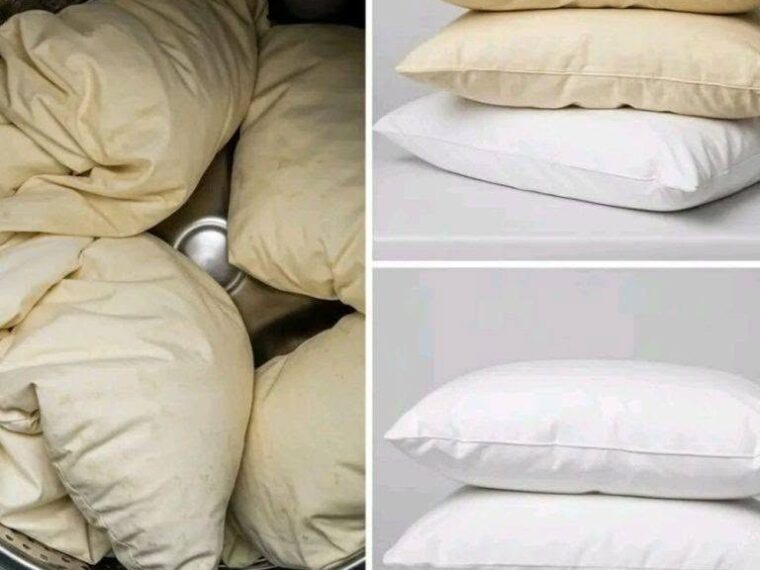
Have your once-white pillows slowly turned yellow?
You’re not alone. Over time, pillows can develop yellow stains and discoloration that make them look old and dirty, even when they are regularly covered with a pillowcase. Sweat, body oils, saliva, skincare products, hair products, and moisture can gradually soak through the pillowcase and accumulate inside the fabric.
The good news is that yellowed pillows can often be refreshed at home with a few simple cleaning techniques.
In this guide, we’ll look at three effective ways to wash and brighten yellowed pillows, along with important precautions to help protect the filling and extend the life of your pillows.
Important: Always check the care label before washing a pillow. Different materials—including down, feather, polyester, memory foam, and latex—require different cleaning methods. Never put a pillow in the washing machine or dryer unless the manufacturer’s instructions allow it.
Why Do Pillows Turn Yellow?
Before trying to remove yellow stains, it helps to understand where they come from.
The most common cause is perspiration.
We spend several hours every night with our heads resting on a pillow. Even if you don’t notice sweating while you sleep, your body naturally releases moisture.
Over months and years, that moisture can penetrate:
- The pillowcase
- The pillow protector
- The outer pillow fabric
- Sometimes even the filling
As the moisture dries and accumulates, it can leave behind yellow or pale brown discoloration.
Other common causes include:
Body oils
Natural oils from your skin and hair can transfer onto the pillow every night.
Wet hair
Going to bed with damp hair can introduce additional moisture into the pillow.
Skincare products
Night creams, moisturizers, hair products, and makeup residue can contribute to staining.
Saliva
Drooling during sleep is another common source of moisture and discoloration.
Humidity
A humid bedroom can make it more difficult for pillows to dry completely.
Before You Start: Check the Pillow’s Care Label
This step is extremely important.
Before using any cleaning solution, look for the manufacturer’s instructions.
Check whether the pillow is:
- Machine washable
- Hand washable
- Dry-clean only
- Suitable for tumble drying
- Suitable for bleach
- Suitable for oxygen-based whitening products
You should also identify the filling.
Polyester or synthetic pillows
Many polyester-filled pillows can be machine washed, but always follow the label.
Down and feather pillows
These often require a gentler washing and drying process.
Memory foam pillows
Most memory foam pillows should not be placed in a washing machine or soaked completely. The removable cover may be washable, but the foam itself usually requires spot cleaning.
Latex pillows
Latex also generally shouldn’t be soaked or machine washed unless the manufacturer specifically says otherwise.
Tip #1: Use Baking Soda and Vinegar for a Gentle Refresh
One of the simplest ways to refresh washable pillows is to combine normal washing with baking soda.
Baking soda can help neutralize odors and loosen some accumulated grime.
What you’ll need:
- Baking soda
- Your usual laundry detergent
- White vinegar
- Warm water, according to the care label
- Washing machine, if the pillow is machine washable
Step 1: Remove the Pillowcase and Protector
Take everything off the pillow.
Wash the pillowcase and protector separately if necessary.
Don’t forget to inspect the pillow itself for yellow areas, stains, or unpleasant odors.
Step 2: Pre-treat Heavily Yellowed Areas
For visible discoloration, you can make a simple paste using:
- Baking soda
- A small amount of water
Mix them until you have a soft paste.
Apply a small amount to the stained area and gently work it into the fabric.
Let it sit for approximately 15–30 minutes, then proceed with washing according to the pillow’s care instructions.
Don’t aggressively scrub the fabric because excessive friction can damage the pillow cover.
Step 3: Wash According to the Label
Place the pillow in the washing machine only if it is machine washable.
Use the recommended amount of detergent.
Avoid automatically using very hot water. The correct temperature depends on the material and care label.
If the pillow’s instructions permit it, an extra rinse cycle can be useful because it helps remove detergent residue.
Step 4: Use Vinegar Carefully
For washable pillows, some people add a small amount of white vinegar to the rinse compartment as a fabric-softening and odor-reducing alternative.
Never mix vinegar directly with chlorine bleach.
If you’re using a commercial laundry product, follow its instructions rather than combining multiple chemicals.
Step 5: Dry the Pillow Completely
This may be the most important part.
A pillow that remains damp inside can develop a musty smell and potentially encourage mold or mildew growth.
Dry the pillow according to its care instructions.
If tumble drying is permitted, use the recommended temperature and periodically check the pillow.
Before putting it back on your bed, make sure it is completely dry inside and out.
Tip #2: Use Oxygen-Based Whitening for Stubborn Yellowing
TO CONTINUE READING THE ARTICLE PLEASE SEE PAGE 2