Bees are among the most fascinating creatures in nature. They live in highly organized colonies, communicate through movement and scent, collect pollen and nectar, care for young bees, defend their home, and work together to keep the colony alive.
But there are many stories about bees circulating online that mix fascinating facts with romanticized or inaccurate claims.
One popular story says that old bees leave the hive in the evening, spend the night on flowers, and continue working the next morning because they know they are nearing the end of their lives.
It is a beautiful story—but the reality of bee behavior is more complicated.
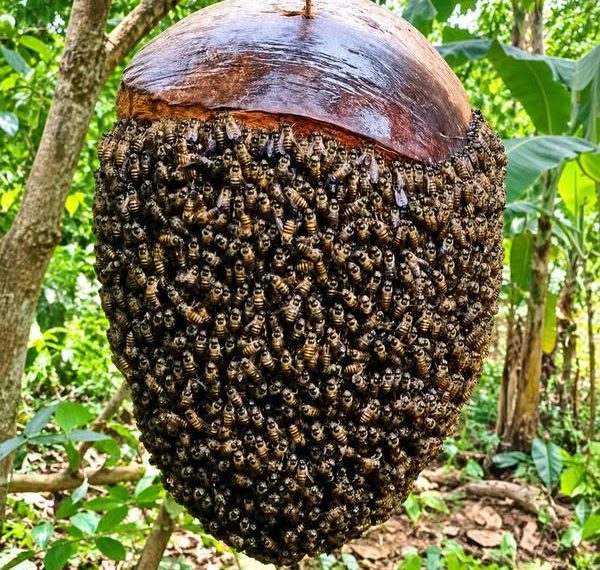
The image accompanying this article shows a remarkable mass of bees clustered around what appears to be a hanging natural structure. It is a striking reminder of just how social and densely organized some bee colonies can be.
So what actually happens to older worker bees? Do they really leave the hive to avoid burdening their colony? And what does it mean to say that bees are “cold-blooded”?
Let’s take a closer look.
The Fascinating Social Life of Bees
A honey bee colony is much more than a collection of individual insects.
It functions as a highly coordinated society in which different bees perform different jobs depending on their age, physical condition, and the needs of the colony.
A typical honey bee colony contains:
- A queen
- Worker bees
- Drones
The queen’s primary role is reproduction.
The workers are females and perform most of the tasks required to maintain the colony.
These tasks can include:
- Cleaning cells
- Feeding larvae
- Caring for the queen
- Producing wax
- Building comb
- Receiving nectar
- Processing food
- Guarding the entrance
- Regulating temperature
- Removing waste
- Foraging for nectar and pollen
What is particularly interesting is that a worker bee’s job can change as she gets older.
Young Bees and Older Bees Have Different Jobs
Honey bee workers generally begin their adult lives performing tasks inside the hive.
Very young workers commonly help with activities such as cleaning and caring for developing larvae.
As they age, they may take on other responsibilities.
Eventually, many workers become foragers.
Foragers leave the colony to search for:
- Nectar
- Pollen
- Water
- Plant resources
This division of labor is one of the reasons honey bee colonies can operate so efficiently.
The colony does not depend on every bee doing the same thing.
Instead, thousands of individuals contribute to different parts of the colony’s survival.
Do Old Bees Leave the Hive Because They Know They Are Dying?
This is where the viral story needs an important correction.
There is no good scientific evidence that old bees consciously leave the colony because they know death is approaching and don’t want to burden their fellow bees.
It is tempting to interpret their behavior in human terms, but bees do not appear to make decisions about death in the way humans do.
The story probably comes from a real observation combined with a sentimental interpretation.
Older worker bees often become foragers, and foraging is physically demanding.
Flying repeatedly, collecting nectar and pollen, navigating long distances, avoiding predators, and dealing with weather all place considerable stress on their bodies.
As a result, foragers generally have relatively short remaining lifespans compared with younger workers.
But that doesn’t mean an aging bee deliberately decides:
“I am going to leave the hive because I am about to die.”
That is a human interpretation of an interesting biological process.
Why Do Foraging Bees Have Shorter Lives?
TO CONTINUE READING THE ARTICLE PLEASE SEE PAGE 2