Why Do Foraging Bees Have Shorter Lives?
Foraging is one of the most demanding jobs in a bee colony.
A forager may make repeated flights between the colony and flowering plants.
During these flights, the bee must:
- Navigate through the environment
- Locate suitable flowers
- Collect nectar
- Collect pollen
- Carry its load
- Avoid predators
- Deal with wind and rain
- Find its way back home
The bee’s wings also experience substantial wear over time.
Eventually, physical deterioration can make efficient flight increasingly difficult.
Foraging is therefore associated with significant physiological wear.
This is one reason worker bees that spend much of their lives foraging generally have shorter remaining lifespans than workers performing less demanding tasks inside the colony.
Do Bees Sometimes Remain Outside the Hive Overnight?
Yes, bees can sometimes be found outside the hive overnight.
But this does not mean that every old bee routinely spends the night sleeping on flowers.
A bee may remain outside the colony because of circumstances such as:
- Cold temperatures
- Rain
- Darkness
- Exhaustion
- Being too far from the colony
- Poor weather conditions
- Disorientation
- Physical weakness
A bee caught away from the hive as daylight disappears may have to remain where it is until conditions improve.
However, this is very different from saying that old bees intentionally choose flowers as a retirement home.
Bees Don’t Have a Human Concept of Retirement
One of the most beautiful aspects of the viral story is also one of the least scientifically supported.
The idea that a bee thinks:
“I am old now, so I will leave the colony and spend my final nights outside.”
is a form of anthropomorphism.
Anthropomorphism means attributing human thoughts, intentions, emotions, or motivations to animals.
Bees certainly display sophisticated behaviors.
They communicate.
They learn.
They navigate.
They recognize environmental patterns.
They respond to changes in their colony.
But scientists cannot conclude from these behaviors that an old bee understands its own approaching death and deliberately removes itself to protect the colony.
Bees Are Often Called “Cold-Blooded”—But There’s More to the Story
The second part of the viral message says:
“Bees have cold blood like all insects, but…”
There is an important biological distinction here.
Bees are ectothermic insects, meaning they cannot maintain a constant internal body temperature in the same way mammals and birds do through their own metabolism.
Their body temperature is strongly influenced by the environment.
But honey bees have an extraordinary ability to regulate temperature through their behavior and collective activity.
And this is where things get fascinating.
Honey Bees Can Generate Heat
A honey bee isn’t simply sitting passively in whatever temperature happens to surround it.
Honey bees can produce heat using their muscles.
When the colony becomes cold, worker bees can contract their flight muscles rapidly without actually flying.
This generates heat.
Thousands of bees working together can create a significant warming effect inside the colony.
This collective behavior is one of the most impressive examples of social thermoregulation in the animal world.
The Colony Can Act Like a Living Heating System
Imagine thousands of bees clustered together inside a hive.
When temperatures fall, bees can form a dense cluster around the colony’s brood.
The bees on the outside help insulate the cluster.
The bees inside generate heat.
The colony can therefore function almost like a biological heating system.
This doesn’t mean the bees maintain exactly the same temperature everywhere.
Different parts of the colony can have different temperatures depending on the season and the location of the brood.
But the colony actively responds to environmental changes.
What Happens When It Gets Too Hot?
Bees also have strategies for cooling the colony.
When temperatures become high, workers may:
- Increase ventilation
- Fan their wings
- Spread out
- Bring water into the colony
- Help evaporate water to produce cooling
This is another example of how individual bees work together to regulate the environment.
A bee colony is therefore not simply reacting individually to temperature.
It behaves as a coordinated social system.
Why Is Temperature So Important?
Temperature is particularly important because developing bee larvae require appropriate environmental conditions.
If the brood becomes too cold or too hot, development can be affected.
This is why temperature regulation is such an important colony task.
Worker bees constantly adjust their behavior according to conditions inside and outside the hive.
Bees Don’t Just Collect Honey
Another common misunderstanding is that bees spend their lives simply collecting honey.
In reality, worker bees perform a huge variety of jobs.
Depending on their age and the colony’s needs, they may:
Clean the hive
Workers remove debris and keep the colony’s interior relatively clean.
Feed developing larvae
Young bees are responsible for feeding and caring for immature bees.
Produce wax
Worker bees produce wax from specialized glands and use it to construct comb.
Process nectar
Nectar brought into the colony is processed and eventually becomes honey.
Guard the entrance
Some workers act as guards and inspect bees attempting to enter.
Regulate temperature
Workers help warm or cool the colony.
Forage
Older workers may leave the colony to collect nectar and pollen.
The colony’s needs determine how labor is distributed.
What Happens When a Worker Bee Becomes Very Old?
An individual worker bee eventually becomes less capable of performing physically demanding tasks.
Her wings may become damaged.
Her muscles may deteriorate.
Her ability to forage can decline.
Eventually, she dies.
The colony does not need to consciously decide that she should leave.
Instead, her biological condition and the colony’s social organization naturally determine what happens.
Dead or dying bees may be removed from the nest by other workers.
This is part of the colony’s sanitation behavior.
Do Bees Care for Sick or Weak Colony Members?
Bee colonies have surprisingly sophisticated hygiene behaviors.
Workers can detect abnormal conditions within the colony and may remove dead individuals or contaminated material.
Some social behaviors can reduce the spread of pathogens.
This is sometimes described as a form of social immunity.
But again, we should be careful not to turn this into a human moral story.
The bees are not necessarily thinking about “sacrifice” or “burden” in the human sense.
Their behavior is shaped by evolution, genetics, environmental conditions, and the needs of the colony.
What Happens to a Bee That Dies Inside the Hive?
Dead bees don’t simply remain inside the colony indefinitely.
Worker bees can remove dead individuals from the nest.
They may carry them outside the hive and drop them away from the main colony.
This helps maintain a cleaner environment.
The behavior is practical and important because dead organisms can become sources of pathogens or attract unwanted organisms.
Why the “Dying Bee” Story Feels So Powerful
The viral message is compelling because it turns a biological behavior into a story about selflessness.
It presents the bee as an elderly worker that understands its approaching death and chooses to stay away from its family so it won’t become a burden.
There is something emotionally powerful about that image.
But nature doesn’t always work according to human emotional narratives.
The real story is arguably even more fascinating.
A bee colony has evolved an extraordinarily efficient system in which thousands of individuals perform different roles without requiring a central commander to direct every action.
Do Bees Know When They Are Going to Die?
There is no established evidence that honey bees have a human-like awareness of their own impending death.
Scientists can observe behaviors associated with aging, illness, exhaustion, and physiological decline.
But those observations cannot tell us that a bee consciously understands:
“I am going to die soon.”
That distinction matters when sharing information about animal behavior.
It is perfectly fine to appreciate the beauty of nature without turning an interesting observation into a scientifically unsupported claim.
The Incredible Life of a Forager
A worker bee’s transition to foraging is one of the most important stages of her life.
Before becoming a full-time forager, she spends much of her adult life inside the colony.
Eventually, she begins making orientation flights and learning the surrounding landscape.
She must learn where food sources are located and how to navigate back to the colony.
Honey bees have remarkable navigational abilities.
They can use environmental landmarks and the position of the sun to help orient themselves.
How Does a Bee Find Its Way Home?
Honey bees have sophisticated navigation abilities.
They can learn the location of food sources and communicate information about profitable resources to other workers.
One of the best-known examples is the waggle dance.
A foraging bee can perform a specific movement pattern inside the colony that communicates information about the direction and approximate distance of a food source.
It is one of the most remarkable communication systems known in the animal world.
A Bee’s Final Days Are Not Necessarily Spent Alone
Another important correction to the viral story is the idea that an old bee always leaves its colony permanently.
That isn’t a universal rule.
Some aging or weakened bees may still be found in or around the colony.
Others may die away from the hive.
Others may return to the colony before dying.
There is no single “retirement behavior” shared by all old worker bees.
The circumstances vary.
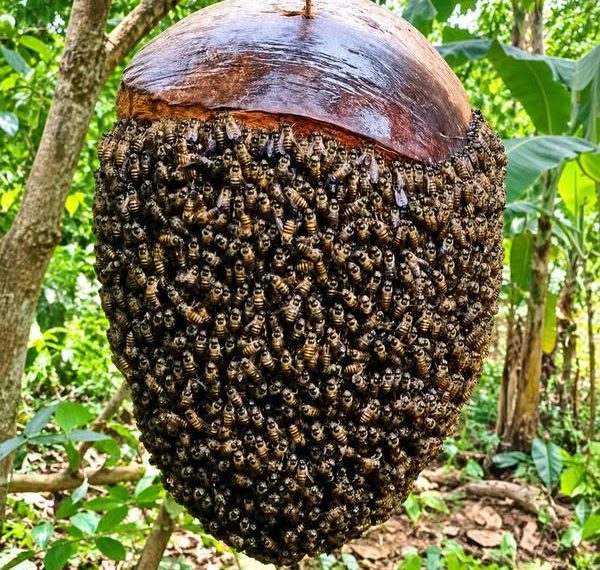
What About the Huge Group of Bees in the Image?
The photograph shows a very large concentration of bees around a hanging structure.
However, a photograph alone isn’t enough to establish exactly what species of bee or insect is shown, what the structure represents, or why the insects are clustered there.
The image may be a real swarm, a nest, or a digitally altered/generated image, and its appearance should not be used as evidence for the specific claims in the viral text.
That distinction is especially important with dramatic wildlife images circulating on social media.
A spectacular photograph can attract attention without necessarily providing reliable information about the biology of the animal.
A Swarm Is Not the Same Thing as a Hive
When honey bees swarm, thousands of bees may temporarily gather together while part of the colony relocates.
A swarm can look dramatic.
You might see a dense mass of bees hanging from:
- A tree branch
- A fence
- A building
- A garden structure
- Another sheltered location
A swarm is often a temporary stage in the process of colony reproduction.
It shouldn’t automatically be interpreted as a colony that has abandoned its hive or as a collection of dying bees.
Never Disturb a Large Bee Cluster
If you encounter a large mass of bees like the one shown in the image, don’t touch it or try to knock it down.
Instead:
- Keep children away.
- Keep pets away.
- Don’t spray the bees.
- Don’t hit or shake the structure.
- Avoid disturbing the cluster.
- Contact a qualified local beekeeper or appropriate pest/wildlife professional if the bees are creating a safety concern.
This is particularly important because bees can defend their colony when they perceive a threat.
Bees Are Essential Pollinators
Beyond honey production, bees play an important role in pollination.
When bees visit flowers for nectar and pollen, pollen grains can be transferred between flowers.
This helps many plants reproduce.
Bees interact with an enormous variety of flowering plants.
Their activity can therefore contribute to:
- Fruit production
- Seed production
- Plant reproduction
- Agricultural yields
- Ecosystem functioning
Not every plant depends on honey bees specifically, and many other insects and animals are important pollinators too.
The Amazing Truth About Bees
The most fascinating part of the story isn’t necessarily that an old bee chooses to die alone.
The genuinely remarkable fact is that a bee colony operates as a highly organized biological system made up of thousands of individuals.
Individual bees perform different tasks.
Workers change roles as they age.
They communicate information.
They regulate temperature.
They care for developing young.
They defend the colony.
They collect food.
They remove waste.
They respond to threats.
And together, they create a functioning society that can survive environmental challenges.
Common Myths About Bees
Let’s separate a few popular claims from what we actually know.
Myth: Every old bee leaves the hive to die.
Reality: Aging foragers may die away from the colony, but there is no universal rule that old bees deliberately leave to die.
Myth: Bees consciously know when death is approaching.
Reality: There is no established evidence that bees possess a human-like awareness of their impending death.
Myth: Bees simply become cold when the weather changes.
Reality: Honey bees can generate heat through muscle activity and regulate colony temperature collectively.
Myth: A large cluster of bees means the bees are dying.
Reality: A large cluster can have several explanations, including swarming or other normal colony behaviors.
Myth: All bees behave exactly like honey bees.
Reality: There are thousands of bee species, and their nesting habits, social structures, lifecycles, and behaviors vary considerably.
What We Can Learn From Bees
Even after separating fact from viral storytelling, bees still offer an extraordinary lesson in cooperation.
A single worker bee is a tiny organism with limited individual abilities.
Yet thousands of bees working together can accomplish remarkable things.
They can:
- Build complex structures
- Produce and store food
- Raise young
- Defend their colony
- Regulate temperature
- Communicate locations
- Adapt their behavior to changing conditions
This phenomenon is sometimes described as collective intelligence.
The colony can display complex behavior even though no individual bee is directing the entire operation.
Final Thoughts
The viral claim that old bees deliberately leave their hive at night, sleep on flowers, and knowingly spend their final days working for the colony is a touching story—but it should not be presented as established scientific fact.
Older worker bees do often become foragers, and foraging is physically demanding. Bees can sometimes be found outside the hive overnight, particularly when weather or circumstances prevent them from returning.
But there is no evidence that they consciously decide to leave the colony because they understand that death is approaching or because they want to avoid burdening other bees.
The truth is no less fascinating.
Honey bees are remarkable insects capable of collective temperature regulation, sophisticated communication, division of labor, navigation, food collection, brood care, and colony defense.
And although bees are ectothermic insects, their colonies can actively generate and manage heat through the coordinated behavior of thousands of individuals.
So the next time you see a bee moving from flower to flower, remember that you are watching one tiny member of an extraordinarily complex society.
Sometimes, the real science behind nature is even more fascinating than the viral story. 🐝