Have you ever come home after being away for a while and noticed your cat immediately rubbing its head or body against your legs? Or perhaps your cat gently presses its face against your hand, arm, or even your face?
At first glance, it may look like a simple request for affection. And often, it is a friendly gesture—but cats have several reasons for doing this. Their behavior combines communication, scent marking, social bonding, curiosity, and sometimes a very practical request for food or attention.
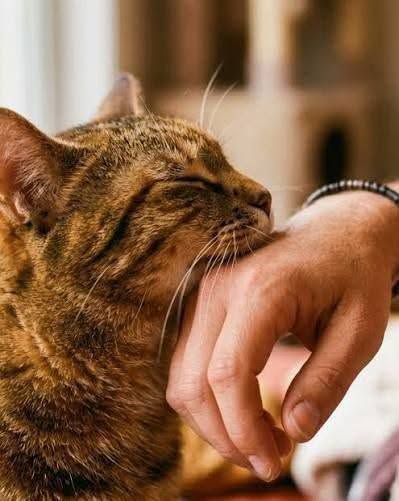
The beautiful image above captures one of these moments: a cat gently pressing its face against a person’s hand. This behavior is commonly known as bunting when the cat uses its head or face.
🐱 Why does your cat rub against you?
Cats communicate differently from humans. While we rely heavily on words, facial expressions, and gestures, cats make extensive use of body language and scent.
When a cat rubs its cheeks, head, or body against you, it can leave chemical signals called pheromones from scent glands located around areas such as the cheeks, chin, head, and tail.
So when your cat rubs against you, it may essentially be saying:
“I know you. You are familiar. You belong in my safe environment.”
That doesn’t necessarily mean the cat is literally thinking of ownership in the human sense. Rather, scent helps cats recognize familiar individuals and objects and establish a sense of familiarity.
❤️ 1. It can be a sign of affection
One of the most pleasant explanations is that your cat simply likes you.
Cats often rub against people they trust. A relaxed cat that approaches you with a loose body, relaxed ears, a raised tail, purring, or gentle head bumps is generally displaying friendly social behavior.
Veterinary sources describe rubbing and head-butting as behaviors associated with greetings, affection, acceptance and social bonding.
This is particularly noticeable when your cat comes to greet you after you’ve been away.
You might see your cat:
- walk toward you with its tail held upright;
- rub its cheeks against your legs;
- circle around your feet;
- gently bump your hand with its head;
- purr while rubbing against you;
- look up at you and wait for attention.
These behaviors can be your cat’s version of a warm welcome.
👃 2. Your cat is leaving its scent on you
There’s another fascinating explanation.
Cats have specialized scent glands around their face and other parts of their body. When they rub against you, they can deposit pheromonal scents onto your skin or clothing.
This helps create a familiar scent environment.
You may notice the same behavior when your cat rubs against:
- furniture;
- door frames;
- your shoes;
- bags;
- blankets;
- other pets;
- its favorite sleeping areas.
In other words, your cat doesn’t only rub against you—it may rub against many things that are important within its environment.
🏠 3. Your cat may be making you smell familiar again
Here’s something many cat owners notice:
You leave the house.
You come back.
Your cat immediately starts rubbing against your legs.
Why?
When you spend time outside, you acquire countless new smells. You may have been around other people, animals, food, plants, perfumes or completely unfamiliar environments.
Your cat’s extraordinary sense of smell allows it to detect information that humans barely notice.
Rubbing against you may help restore the familiar scent associated with the household and your relationship with the cat. Veterinary explanations suggest that cats may repeat scent marking because these scents naturally fade over time.
So that enthusiastic greeting at the door may have more meaning than simply:
“Where have you been?”
It can also be a way of reconnecting with a familiar member of the household.
🐾 4. Sometimes your cat simply wants something
Not every rub is an expression of affection.
Your cat may also be communicating a request.
For example, your cat might rub against you because it wants:
- food;
- treats;
- playtime;
- petting;
- access to another room;
- its water refreshed;
- attention.
Experienced cat owners often recognize that a particular rubbing routine can be followed by a very specific request.
For example, your cat might rub against your legs, walk toward the kitchen, look back at you, and meow.
That’s probably not a philosophical discussion.
It may simply mean:
“Follow me. The food bowl situation requires your immediate attention.” 😹
🧠 5. It can also be a way of gathering information
Cats are extremely curious animals.
When a cat encounters a new person, animal or unfamiliar object, rubbing can sometimes be part of an information-gathering process rather than an invitation to be touched.
Veterinary behavior explanations note that cats may use rubbing to investigate unfamiliar individuals and gather information through scent.
That’s why you shouldn’t automatically assume that every cat rubbing against a stranger wants extensive petting.
The rest of the cat’s body language matters.
Look at the whole cat
A friendly, relaxed cat may have:
- relaxed ears;
- a loose body;
- a gently raised tail;
- relaxed whiskers;
- slow blinking;
- normal movement.
A frightened or overstimulated cat may instead have:
- flattened ears;
- a tense body;
- a rapidly flicking tail;
- dilated pupils;
- hissing or growling;
- attempts to move away.
One behavior should never be interpreted in isolation.
🐈 What does it mean when your cat bumps your hand?
The behavior shown in the photograph is particularly interesting.
When a cat deliberately pushes its forehead or cheek against a person, this is often referred to as head bunting.
It can be a friendly social gesture and may involve scent communication.
If your cat approaches you, gently bumps your hand and then stays close, it may be inviting interaction.
A good response is usually to let the cat control the interaction.
Instead of immediately grabbing or holding the cat, allow it to approach and offer your hand for sniffing. If the cat continues rubbing against you, gentle petting around areas it normally enjoys can be appropriate.
😺 Why do cats rub against each other?
This behavior isn’t exclusive to humans.
Cats can rub against other cats as part of their social interactions. Cats living together can develop a shared scent, which helps establish familiarity within their social environment.
This helps explain why cats sometimes rub against one another and then groom each other.
For a cat, scent is an important part of recognizing the world around it.
Humans see a familiar family member.
A cat can also experience that familiarity through smell.
💕 Does rubbing mean your cat loves you?
It’s tempting to translate every cat behavior directly into human emotions, but animal behavior is more complicated.
Still, when a relaxed cat voluntarily approaches a trusted person and rubs against them, it is reasonable to interpret the behavior as friendly and socially positive.
Research and veterinary explanations associate rubbing with several overlapping functions—including greeting, social bonding, affection, familiarity and scent communication.
So yes, you can take it as a compliment.
Your cat is comfortable enough around you to initiate contact.
⚠️ When should unusual rubbing concern you?
TO CONTINUE READING THE ARTICLE PLEASE SEE PAGE 2