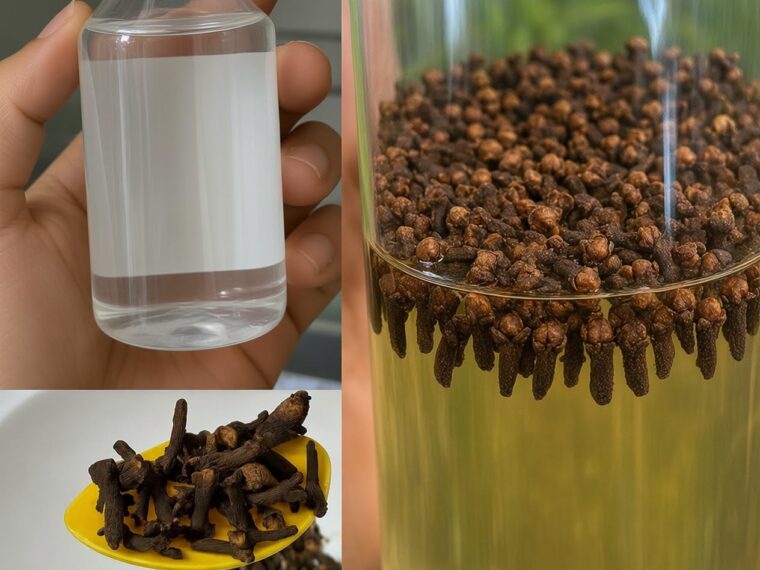
Cloves are one of the most aromatic spices in the kitchen, but they have also been used for centuries in traditional remedies. Their strong fragrance comes largely from eugenol, a natural compound found in high concentrations in clove essential oil.
The image shows whole cloves being infused in a clear alcoholic liquid. This type of preparation is sometimes described as a clove tincture or clove infusion. Traditionally, preparations like this have been used for their strong aroma and for various household and topical purposes.
However, there is an important distinction: traditional use is not the same as proven medical effectiveness. Scientific evidence for many of the popular claims surrounding homemade clove-and-alcohol mixtures remains limited.
Why combine cloves with alcohol?
Alcohol can extract certain aromatic compounds from plant material more effectively than water alone. When whole cloves are left in alcohol, some of their compounds—including eugenol and other volatile substances—can move into the liquid.
This produces a strongly scented preparation that may be useful for certain traditional, household or topical applications.
The concentration, however, depends on several factors, including:
- The type and strength of alcohol
- The quantity of cloves
- How long they are infused
- Temperature and storage conditions
- Whether the cloves are whole, crushed or ground
For this reason, a homemade infusion should not be treated like a standardized medicine.
1. The main compound: eugenol
The most interesting component of cloves is eugenol, an aromatic compound responsible for much of their characteristic smell and flavor.
Clove oil contains a particularly high proportion of eugenol—approximately 60–90% according to toxicology sources. Eugenol has demonstrated antioxidant, antimicrobial and anti-inflammatory properties in laboratory research.
This helps explain why cloves have traditionally been associated with:
- Oral and dental preparations
- Aromatic applications
- Food preservation
- Traditional topical remedies
- Household preparations
But laboratory activity does not automatically mean that a homemade clove tincture will treat an illness.
2. Traditional use for tooth discomfort
Cloves have a long history in dental preparations. Eugenol has been used in dentistry, particularly in products intended for temporary relief of tooth-related discomfort and in certain dental materials.
This is one reason people sometimes make clove preparations at home.
However, applying homemade alcohol-and-clove mixtures directly inside the mouth is not recommended. Alcohol can irritate oral tissues, while concentrated clove preparations can cause irritation or burns.
If you have severe tooth pain, swelling, fever or a dental abscess, a dentist should evaluate the underlying problem rather than relying on a homemade remedy.
3. A strong aromatic preparation
One of the simplest benefits of cloves is their powerful aroma.
A clove infusion can have a warm, spicy fragrance that some people find pleasant when used appropriately as a household aromatic preparation.
The combination of alcohol and cloves can produce a particularly intense scent because alcohol helps extract and carry aromatic compounds.
This makes the preparation interesting for people who enjoy natural fragrances and traditional herbal preparations.
4. Antimicrobial properties: what the research actually says
Cloves and eugenol have demonstrated antimicrobial activity in laboratory studies.
Research has investigated their activity against various microorganisms, including certain bacteria and fungi. This is one reason clove-derived ingredients are found in some oral-care, cosmetic and household products.
But there is an important limitation.
A substance showing antimicrobial activity in a laboratory does not prove that drinking a homemade clove-and-alcohol mixture will prevent or cure an infection.
In particular, homemade preparations have unpredictable concentrations and are not equivalent to tested disinfectants or medicines.
5. Antioxidant properties
Cloves are rich in plant compounds with antioxidant activity. Eugenol is one of the compounds responsible for this characteristic. Antioxidants can help neutralize certain reactive molecules in laboratory settings.
This is one reason cloves are often described as a “powerful antioxidant spice.”
However, it would be misleading to claim that drinking a clove-and-alcohol infusion will “detoxify the body” or cure chronic diseases. Those claims are not established by good clinical evidence.
For antioxidant benefits, using cloves normally in food is a much more conventional approach.
Can you drink homemade clove alcohol?
This is where caution is especially important.
A mixture containing cloves and alcohol should not automatically be considered a health drink.
There is a major difference between:
Cloves used as a culinary spice
and
a concentrated clove extract or clove oil.
Clove oil contains very concentrated eugenol, and swallowing excessive amounts can cause serious poisoning. Reported complications include nervous-system effects, breathing problems and severe liver injury.
MedlinePlus notes that relatively small amounts of clove oil can cause serious effects, particularly in children.
Therefore, a homemade clove-and-alcohol preparation should not be promoted as something to drink by the spoonful.
What about using it on the skin?
Some traditional preparations containing cloves are used externally because of their strong aroma and the properties associated with eugenol.
If someone chooses to experiment with a homemade preparation for an external, non-medical purpose, several precautions are important:
- Never apply it to open wounds.
- Avoid the eyes and mucous membranes.
- Do not apply it to irritated or damaged skin.
- Test a very small area first.
- Stop immediately if burning, redness or swelling occurs.
- Keep it away from children and pets.
- Keep it away from flames because alcohol is highly flammable.
Clove oil and concentrated eugenol can themselves irritate skin and mucous membranes.
What about using it as a natural insect repellent?
The strong aroma of cloves has also attracted interest for household and insect-related applications. Certain clove-derived compounds have demonstrated insecticidal or repellent activity in experimental settings.
However, a homemade clove-and-alcohol preparation should not be assumed to be an effective pest-control product.
If you’re dealing with a serious infestation, a properly tested household insect-control product or professional pest-control service is more reliable.
How to make a traditional clove infusion
If the goal is simply to create a non-food aromatic infusion for traditional household use, a basic preparation can be made with whole cloves and an appropriate alcohol-based liquid.
You will need:
TO CONTINUE READING THE ARTICLE PLEASE SEE PAGE 2