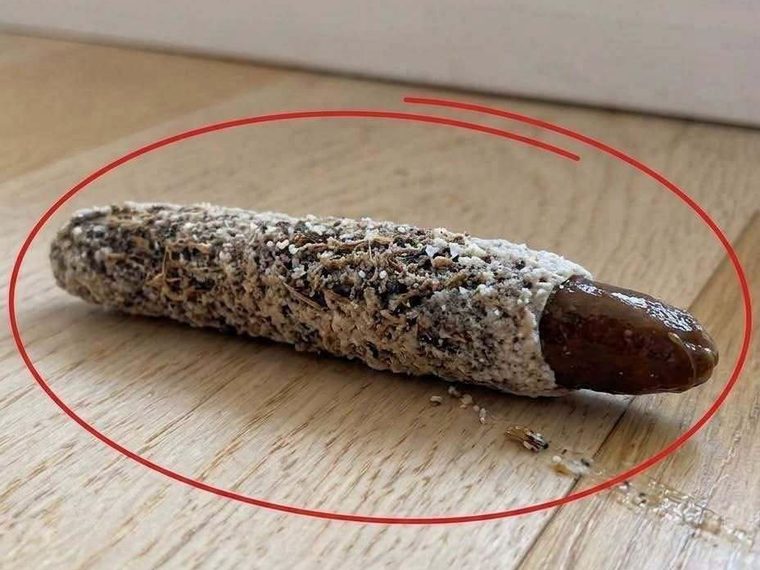
Imagine walking toward your bedroom, looking down at the floor, and noticing something strange lying near the door. At first glance, it looks like a small, elongated object covered in dust, fibers, and tiny pieces of debris. One end appears dark brown and shiny, while the rest looks rough and textured.
You might wonder whether it is an insect, a cocoon, something left behind by a household pest, or even something that came in from outside.
The photograph accompanying this story shows an unusual, elongated object with a rough outer covering and a smooth, brown end. Its appearance is certainly intriguing, but a photograph alone is not enough to identify it with certainty. It could be a biological object, an insect-related structure, or even an ordinary item covered in lint and debris.
If you have found something similar near your bedroom door, there is no need to panic. The best approach is to examine its appearance, consider where it was found, and look for other clues around your home.
In this article, we will explore several possible explanations, explain how to investigate the discovery safely, and share practical ways to prevent unwanted insects from entering your bedroom.
1. Could It Be an Insect Carrying Its Own Protective Case?

One possibility worth considering is a case-bearing moth larva, sometimes called a household casebearer. These small caterpillars construct protective cases from silk mixed with materials such as lint, hair, and other fibers.
Their cases can look like tiny elongated tubes made from dust and debris. Depending on the species and stage of development, the larva may protrude from one end as it moves.
These insects are associated with places where suitable food and shelter are available, including dusty corners, closets, and areas containing natural fibers.
However, there is an important difference between a typical household casebearer and the object in your photograph: the pictured object appears relatively large and has a prominent, smooth, brown end. Without a clear view of its structure and size, it would be premature to identify it as a moth larva.
What to look for:
- A narrow, tube-shaped case made of fibers or debris.
- A small head or legs protruding from one end.
- Similar cases attached to walls, ceilings, or hidden corners.
- Tiny moths or larvae nearby.
If several similar cases appear around your home, inspect closets, rugs, stored clothing, and dusty areas for other signs of insects.
2. Could It Be a Bagworm or Another Type of Caterpillar?

Another possibility is a bagworm or another case-building caterpillar.
Many caterpillars create portable coverings using silk and materials collected from their surroundings. Depending on the species, these coverings can contain pieces of leaves, bark, twigs, or other debris.
Bagworms are particularly associated with outdoor plants, shrubs, and trees, although certain case-bearing moth species are found indoors.
If the object came in on shoes, clothing, a plant, or an item brought in from outdoors, an insect-related explanation is conceivable.
Nevertheless, the photograph does not provide enough information to establish that this is a bagworm. Its apparent size, the glossy brown end, and the thick layer of material require closer examination before a reliable identification can be made.
3. Could It Be a Slug Covered in Dust and Debris?

The shiny brown section in your photograph might initially make you think of a slug or another soft-bodied animal.
Slugs have moist, soft bodies and can appear brown, gray, or nearly black. They sometimes enter homes through gaps around doors, cracks, or other openings, particularly when outdoor conditions are damp.
However, slugs do not normally construct a long, rigid, fibrous case around their bodies. If the rough outer covering in your photograph is genuinely attached to the smooth brown portion, a typical slug would not explain the entire appearance particularly well.
If you suspect that you have found a slug, look for:
- A soft, moist body rather than a rigid shell.
- A continuous body shape without a distinct fibrous case.
- A shiny mucus trail on the floor.
- Similar animals around damp areas, door thresholds, or potted plants.
Avoid touching an unidentified animal with bare hands. If it appears to be a slug, use gloves or a suitable tool to move it safely, and wash your hands afterward.
4. Could It Be Something Left Behind by a Household Pest?

It is also worth checking whether the object is related to a household insect infestation.
Several pests leave behind material that can look unfamiliar when discovered on the floor.
For example:
- Carpet beetle larvae can leave behind bristly shed skins and feed on susceptible natural materials.
- Clothes moth larvae may produce silk, feeding damage, and small cases or coverings, depending on the species.
- Other insect larvae may leave cocoons, pupal cases, or debris near places where they develop.
These examples are possibilities to investigate, not confirmed identifications of your photograph.
A single unidentified object does not establish that your home has an infestation. Look for additional evidence before using pesticides or treating the entire room.
5. Why Would Something Like This Appear Near a Bedroom Door?
TO CONTINUE READING THE ARTICLE PLEASE SEE PAGE 2