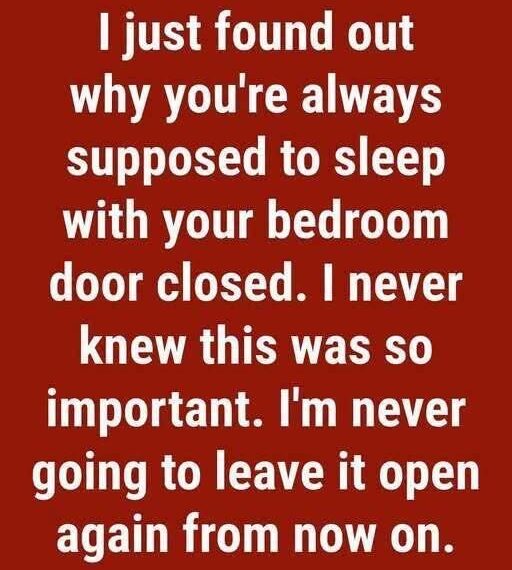
Why is closing the door especially important while sleeping?
During the day, you may notice unusual smells, hear something crackling, see smoke, or notice a fire developing.
At night, you may be completely unaware that anything is happening.
You are unconscious and your senses are less responsive to environmental changes.
That’s why fire safety becomes particularly important in bedrooms.
A closed door creates a passive layer of protection before you even know there’s a problem.
UL’s Fire Safety Research Institute specifically promotes the message “Close Before You Doze”, encouraging people to close their bedroom doors before going to sleep.
But there’s something even more important than the door
Closing your bedroom door is helpful, but it should never replace working smoke alarms.
In fact, the two should work together.
The NFPA recommends installing smoke alarms:
- Inside every sleeping room
- Outside each separate sleeping area
- On every level of the home
For additional protection, alarms should be interconnected so that when one alarm detects smoke, the others sound as well.
This is especially important when bedroom doors are closed.
Why?
Because a closed door can also reduce the volume of an alarm located somewhere else in the house.
That’s why proper smoke-alarm placement is essential.
What if the smoke alarm is outside the bedroom?
This is an important consideration.
If you sleep with your door closed, you should not simply assume that a hallway smoke alarm will always provide sufficient warning.
The NFPA specifically recommends smoke alarms inside and outside bedrooms when people sleep with their doors closed. Interconnected alarms provide the best protection.
So the ideal setup isn’t:
Closed door + one alarm somewhere in the hallway.
It’s:
Closed bedroom door + properly positioned working smoke alarms + a practiced escape plan.
What should you do if the alarm sounds?
The general principle is simple:
Get out and stay out if you can safely escape.
Don’t waste precious time collecting valuables.
Don’t go back inside because you forgot your phone.
Don’t assume a small fire is harmless.
The NFPA advises that if smoke blocks the first exit, occupants should use their second way out if available.
That’s why every household should have an escape plan.
You should have two ways out
Ideally, everyone in the home should know two possible escape routes from their sleeping area.
For a bedroom on the ground floor, this might mean:
- The bedroom door
- A suitable window
For an upstairs bedroom, the second route might involve an approved emergency escape window or another appropriate exit depending on the home’s design.
Don’t wait until there’s smoke everywhere to figure this out.
Practice beforehand.
What if the bedroom door is hot?
This is extremely important.
If a fire alarm sounds and you’re preparing to leave through a door, don’t blindly open a door that may be exposed to fire.
The NFPA advises checking the doorknob and door; if either is hot, keep the door closed and use another way out. If smoke is coming around the door, leave it closed and use your second exit if possible.
A door that is hot or surrounded by smoke can be a warning that dangerous conditions are on the other side.
What if you can’t escape?
This is where the closed door can become particularly important.
If your normal escape routes are blocked by smoke or fire, a closed bedroom door can provide a protective barrier while you call emergency services and wait for rescue.
FSRI describes this as a possible Plan C when escape routes A and B are unavailable: get behind a closed door, signal your location, and call emergency services.
If you are trapped:
- Keep the door closed.
- Call your local emergency number.
- Signal your location if possible.
- Stay as far away from smoke as practical.
- Follow instructions from emergency responders.
Why modern homes can make fires particularly dangerous
Fire behavior has changed over time.
Modern homes contain synthetic furnishings, plastics, engineered materials, and other products that can contribute to rapid fire development and toxic smoke production.
UL’s Fire Safety Research Institute describes today’s fire environment as evolving and notes that modern furnishings, open layouts, and construction materials can allow fires to spread and become more toxic quickly.
This is one reason why fire-safety researchers emphasize simple passive measures such as closing doors.
You don’t need to buy an expensive device.
You simply need to close a door.
There may be other benefits to a closed bedroom door
Fire safety is the most important reason highlighted by the image, but a closed bedroom door can also have everyday benefits.
It may help reduce:
- Hallway light
- Household noise
- Disturbances from other rooms
- Some airborne particles entering the room
For some people, a quieter and darker environment can also make it easier to sleep.
However, these benefits vary from home to home.
Ventilation and indoor air quality still matter, so closing the door shouldn’t mean ignoring problems such as excessive heat, poor ventilation, or inadequate fresh-air exchange.
Don’t turn the message into a dangerous rule
There’s an important nuance here.
The advice isn’t:
“Close your bedroom door and you’re safe.”
That’s not true.
A closed door can slow fire and smoke, but it cannot guarantee protection from a fire.
The correct message is:
A closed bedroom door is one layer of fire protection—and it should be combined with working smoke alarms, a fire-escape plan, and safe behavior.
The NFPA explicitly emphasizes both closed doors and properly installed smoke alarms.
A simple nighttime fire-safety checklist
Before going to bed, make these habits automatic:
✅ Close bedroom doors
Make this part of your nightly routine.
✅ Check your smoke alarms
Make sure they are operational and maintained according to the manufacturer’s instructions.
✅ Have alarms in the right locations
Bedrooms and areas immediately outside sleeping areas are important locations.
✅ Know two ways out
Every member of the household should know their escape routes.
✅ Keep exits clear
Don’t block doors, hallways, stairways, or emergency windows with furniture or clutter.
✅ Keep phones accessible
Have a way to contact emergency services if needed.
✅ Practice your escape plan
Don’t wait for a real emergency to discover that someone doesn’t know what to do.
The simple habit that could make a difference
The image’s message is dramatic, but the underlying lesson is surprisingly simple.
Close your bedroom door before you go to sleep.
It costs nothing.
It takes only a second.
And fire-safety research shows that a closed door can substantially change the conditions inside a bedroom during a fire, potentially slowing the spread of heat and toxic smoke and giving occupants additional time.
But don’t stop there.
Make sure your smoke alarms work.
Make sure they’re installed in appropriate locations.
Know two ways out.
Practice your escape plan.
And remember that if a fire occurs, getting outside safely is the priority whenever an escape route is available.
So tonight, when you turn off the lights and get into bed, take one extra second.
Close the door.
It may be one of the simplest fire-safety habits you can add to your nightly routine.