4. Are wrapped cucumbers safer to eat?

Plastic wrapping provides a physical barrier that can reduce direct handling and some forms of contamination during transportation and display.
However, this does not mean a wrapped cucumber is sterile or automatically safer than an unwrapped one.
Bacteria and other contaminants can still be present on produce, and contamination may occur before packaging or when the wrapping is removed.
To handle cucumbers safely:
- Wash your hands before preparing food.
- Rinse the cucumber under clean running water before cutting or eating it.
- Rub the surface gently with your hands while rinsing.
- Use a clean knife and cutting board.
- Remove the wrapping before washing and preparing the cucumber.
- Avoid using soap, bleach, or household cleaning products on produce.
The U.S. Food and Drug Administration recommends washing fresh produce under running water and advises against using soap or commercial produce washes.
Wiley Online Library
The wrapping is primarily intended to preserve quality and reduce moisture loss, not to replace good food hygiene.
5. Should you keep the plastic on after bringing cucumbers home?


In many cases, yes. If you buy a plastic-wrapped English cucumber, keeping the original wrapping on until you are ready to use it can help slow dehydration.
Here are some practical storage tips.
For an unopened cucumber: Keep the wrapping intact if it is clean and undamaged, and follow any storage advice printed on the packaging. Store the cucumber under suitable conditions, away from produce that releases large amounts of ethylene, such as ripe bananas and tomatoes.
For a partially used cucumber: Remove the original wrapping as needed, wash the cucumber before cutting, and cover the cut surface or place the remaining piece in a clean, sealed container. Refrigerate it and use it promptly.
For an unwrapped cucumber: Keep it protected from excessive moisture loss and avoid crushing it under heavier items in the refrigerator.
One caution: cucumbers can be sensitive to chilling injury at temperatures that are too low. Very cold storage may cause pitting, water-soaked areas, or deterioration. The best storage conditions depend on the variety, maturity, and expected storage time.
For that reason, follow the product’s storage guidance rather than assuming that the coldest part of the refrigerator is always the best place.
6. Is it better to buy wrapped or unwrapped cucumbers?


There is no single answer that applies to every shopper. The best choice depends on where the cucumber was grown, how far it traveled, how quickly you plan to eat it, and whether you can avoid wasting it.
| Your situation | A practical choice |
|---|---|
| You want to store an English cucumber for several days | A wrapped cucumber may retain its firmness longer. |
| You plan to eat it the same day | An unwrapped cucumber may be perfectly suitable. |
| You can buy locally grown produce | Compare freshness, transport distance, and packaging. |
| You regularly throw away wilted cucumbers | Packaging that extends freshness may help reduce waste. |
| You want to minimize disposable plastic | Look for suitable loose cucumbers and buy quantities you can use. |
It is also worth considering the amount of packaging rather than judging a product solely by whether it contains plastic.
A cucumber wrapped in a thin film may use relatively little material, but that material still creates waste. On the other hand, buying several loose cucumbers that spoil before you eat them is not necessarily the more sustainable option.
The goal is to choose the option that minimizes both unnecessary packaging and unnecessary food waste.
7. Are there alternatives to traditional plastic wrapping?


Researchers and food producers are exploring alternatives that can protect fresh produce without relying entirely on conventional plastic film.
Some options include:
- Compostable packaging: Materials designed to break down under appropriate composting conditions. Whether they offer an environmental advantage depends on their production and disposal.
- Edible coatings: Thin protective layers made from suitable food-grade materials that may help slow moisture loss.
- Reusable packaging: Containers or bags that can be used repeatedly, provided they are suitable for the produce and properly cleaned.
- Improved transport and storage: Better temperature control and handling can reduce damage and spoilage, potentially reducing the need for additional packaging.
Research on compostable packaging for cucumbers has found that suitable packaging designs can reduce weight loss and shriveling while helping preserve quality.
Nevertheless, no alternative should be considered automatically superior simply because it is labeled compostable or plastic-free. Its environmental impact depends on how it is produced, how well it protects the cucumber, and whether local waste-management systems can process it.
The long-term goal is to protect fresh food effectively while reducing pollution and the use of unnecessary materials.
8. A few common myths about plastic-wrapped cucumbers


Let’s clear up a few misunderstandings.
Myth 1: The plastic is there only to make the cucumber look attractive.
The appearance may be part of its retail presentation, but the main practical purpose is to reduce moisture loss and protect the delicate skin.
Myth 2: Wrapped cucumbers never spoil.
They still deteriorate. Packaging slows certain quality losses but cannot prevent all spoilage or compensate for poor storage.
Myth 3: Unwrapped cucumbers are always better for the environment.
Not necessarily. The environmental comparison depends on how much food is wasted, the supply chain, and the type and amount of packaging used.
Myth 4: Plastic wrapping means the cucumber does not need washing.
Incorrect. Remove the wrapping and rinse the cucumber under clean running water before cutting or eating it.
Myth 5: Every cucumber needs plastic.
No. Many varieties can be sold loose, especially when their skin is more robust or when transportation and storage conditions make individual wrapping unnecessary.
Final thoughts: Was the store employee right to recommend the wrapped cucumbers?
The employee may well have had a good reason for recommending them.
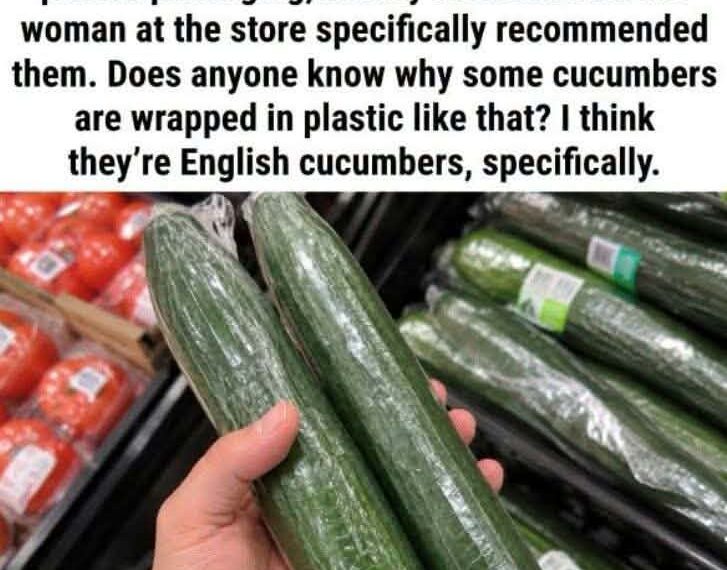
English cucumbers have delicate skin and can lose moisture relatively quickly. Their thin plastic wrapping helps preserve their firmness and appearance, protects them during handling, and may reduce food waste.
At the same time, concerns about plastic pollution are valid. The best approach is not necessarily to avoid all packaging, but to understand when it serves a useful purpose and to avoid wasting either food or packaging.
If you bought the wrapped cucumbers, there is no need to feel guilty. Keep the wrapping on until you are ready to use them, handle them hygienically, and try to eat them before they deteriorate.
And if you prefer unwrapped produce, you can still make a sensible choice by buying only what you need and storing it appropriately.
Sometimes, the most sustainable choice is the one that keeps good food from being thrown away—while using as little packaging as reasonably possible.