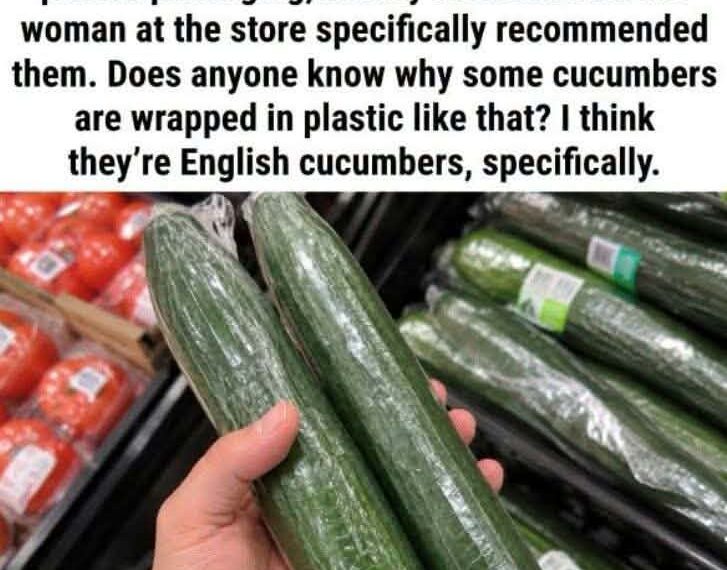


“I asked my husband to buy some cucumbers, and he bought the ones wrapped in plastic. I’ve always avoided buying those because of the plastic packaging, but the woman at the store specifically recommended them. Does anyone know why some cucumbers are wrapped in plastic like that? I think they’re English cucumbers, specifically.”
If you’ve ever stood in the produce aisle wondering why one cucumber is sold loose while another is tightly wrapped in a layer of clear plastic, you’re not alone.
At first glance, individually wrapped cucumbers may seem unnecessarily packaged. After all, cucumbers are fresh vegetables, and many shoppers would prefer to avoid single-use plastic whenever possible.
However, there is a practical reason why long English cucumbers are frequently sold this way. Their thin, delicate skin makes them more vulnerable to moisture loss, dehydration, and physical damage. Plastic wrapping helps preserve their firmness and freshness during transportation, in supermarkets, and at home.
The explanation is more interesting than it might seem because it involves not only food preservation, but also food waste, transportation, storage, and the environmental impact of packaging.
Let’s explore why English cucumbers are wrapped, whether the packaging is necessary, how it affects their shelf life, and what you can do if you want to reduce plastic waste without throwing away more food.
1. What makes English cucumbers different?


English cucumbers, sometimes called European or greenhouse cucumbers, are usually long, slender, and dark green. They are often sold individually rather than in bags.
Compared with many traditional slicing cucumbers, they typically have thinner skin, smaller seeds, and a mild flavor. Their delicate skin makes them appealing for sandwiches, salads, and recipes where peeling is unnecessary.
But that same characteristic creates a storage challenge.
Cucumbers contain a great deal of water. When exposed to dry air, they gradually lose moisture through their skin. As moisture loss increases, they may become softer, wrinkled, and less appealing to eat.
Traditional cucumbers with thicker skins may offer more natural protection against handling and moisture loss. English cucumbers are more vulnerable, so producers and retailers often use protective packaging to help maintain their quality.
This is one reason the woman at the store may have recommended the wrapped variety: the packaging is designed to help the cucumber remain fresh for longer.
2. The main reason cucumbers are wrapped in plastic


The primary purpose of the wrapping is to slow moisture loss and protect the cucumber from damage.
Here is how it helps.
It keeps the cucumber from drying out
A cucumber’s crisp texture depends on its water content. When moisture escapes from the skin, the vegetable gradually loses firmness.
A thin plastic film acts as a barrier that slows this process. This can help the cucumber stay firm and crisp rather than becoming limp after several days.
It helps preserve the appearance
Fresh cucumbers are expected to have a firm texture and an attractive green color. Dehydration, bruising, and surface damage can make them less appealing to shoppers.
The wrapping offers an additional layer of protection during packing, shipping, and handling.
It can extend shelf life
Research published in Frontiers in Sustainable Food Systems examined plastic wrapping in a cucumber supply chain from Spain to Switzerland. The researchers found that wrapping reduced cucumber losses at retail in their specific case study. The study also explained that wrapped cucumbers can have a substantially longer shelf life than unwrapped ones, depending on storage conditions and the supply chain.
This does not mean every wrapped cucumber will last a particular number of days. Freshness depends on the cucumber’s condition when purchased, its storage temperature, and how it is handled.
3. Does plastic wrapping really prevent food waste?


This is where the subject becomes particularly interesting.
Many people understandably want supermarkets to eliminate unnecessary plastic packaging. Plastic pollution is a serious environmental concern, and disposable packaging creates waste that must be managed.
However, removing packaging can also have consequences if more food spoils before it is eaten.
A 2022 study in Frontiers in Sustainable Food Systems evaluated the environmental trade-off between plastic wrapping and cucumber waste in a specific imported-cucumber supply chain.
The researchers estimated that plastic wrapping had a relatively small environmental impact compared with the cucumber’s overall production and distribution. In their case study, the reduction in food waste was large enough to outweigh the environmental impact of the wrapping.
Why does that matter?
Growing cucumbers requires land, water, energy, and agricultural inputs. Transporting and refrigerating them also consumes resources. If a cucumber spoils and is thrown away, much of that environmental investment is wasted.
A small amount of packaging may therefore help prevent a larger loss of resources.
However, the study focused on a particular supply chain. It does not prove that plastic wrapping is always the best environmental choice everywhere. Locally grown cucumbers that travel shorter distances may have different packaging needs.
The important lesson is that reducing plastic and reducing food waste should be considered together.
4. Are wrapped cucumbers safer to eat?
TO CONTINUE READING THE ARTICLE PPLEASE SEE PAGE 2