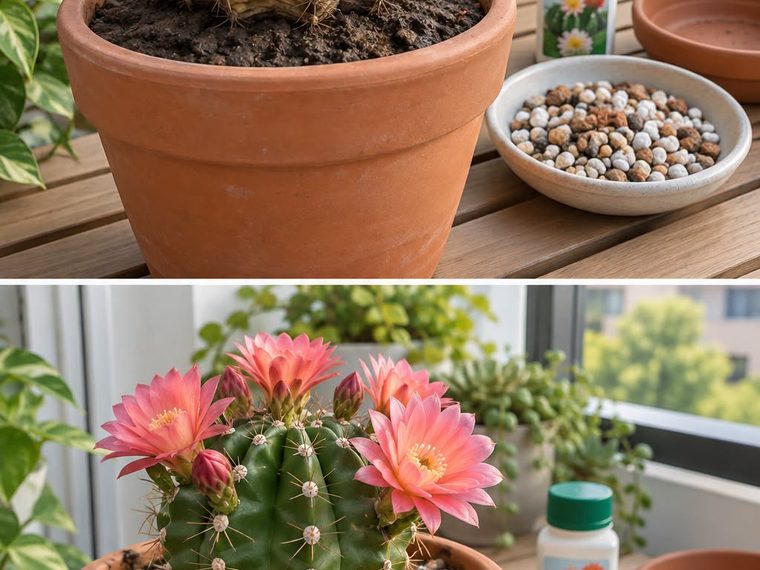
What should good cactus soil contain?
A suitable cactus mix often combines:
- Pumice: Improves drainage and creates air spaces.
- Perlite: Helps keep the growing medium light.
- Lava rock: Adds structure and improves drainage.
- Coarse horticultural sand: Adds mineral material and reduces excessive water retention.
- A smaller amount of organic potting material: Provides some nutrients and moisture retention.
A practical starting recipe for many desert cacti is:
- 1 part quality potting mix.
- 1 part pumice or perlite.
- 1 part coarse mineral material, such as suitable horticultural grit.
Adjust the mixture according to your environment. In humid conditions, a more mineral-heavy mix may be useful. In a very hot, dry environment, a little more organic material may help prevent the soil from drying excessively quickly.
Avoid fine construction sand, heavy garden soil, and mixtures that become compacted.
Why drainage matters so much
Cactus roots need oxygen as well as water. When soil remains saturated, oxygen becomes limited and the roots may begin to deteriorate.
A fast-draining mixture helps water move through the pot rather than remaining around the roots for long periods.
4. Terracotta or Plastic Pots: Which Is Better?
The type of pot you choose can make a surprising difference to cactus health.
The two most common options are terracotta and plastic.
Terracotta pots
Terracotta is made from porous clay, allowing moisture to evaporate through the sides.
Advantages include:
- Helps the soil dry more quickly.
- Reduces the risk of prolonged moisture retention.
- Provides stability for heavier plants.
- Looks attractive with desert-style plants.
This makes terracotta a particularly good choice for beginners and for people who tend to water too frequently.
Its main disadvantage is that the soil may dry too quickly in very hot or dry conditions.
Plastic pots
Plastic pots retain moisture for longer because their walls are not porous.
Advantages include:
- Lightweight and inexpensive.
- Easy to clean.
- Available in many sizes.
- Useful in very hot, dry environments where soil dries rapidly.
However, they require more careful watering because moisture can remain in the soil longer.
Which pot should you choose?
| Pot type | Main advantage | Main disadvantage |
|---|---|---|
| Terracotta | Dries soil more quickly | May dry out too fast |
| Plastic | Retains moisture longer | Greater risk of overwatering |
| Ceramic with drainage | Attractive and stable | Can be heavy |
| Ceramic without drainage | Decorative appearance | Difficult to manage safely |
The most important rule: Whatever material you choose, make sure the pot has drainage holes.
A decorative pot without drainage can trap water around the roots. If you love its appearance, use it as an outer cover and keep the cactus in a smaller pot with drainage inside.
5. Fertilizing: Give Your Cactus Nutrients Without Overdoing It
Cacti grow slowly, so they do not require large amounts of fertilizer.
However, they still need nutrients to support healthy roots, new growth, and flowering.
A suitable cactus or succulent fertilizer is usually a good choice. Look for a balanced product or one with relatively low nitrogen compared with phosphorus and potassium.
When should you fertilize?
For many desert cacti, the best time is during the active growing season, usually spring and summer.
A simple routine is:
- Wait until the plant shows signs of active growth.
- Choose a fertilizer specifically suitable for cacti and succulents.
- Follow the manufacturer’s dilution instructions.
- Apply it to moist soil rather than completely dry roots.
- Stop or reduce feeding when growth slows during the colder months.
You generally do not need to fertilize a cactus every time you water it.
Why too much fertilizer can be harmful
Excess fertilizer can cause salt buildup in the soil and damage roots.
Too much nitrogen may also encourage soft, excessive growth that is less suitable for the plant’s natural form.
Avoid fertilizing a cactus that is:
- Sick or suffering from root rot.
- Recently repotted and still recovering.
- Dormant.
- Severely dehydrated.
Fertilizer cannot compensate for poor light, incorrect watering, or damaged roots.
6. Sunlight: Give Your Cactus Enough Light, but Introduce It Gradually
Sunlight is essential for most desert cacti.
When a cactus does not receive enough light, it may become pale, weak, or stretched. This condition is called etiolation.
Instead of maintaining its natural compact shape, the plant grows unusually thin as it stretches toward the light.
Where should you place your cactus?
Good locations often include:
- A bright south- or west-facing window, depending on your hemisphere and local conditions.
- A sunny balcony with appropriate protection from extreme heat.
- A bright indoor area with several hours of suitable light.
However, a cactus that has spent months indoors should not suddenly be placed in intense direct sunlight.
Its skin may burn, leaving permanent pale, yellow, or brown patches.
Introduce stronger sunlight gradually over one or two weeks, increasing exposure as the plant adjusts.
Also rotate the pot occasionally to encourage more even growth.
Can a cactus survive in a room without direct sunlight?
Some varieties tolerate bright indirect light, but most desert cacti need substantial light to maintain healthy growth.
If natural light is insufficient, a suitable grow light can help.
7. How to Encourage Your Cactus to Flower
One of the most exciting moments in cactus care is seeing the first flower appear.
Some cacti produce large, colorful flowers that last only a short time, while others bloom repeatedly under suitable conditions.
But flowering is not simply a matter of adding more fertilizer or watering more frequently.
A cactus generally needs to reach the appropriate stage of maturity and receive the correct combination of light, temperature, and seasonal care.
Five ways to encourage flowering
1. Provide sufficient light
Many flowering desert cacti need strong light to grow properly and develop flower buds.
A bright location is often essential, although the exact requirements depend on the species.
2. Respect the winter resting period
Many desert cacti benefit from a cooler, relatively dry rest period during winter.
During this time, growth slows down and watering should usually be reduced substantially.
Some species use this seasonal change as an important part of their flowering cycle.
3. Avoid excessive watering
Constantly wet soil can weaken the roots and prevent healthy growth.
Water according to the plant’s actual needs rather than trying to force it to grow faster.
4. Fertilize moderately during active growth
A suitable cactus fertilizer can support healthy development, but too much fertilizer will not guarantee flowers.
5. Be patient
Some cacti need several years to reach flowering maturity.
A young plant may be perfectly healthy even if it does not produce flowers immediately.
Why does a cactus produce flower buds but fail to open them?
Possible reasons include:
- Sudden changes in temperature.
- Insufficient light.
- Stress caused by moving the plant.
- Inconsistent watering.
- Damage to developing buds.
- Normal differences between species.
Try to maintain stable conditions once buds appear.
8. Repotting: When and How to Move Your Cactus
Cacti do not need frequent repotting. In fact, many varieties are happy to remain in the same container for several years.
However, repotting becomes necessary when:
- Roots emerge through the drainage holes.
- The plant becomes too large or unstable for its container.
- The soil has become compacted.
- Water no longer drains properly.
- The plant shows signs of root problems.
- The pot has become damaged.
Step-by-step repotting guide
- Choose a new pot only slightly larger than the previous one.
- Make sure it has drainage holes.
- Prepare a fresh, fast-draining cactus mix.
- Wear thick gardening gloves or use folded newspaper or cactus tongs to handle the plant safely.
- Carefully remove the cactus from its old container.
- Inspect the roots and remove dead or rotting material with a clean tool.
- Place the plant in the new pot at approximately its original depth.
- Fill around the roots with the prepared growing medium.
- Avoid compacting the soil too firmly.
- Wait several days before watering, especially if roots were disturbed or damaged.
The waiting period allows minor root injuries to dry and reduces the risk of infection.
Do not bury the green body of the cactus deeper than it was previously planted.
9. Common Cactus Problems and How to Fix Them
Even though cacti are generally resilient, they can develop problems when their environment is unsuitable.
Here are some common warning signs.
| Problem | Possible cause | What to do |
|---|---|---|
| Yellowing stem | Overwatering, poor roots or light stress | Check soil moisture and roots |
| Soft or mushy base | Root or stem rot | Remove affected tissue if possible and correct watering |
| Thin, stretched growth | Insufficient light | Gradually increase light exposure |
| Brown sunken patches | Sunburn or injury | Protect from sudden intense sunlight |
| No flowers | Immaturity or unsuitable seasonal conditions | Improve light and follow species-specific care |
| Roots growing out of drainage holes | Pot may be too small | Check the root system and repot if necessary |
| White cotton-like patches | Possible mealybugs | Isolate the plant and treat the infestation |
Watch out for mealybugs
Mealybugs are small pests that often look like white cotton around the cactus or its roots.
They feed on plant sap and can weaken the plant.
Inspect the cactus regularly, especially around the base and between its ribs.
If you notice an infestation:
- Isolate the affected plant.
- Remove visible insects carefully.
- Use an appropriate treatment labeled for mealybugs and safe for your plant.
- Check nearby plants for signs of infestation.
Avoid applying harsh products in strong sunlight, and always follow the product instructions.
10. Little-Known Tips That Can Make a Big Difference
Sometimes, the smallest changes in your care routine can have the greatest impact.
Here are some useful tips that many beginners overlook.
Tip 1: Never water just because the surface looks dry
The top layer of soil can dry while the deeper soil remains wet.
Check below the surface before adding more water.
Tip 2: Do not use decorative stones to hide watering problems
A layer of stones can look attractive, but it may make it harder to inspect the soil and can sometimes slow evaporation from the surface.
Keep the growing medium airy and monitor moisture carefully.
Tip 3: Use rainwater when practical
Rainwater can be a useful alternative to tap water, especially where tap water is very hard.
Clean, room-temperature water is generally suitable for most common cacti.
Tip 4: Do not choose an enormous pot
A very large container holds more soil and may stay wet longer than a smaller one.
Choose a pot that comfortably accommodates the roots without leaving excessive unused space.
Tip 5: Keep the cactus away from cold, wet conditions
Many desert cacti tolerate cooler winter temperatures when kept dry, but cold and wet soil can be particularly damaging.
Protect sensitive varieties from frost.
Tip 6: Avoid constantly moving the plant
Cacti benefit from stable growing conditions.
Once you find a location with suitable light and temperature, try to keep the plant there, especially when flower buds begin developing.
Tip 7: Check the cactus after watering
A few minutes after watering, make sure excess water has drained away.
Never leave the pot sitting in a full saucer.
11. A Simple Seasonal Cactus Care Calendar
Different species have different growth cycles, but this general calendar can help with many common desert cacti.
| Season | Recommended care |
|---|---|
| Spring | Increase watering as growth resumes; begin light fertilizing |
| Summer | Provide suitable sunlight; water when the soil is completely dry |
| Autumn | Gradually reduce watering as growth slows |
| Winter | Keep many desert varieties cooler and drier; avoid unnecessary fertilizer |
Remember that this schedule is not suitable for every cactus. Tropical forest cacti, for example, may need a different watering and temperature routine.
Frequently Asked Questions About Cactus Care
1. How long can a cactus survive without water?
Some mature desert cacti can survive for months without watering because they store moisture in their tissues. However, the exact period depends on the species, temperature, pot, and growing conditions. Survival without water should not be treated as an ideal care routine.
2. Should I water my cactus in winter?
Many desert cacti need very little water during winter dormancy. However, the plant should not automatically be left completely dry for a fixed number of months. Check the species and growing conditions.
3. Can I use ordinary potting soil for a cactus?
It is usually better to use a dedicated cactus mix or improve ordinary potting soil with suitable mineral materials to increase drainage and airflow.
4. Why is my cactus growing but not flowering?
It may still be too young, may not receive enough light, or may not experience the seasonal conditions required by its species.
5. Should I remove dead cactus flowers?
Yes, you can carefully remove dried flowers once they have finished blooming. Use clean tools and avoid damaging the plant.
6. Do cacti need fertilizer every month?
No. Many desert cacti need only occasional feeding during active growth. Follow the fertilizer label and avoid feeding dormant or unhealthy plants.
7. Can I grow a cactus in a bathroom?
It depends on the bathroom. Many desert cacti struggle in rooms with low light and high humidity. A bright, well-ventilated location is usually better.
8. Why is my cactus turning brown?
Brown areas can result from sunburn, physical damage, pests, disease, or rot. Check whether the affected area is dry and firm or soft and mushy before deciding how to treat it.
Final Thoughts: The Secret to a Healthy, Flowering Cactus
Caring for a cactus is not about giving it constant attention. It is about understanding what it needs and avoiding the mistakes that interfere with its natural growth.
The most important principles are simple:
- Choose a well-draining soil mixture.
- Use a pot with drainage holes.
- Water thoroughly but only when the growing medium has dried sufficiently.
- Provide enough light and introduce direct sunlight gradually.
- Fertilize moderately during active growth.
- Respect the seasonal resting period of desert varieties.
- Give the plant time to mature before expecting flowers.
A cactus does not need complicated treatments or expensive products to thrive. With suitable conditions and a little patience, it can remain healthy for years and eventually produce beautiful flowers that transform an ordinary windowsill or balcony into something special.
The biggest secret of cactus care? Sometimes, the best thing you can do for your cactus is simply to stop watering it too often!