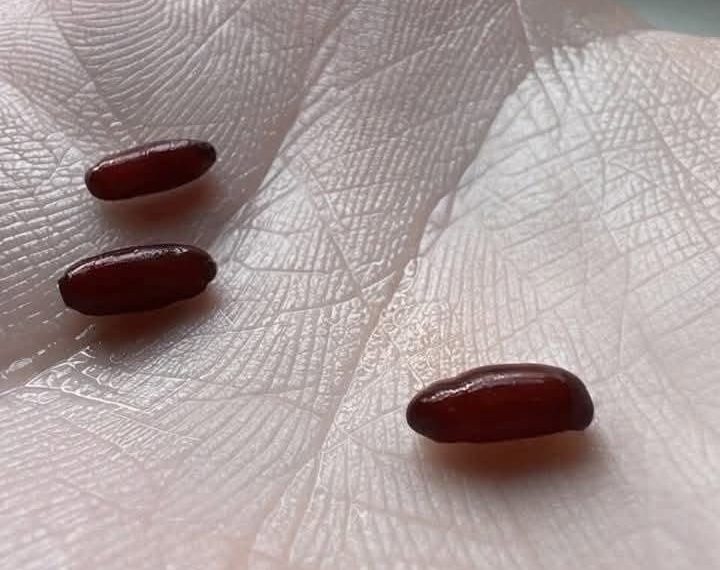
For example, pieces of:
- beans;
- seeds;
- dried fruit;
- spices;
- grains;
- plant material;
- pet food
can sometimes resemble insect bodies or eggs.
If the objects are hard and dry, gently crushing one with a disposable tool rather than your fingers may reveal whether it has the structure of a seed, food fragment, or insect-related material.
Do not deliberately crush an unknown object if you suspect it could be contaminated with animal waste or another biological material.
What About Bed Bugs?
If your real concern is whether you have bed bugs, don’t rely on these objects alone.
Instead, inspect the bed carefully.
1. Check the mattress seams
Remove the sheets and examine the seams and piping around the mattress.
Use a flashlight and look carefully for:
- tiny insects;
- pale eggs;
- shed skins;
- dark spots;
- reddish stains.
Pay particular attention to folds and protected areas.
2. Examine the bed frame
Bed bugs don’t necessarily remain on the mattress.
They can hide in:
- cracks in the bed frame;
- screw holes;
- joints;
- headboards;
- gaps between furniture;
- areas close to the bed.
A flashlight can make small insects and evidence easier to see.
3. Check nearby furniture
If the bed is next to a nightstand, dresser, or upholstered chair, inspect the areas closest to the bed.
Look underneath and around:
- drawers;
- joints;
- cracks;
- upholstery;
- wall gaps.
What Do Bed Bug Droppings Look Like?
Bed bug fecal material is often described as small dark or rusty spots.
Because bed bugs feed on blood, their droppings can contain digested blood.
On light-colored fabric, these spots can be particularly noticeable.
One important distinction is that fecal material generally appears as spots or stains, not as smooth, solid capsules like the objects shown in the photograph.
Don’t Panic After Finding One Strange Object
One of the biggest mistakes people make is seeing something unusual on their bedding and immediately assuming they have an infestation.
A single unexplained object is not enough to diagnose a pest problem.
For example, you might find:
Something brown → assume bed bug → search the internet → become convinced there are hundreds of bed bugs.
But the original object may not have been a bed bug-related object at all.
This is why identifying the surrounding evidence is much more useful than identifying one isolated item.
Look for a Pattern
If you repeatedly find the same objects, document them.
Take a photograph next to something that provides scale, such as:
- a ruler;
- a coin;
- a millimeter scale;
- the tip of a pencil.
Also record:
- where you found them;
- how many there were;
- whether they appeared overnight;
- whether they were attached to fabric;
- whether they were hard or soft;
- whether they crushed easily;
- whether you found similar objects elsewhere.
These details can make identification much easier.
Could They Be Insect Eggs?
Not every small object found in a bedroom is an insect egg.
Actual insect eggs vary enormously in appearance.
Depending on the species, they can be:
- white;
- yellow;
- green;
- brown;
- black;
- transparent;
- spherical;
- oval;
- elongated.
Some are laid individually, while others are deposited in clusters.
This means color and shape alone aren’t enough to identify an egg.
The location is also important.
For example, an insect that normally lays eggs on plants is unlikely to suddenly leave large numbers of eggs on a bed without some other explanation.
What Should You Do Right Now?
If you discover objects like these on your bed, don’t immediately throw everything away.
Instead, follow a simple inspection process.
Step 1: Photograph them
Take several close-up photographs.
Include one photograph showing their size relative to a coin or ruler.
Step 2: Remove the bedding
Wash your sheets and pillowcases according to their care instructions.
Step 3: Inspect the mattress
Concentrate on seams, folds, corners, and underneath the mattress.
Step 4: Inspect the bed frame
Check cracks, joints, screw holes, and the headboard.
Step 5: Vacuum the surrounding area
Vacuum around the bed, especially along edges and cracks.
Empty the vacuum according to the manufacturer’s instructions.
Step 6: Look for additional evidence
The most important question is:
Are there other signs of insects?
If there are no insects, eggs, shed skins, characteristic stains, or other evidence, a single mysterious object is much less informative.
Don’t Spray Random Insecticide on Your Bed
If you’re worried about bed bugs, it can be tempting to immediately spray insecticide everywhere.
That isn’t necessarily a good idea.
Using pesticides incorrectly can create health risks and may not solve the underlying problem.
Never apply a pesticide to bedding, mattresses, clothing, or other surfaces unless the product label specifically permits that use.
If you actually find bed bugs or another pest infestation, identification should come first.
When Should You Contact a Pest Professional?
Professional identification can be worthwhile if:
- you repeatedly find suspicious objects;
- you find live insects;
- you see multiple signs of bed bugs;
- you discover an increasing number of unexplained specimens;
- you notice bites together with other evidence of insects;
- the objects appear in several rooms.
A pest-control professional can inspect areas that are difficult to examine yourself and identify the species involved.
The Most Important Clue Is What Happens Next
If you find three strange objects once and never see anything similar again, they may have been completely unrelated to an infestation.
But if you keep discovering similar objects every few days, that’s different.
Repeated discoveries suggest that there may be a source nearby.
For that reason, monitoring is often more useful than guessing from one photograph.
A Simple Bed Inspection Checklist
If you are worried about bed bugs or other pests, use this checklist:
☐ Check mattress seams
☐ Check underneath the mattress
☐ Inspect the headboard
☐ Examine the bed frame
☐ Check nearby furniture
☐ Look for dark spots
☐ Look for shed insect skins
☐ Look for pale eggs
☐ Look for live insects
☐ Photograph anything suspicious
☐ Monitor the area for several days
So, What Is It?
Based on the photograph alone, I would not confidently identify these objects as bed bug eggs.
Their dark reddish-brown, smooth, capsule-like appearance is not typical of ordinary bed bug eggs, which are generally much smaller and pale.
Other possibilities include plant material, seeds, food fragments, insect pupae, or another small household object. Determining the exact identity would require additional information such as their precise size, texture, location, and whether similar objects are found elsewhere.
If these were genuinely found on your bed, the best approach is not to panic but to inspect the mattress and surrounding area for additional evidence.
Final Takeaway
Finding something strange on your bed can definitely be creepy, especially when you have no idea where it came from.
But the objects in the photograph do not provide enough evidence to conclude that you have bed bugs or another infestation.
The most useful next step is to look for a pattern:
One unexplained object = investigate.
Repeated objects plus insects or other evidence = investigate further.
Confirmed insects or an expanding infestation = consider professional identification.
And remember: a mysterious object on your bed doesn’t automatically mean your bed is infested. Sometimes the explanation is much more ordinary than it first appears.