7. Pay Attention to the Shape
Different avocado varieties naturally have different shapes, so there isn’t one perfect shape for every avocado.
Generally, look for fruit that appears well-developed and evenly shaped for its variety.
Avoid avocados with extremely deep dents, collapsed sections or unusual deformities caused by damage.
A slightly irregular avocado isn’t necessarily bad. The inside can still be excellent.
8. Decide When You Want to Eat It
This is perhaps the most important shopping trick.
Don’t necessarily buy the ripest avocado available if you don’t plan to eat it immediately.
If you’re eating it today
Choose an avocado that yields gently when pressed.
It should feel ripe but not mushy.
If you’re eating it in two or three days
Choose one that is still relatively firm but shows signs that it is beginning to ripen.
If you’re planning meals for later in the week
Select firmer avocados and allow them to ripen at home.
This simple strategy can prevent the frustrating situation where every avocado in your kitchen becomes ripe at the same time.
9. What About the Brown Areas Inside?
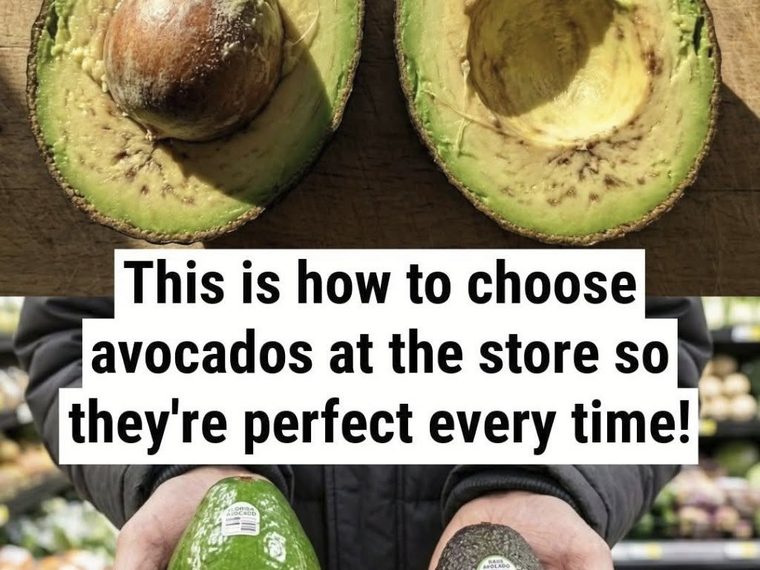
The image shows an avocado with areas of discoloration around the flesh.
Brown or grayish areas can develop for several reasons, including oxidation, bruising, overripening or tissue damage.
A small amount of discoloration doesn’t necessarily mean the entire avocado needs to be discarded. If the surrounding flesh is normal in appearance, smell and texture, some people simply remove the affected portion.
However, if the avocado has:
- A strong unpleasant odor
- Extensive dark discoloration
- Slimy or unusually mushy flesh
- Visible mold
- Fermented or rotten characteristics
it is better not to eat it.
When in doubt about an avocado that appears spoiled, discard it.
10. Don’t Be Afraid of Slightly Bumpy Skin
For Hass avocados, rough skin is completely normal.
In fact, the characteristic pebbly texture is one of the features of the variety.
A rough exterior doesn’t automatically mean that the avocado is old or poor quality.
What matters more is whether the skin has serious damage, whether the fruit has appropriate firmness and whether there are signs of decay.
11. Buy a Combination of Ripeness Levels
If your household eats avocados regularly, one of the best strategies is to buy several at different stages of ripeness.
For example, you might choose:
- One avocado that is ready to eat today
- Two that are slightly firm
- One or two that are quite firm
This gives you a longer window for enjoying ripe avocados instead of having several become overripe simultaneously.
12. How to Ripen an Avocado at Home
If you purchase a firm avocado, leave it at room temperature.
Ripening generally happens naturally over time.
Once it reaches the desired ripeness, refrigeration can slow further softening and help extend its useful eating window.
If an avocado is already ripe, moving it to the refrigerator can be helpful when you don’t plan to eat it immediately.
Avoid cutting an unripe avocado simply because you are impatient. Once cut, the exposed flesh begins to oxidize, and the fruit will not behave like an intact avocado ripening naturally.
13. How to Store a Cut Avocado
Once an avocado has been cut, its exposed flesh reacts with oxygen, causing browning.
To slow this process:
- Keep the unused portion refrigerated.
- Minimize the amount of exposed flesh.
- Store it in a tightly sealed container.
- A little lemon or lime juice on the exposed surface can also help slow browning.
The browning process is largely an oxidation reaction and doesn’t automatically mean that the avocado has become unsafe to eat.
Texture, smell and overall condition are more important indicators.
14. Why Ripe Avocados Are So Popular
Avocados are valued for their creamy texture and versatility.
They can be used in:
- Guacamole
- Salads
- Sandwiches
- Wraps
- Toast
- Smoothies
- Dips
- Sauces
- Breakfast dishes
They also provide fiber and unsaturated fats, making them a popular ingredient in many balanced diets.
Their mild flavor allows them to work in both savory and creative recipes.
15. The Simple Supermarket Checklist
Before placing an avocado in your shopping cart, take a few seconds to check it.
Look:
Is the skin relatively intact and free from serious damage?
Feel:
Does it have the appropriate firmness for when you plan to eat it?
Lift:
Does it feel reasonably heavy for its size?
Inspect:
Are there deep bruises, soft collapsed areas or signs of mold?
Consider the variety:
Is it a Hass or another type that naturally remains green?
Plan:
Do you need one ready today or several that will ripen over the next few days?
Using all of these clues together is much more reliable than simply choosing the darkest avocado in the display.
Final Thoughts
Finding a perfect avocado doesn’t have to be a matter of luck. The key is to combine several simple observations rather than relying on one characteristic.
Look for an avocado that is appropriate for your intended eating date, gently check its firmness, examine the skin for serious damage and compare its weight with other fruit of similar size. For Hass avocados, darker skin can indicate ripeness, but color should always be considered alongside firmness and overall condition.
And remember: the “perfect” avocado is not necessarily the softest or darkest one in the store. It’s the one that reaches the right stage of ripeness at the right time for you.
With a little practice, selecting avocados becomes much easier—and you can dramatically reduce the disappointment of cutting one open only to discover that it is either rock-hard or past its prime.