Have you ever noticed someone leaving tangerine or orange peels on a windowsill instead of throwing them into the rubbish bin? At first glance, it might seem like a strange habit, especially when the peels remain there for several days. But this simple practice has a few interesting explanations rooted in traditional household wisdom.
My husband’s grandmother has always done this after eating tangerines. She carefully places the leftover peels near the windows, sometimes leaving them there for days. When someone asks why she doesn’t throw them away, she simply explains that they serve a purpose.
And surprisingly, there is some science behind the idea!
Citrus peels contain aromatic compounds, including a natural substance called limonene, which gives tangerines their characteristic fresh, citrusy smell. These compounds are used in various cleaning products, fragrances and even certain commercial insect-control products.
But can ordinary tangerine peels really freshen a room, discourage insects or improve the home environment? Let’s explore the possible benefits, the science behind them and how to use citrus peels safely.
1. They Release a Fresh, Pleasant Citrus Fragrance
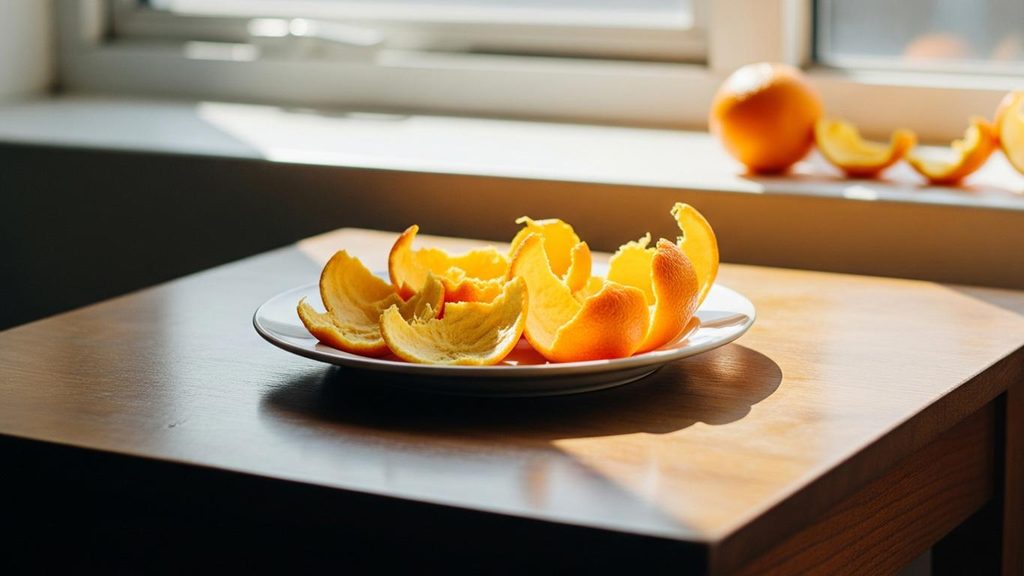
One of the simplest reasons people leave tangerine peels on windowsills is their pleasant fragrance.
The outer layer of a tangerine contains tiny oil glands filled with aromatic compounds. When the peel is broken, squeezed or slightly crushed, these glands release essential oils into the air.
One of the main components is limonene, a naturally occurring compound responsible for much of the familiar citrus aroma.
As the peels sit near a window, they gradually release some of their fragrance. Air circulation can help distribute that smell throughout the nearby area.
This makes fresh citrus peels a simple, inexpensive way to introduce a pleasant scent into a room.
However, there is an important distinction: tangerine peels are not a scientifically proven air purifier. They can provide fragrance, but they do not reliably remove harmful particles, allergens or pollutants from indoor air.
2. Could Tangerine Peels Help Keep Insects Away?
Orange peel texture Images – Free Download on Magnific (formerly Freepik)
This is perhaps the most interesting explanation behind the traditional windowsill trick.
Citrus peels contain essential oils that have been studied for their potential insect-repelling and insecticidal properties.
Limonene, in particular, is used in certain commercial products designed to control insects such as ants, fleas and other household pests.
The strong citrus smell may also influence how certain insects respond to their surroundings.
This is why some people traditionally place orange or tangerine peels near:
- Windows and window frames.
- Doorways and entrances.
- Kitchen corners.
- Areas where ants have previously appeared.
- Places where small insects are occasionally noticed.
But does this really work?
There is an important scientific distinction between concentrated citrus oil and an ordinary piece of fruit peel.
According to an agricultural entomologist from the University of Georgia Cooperative Extension, discarded citrus peels generally do not release enough concentrated oil to provide reliable insect control. Their fragrance also fades as the volatile compounds evaporate. UGA Today+1
Therefore, tangerine peels may have some aromatic properties, but they should not replace proven pest-control methods.
3. They Can Be Used to Make Natural Household Cleaners

Another reason not to throw away citrus peels is that they can be reused to prepare simple homemade cleaning products.
Tangerine, orange and lemon peels contain aromatic oils that can contribute to the fragrance of homemade cleaners.
One popular method involves combining citrus peels with white vinegar.
How to prepare a citrus-infused cleaning solution:
- Collect fresh tangerine or orange peels.
- Place them inside a clean glass jar.
- Cover the peels completely with white vinegar.
- Close the jar and leave it in a cool place for approximately one to two weeks.
- Strain the liquid and transfer it into a clean spray bottle.
- Dilute with water if necessary, depending on the intended surface and product concentration.
The result is a fragrant, citrus-infused vinegar solution that can be useful for certain household cleaning tasks.
Important precautions:
- Never mix vinegar with bleach because this can release dangerous chlorine gas.
- Avoid using acidic vinegar cleaners on marble, natural stone, limestone or other acid-sensitive surfaces.
- Test the solution on a small, inconspicuous area first.
- Do not assume that a homemade citrus cleaner is a registered disinfectant.
4. Tangerine Peels Can Help Reduce Household Waste
TO CONTINUE READING THE ARTICLE PLEASE SEE PAGE 2