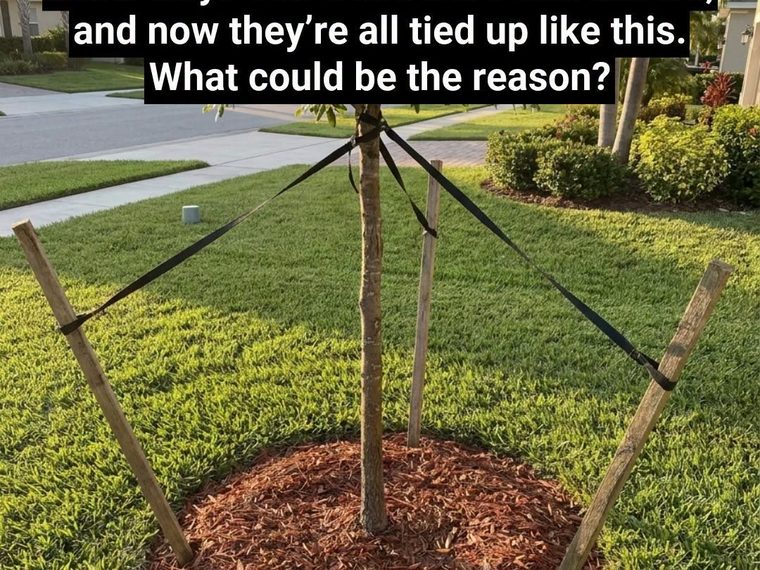
Imagine walking through your neighborhood and discovering that someone has tied nearly every young tree to wooden stakes. The trees were standing normally before, but now they are surrounded by wooden supports and secured with thick straps.
At first glance, this may look unnecessary. Why would healthy trees suddenly need extra support? Were they damaged by strong winds? Is someone trying to protect them from falling, or is there a special reason for tying them up this way?
The practice is known as tree staking, and it is a common technique used in landscaping, urban forestry, and the establishment of newly planted trees.
Although the arrangement in the photograph may look unusual, there are several possible explanations. The most likely is that the trees were recently planted or identified as needing temporary support. However, staking is not always necessary, and doing it incorrectly can actually harm a tree.
Let’s explore why trees are staked, how the system works, and when those supports should be removed.
1. The Main Reason: Helping Newly Planted Trees Establish Their Roots

One of the most common reasons for staking a tree is to help it remain stable after transplantation.
When a tree is moved from a nursery to a garden, street, or landscaped property, much of its root system may be left behind or disturbed. Even when the tree looks healthy above ground, its roots may not yet be firmly established in the surrounding soil.
Wind can move the trunk and root ball back and forth. If the movement is excessive, it may interfere with the development of new roots and cause the tree to lean.
Stakes provide temporary support while the roots begin to anchor the tree in its new location.
This can be particularly useful when:
- The tree has a relatively small or unstable root ball.
- The planting site is exposed to strong winds.
- The tree has a tall trunk or a heavy crown.
- The soil is loose or the planting area has recently been disturbed.
- The tree cannot remain upright without assistance.
However, not every newly planted tree needs stakes. A tree with a stable root ball may establish itself more successfully without rigid support, because natural movement helps the trunk develop strength.
The decision should depend on the tree’s stability, its root system, and the conditions at the planting site.
2. Why Are There Three Stakes Instead of One?

In the photograph, the tree is supported by three wooden stakes positioned around the trunk. The black straps connect the trunk to the stakes, forming a triangular support system.
This arrangement can help stabilize the tree from different directions.
Each stake provides an anchor point, while the straps help prevent excessive movement when the wind blows. Using several anchor points can be useful for taller trees or trees planted in exposed locations.
However, three stakes are not always better than two. The appropriate arrangement depends on the size of the tree, the stability of its root ball, the soil conditions, and the wind exposure.
According to university extension guidance, most ordinary newly planted trees do not require staking at all. When support is necessary, the goal is to stabilize the root ball while allowing some natural movement of the trunk.
3. Could Strong Winds or Recent Storms Be the Reason?

Another possible explanation is that the trees are located in an area exposed to strong winds.
Wind puts pressure on the trunk, branches, and canopy. When a tree has not yet developed a strong root system, this pressure can cause the root ball to shift or the tree to lean.
The risk can be greater in open residential areas, along roads, in newly developed neighborhoods, and in places where buildings or landscaping leave young trees exposed to gusts.
If several trees were planted around the same time, the landscaping contractor may have installed supports on all of them as part of a planting or maintenance project.
Nevertheless, the photograph alone cannot tell us whether a storm occurred or whether the trees were damaged. The supports could simply have been installed as a precaution after planting.
4. Why Are the Straps So Tight? Can They Hurt the Trees?

This is an important detail in the photograph.
The straps appear to hold the trunk in position between the stakes. Properly installed tree ties should provide support without completely preventing the trunk from moving.
Young trees benefit from some movement in the wind. This movement encourages the development of a stronger trunk and helps the root system establish itself.
If the straps are too tight, several problems can occur:
- Bark damage: Constant friction can injure the tree’s outer tissues.
- Restricted growth: As the trunk expands, a tight strap may begin to constrict it.
- Weak trunk development: Excessive restraint can interfere with the tree’s natural response to wind.
- Long-term damage: If ties are forgotten and left in place, they can become embedded in the growing trunk.
The University of Maryland Extension advises that supports should allow some movement and generally be removed after about one year.
Therefore, the goal is not to immobilize the tree completely. It is to give the roots enough stability to establish themselves while allowing the trunk to develop naturally.
5. Why Would Workers Tie Up Every Tree Without Asking Permission?
TO CONTINUE READING THE ARTICLE PLEASE SEE PAGE 2