5. Why Would Workers Tie Up Every Tree Without Asking Permission?

The caption in the original photograph raises another question: why would people in uniforms come onto a property and install supports without the owner’s permission?
There are several possible explanations, but none can be confirmed from the image alone.
A municipal landscaping project: If the trees are planted along a public sidewalk or within a public right-of-way, municipal workers or contractors may be responsible for maintaining them.
A property management agreement: In a planned community, a homeowners’ association or property management company may arrange tree maintenance on shared landscaping.
A landscaping contractor’s work: A contractor may have been instructed to stabilize recently planted trees throughout an entire development.
A tree protection or maintenance program: Workers may have been asked to secure trees that were leaning, unstable, or exposed to strong winds.
A misunderstanding about property boundaries: In some cases, the workers may have believed the trees were part of a public or shared area.
If the trees are entirely on private property, the owner can reasonably ask who authorized the work and why it was considered necessary. The appropriate next step is to contact the property manager, municipality, or organization responsible for the landscaping.
The presence of uniforms does not, by itself, establish who the workers were or whether they had permission.
6. Can Trees Become Too Dependent on Their Stakes?

Yes, prolonged or overly rigid staking can interfere with normal development.
A tree that is held completely upright for too long may develop a thinner trunk and a less extensive anchoring root system than it would have developed with appropriate natural movement.
This does not mean that every staked tree will become weak. Properly installed temporary supports can be valuable when a tree genuinely needs stabilization.
The problem arises when supports are installed unnecessarily, attached too tightly, or left in place after they are no longer needed.
Purdue Extension and other university sources emphasize that excessive or prolonged staking can cause trunk injuries and interfere with the development of a self-supporting tree.
A well-established tree should eventually be able to stand independently. Stakes are intended to assist that process, not replace it permanently.
7. When Should the Stakes Be Removed?

In many cases, tree stakes and ties can be removed after one growing season or approximately one year. Some trees may need support for a shorter period, while particular planting conditions may require an individualized assessment.
Before removing the supports, it is important to check whether the tree can remain upright without them.
Look for the following signs:
- The root ball no longer shifts noticeably when the trunk moves.
- The tree can return to an upright position after gentle movement.
- The trunk is not leaning progressively.
- The roots appear to have established themselves in the surrounding soil.
If the tree remains unstable, simply leaving the same stakes in place indefinitely is not necessarily the answer. The underlying problem may involve the root ball, planting depth, soil conditions, or an unsuitable support arrangement.
If a tree is large or appears unsafe, a qualified arborist can assess its stability.
8. How to Stake a Tree Correctly

If you have recently planted a tree and discovered that it needs support, follow these general principles.
Step 1: Check whether staking is necessary.
Try to determine whether the root ball is stable and whether the tree can stand upright on its own. Many newly planted trees do not need stakes.
Step 2: Place the stakes outside the root ball.
Drive the stakes into firm ground without damaging the main root system.
Step 3: Use broad, flexible ties.
Choose materials that distribute pressure over a wider area of the trunk. Avoid thin wire, string, or other materials that can cut into the bark.
Step 4: Allow some movement.
The ties should prevent excessive leaning without rigidly locking the trunk in place.
Step 5: Inspect the supports regularly.
Check for rubbing, loose stakes, damaged bark, or ties that are becoming tight as the trunk grows.
Step 6: Remove the supports when they are no longer needed.
For many trees, this will be within the first year. The exact timing depends on how quickly the tree establishes itself and the conditions at the site.
9. What Does the Mulch Around the Tree Do?

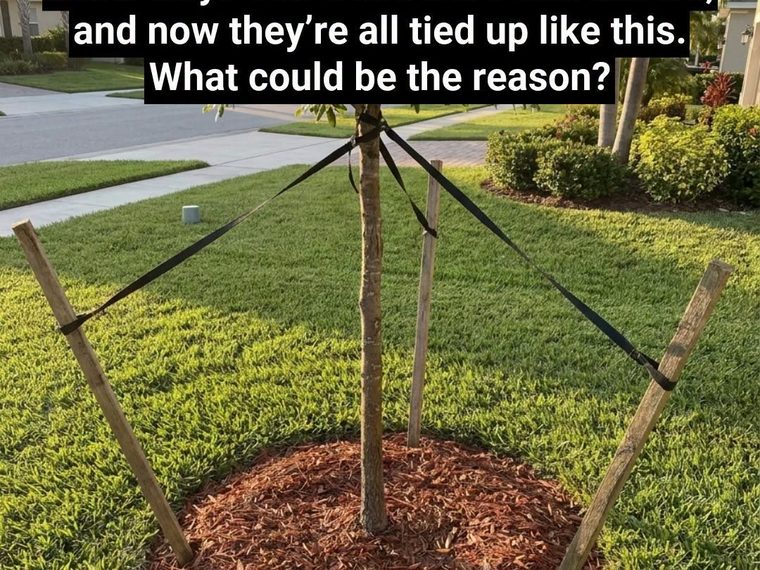
The photograph also shows a circular layer of wood chips around the base of the tree.
This is mulch, and it serves a different purpose from the wooden stakes.
Mulch can help conserve soil moisture, moderate soil temperature, reduce competition from grass and weeds, and protect the soil surface.
However, it should not be piled directly against the trunk. Leaving a small gap around the trunk helps keep the bark from remaining excessively moist and reduces the risk of certain trunk problems.
A properly mulched root zone, appropriate watering, and suitable planting conditions all contribute to successful tree establishment.
The mulch and the support system may therefore be part of a broader landscaping project rather than evidence that the trees were damaged.
Final Verdict: Why Were These Trees Tied Up?

Based on the photograph, the most plausible explanation is that the trees were given temporary support as part of a landscaping or tree-maintenance operation.
The three stakes and connecting straps form a support system designed to limit excessive movement while the tree becomes established. The mulch around the base is another common landscaping practice.
However, we cannot determine from the photograph whether the trees were newly planted, damaged by wind, or supported as part of a municipal project. Nor can we identify the workers or establish whether they had authorization to enter the property.
One point is particularly important: staking is not automatically beneficial for every tree. If supports are unnecessary, too tight, or left in place for too long, they can do more harm than good.
The best approach is to establish why the supports were installed, check that they are fitted correctly, and ensure that they are removed once the trees can stand independently.