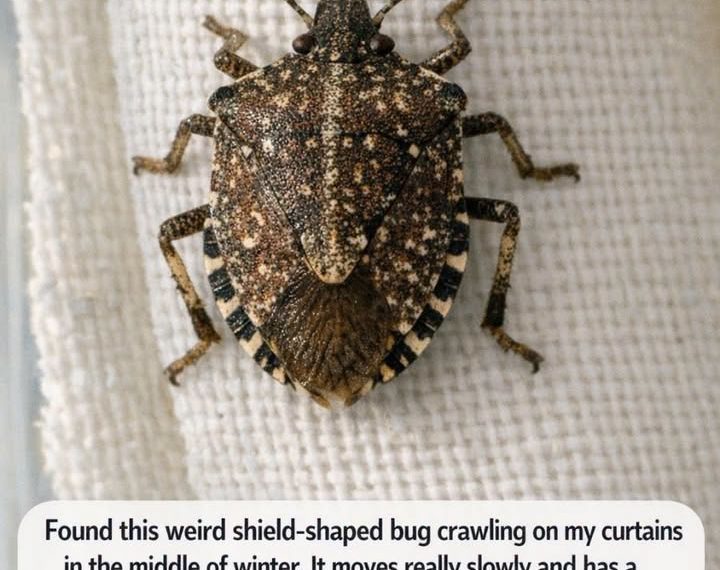
Finding a strange, slow-moving insect crawling across your curtains in the middle of winter can be unsettling. Its shield-shaped body, mottled brown coloring, long antennae, and unusual appearance may make you wonder whether it can bite, damage your home, or multiply inside your house.
The insect in the supplied photograph appears to be a brown marmorated stink bug (Halyomorpha halys), an insect originally native to East Asia that has spread to many other parts of the world. Its distinctive brown-and-cream speckled back and alternating light and dark markings along the edges of its abdomen are characteristic features of this species.
Although its appearance can be intimidating, there is good news: this insect is generally harmless to people and pets. However, it can become a nuisance when large numbers gather inside homes to shelter from cold weather.
Let’s look at how to identify it, why it might be on your curtains in winter, whether it can bite, and what you can do to prevent more from entering your home.
1. What Is This Strange Brown Bug?

The brown marmorated stink bug belongs to the family Pentatomidae, commonly known as shield bugs or stink bugs. Adults usually measure approximately 12–17 millimeters long, making them large enough to notice when they appear on indoor surfaces.
Several distinctive features help identify this insect:
- Shield-shaped body: Its broad, angular back resembles a small shield.
- Mottled brown coloring: The body is covered with tiny light and dark spots, creating a marbled appearance.
- Banded antennae: The antennae have contrasting pale and dark sections.
- Striped abdominal edges: Alternating light and dark markings are visible around the exposed sides of its abdomen.
- Six legs: Like other insects, it has three pairs of legs.
The insect in your photograph displays several of these identifying characteristics. However, other shield bugs can look similar, so a photograph alone cannot establish the species with complete certainty.
2. Why Is It Crawling on Your Curtains in the Middle of Winter?

Seeing a stink bug indoors during winter does not necessarily mean your home is dirty or infested.
Many adult brown marmorated stink bugs seek sheltered places in autumn, before temperatures become too cold. They may enter buildings through small openings around window frames, door seals, vents, rooflines, and utility pipes. Once inside, they settle into protected spaces to survive the winter.
Your curtains may simply be where the insect happened to emerge or crawl.
Here are some possible explanations:
It entered your home months ago. The bug may have found a narrow opening in autumn and remained hidden behind a curtain, inside a window frame, or in another sheltered area.
Indoor warmth made it active. Heating, sunlight, or a warmer day can cause an overwintering insect to move around. It may then appear on walls, curtains, ceilings, or windows.
It was searching for a place to settle. If it has only recently entered the building, it may be looking for a protected crevice.
It is moving slowly because of the temperature. Insects are cold-blooded, so their activity is strongly influenced by environmental temperature. A cool or recently emerged stink bug may move sluggishly.
Importantly, finding one insect does not automatically mean that dozens are hiding nearby.
3. Will It Bite You or Your Family?

This is probably the most important question for anyone who discovers one of these insects indoors.
The brown marmorated stink bug is not considered a threat to people or household pets. It does not feed on human blood, and it does not normally bite or sting. It also does not chew through furniture, clothing, or wooden structures.
Its intimidating appearance can be misleading. The insect has a sturdy outer shell and prominent legs, but it is not a predator that hunts people or animals.
If you see one crawling on your curtain, you do not need to panic or leave the room.
Nevertheless, avoid crushing it with your bare fingers. When threatened or squashed, stink bugs can release a strong, unpleasant odor from specialized scent glands. The smell can linger on your hands or nearby surfaces.
People with sensitive skin should also avoid unnecessary direct contact, as insect secretions may occasionally cause irritation.
4. Can It Infest Your House and Multiply Indoors?
TO CONTINUE READING THE ARTICLE PLEASE SEE PAGE 2