4. Can It Infest Your House and Multiply Indoors?

The answer depends on what you mean by an infestation.
Brown marmorated stink bugs can enter homes in considerable numbers, particularly in places where the species is established. They sometimes gather inside wall voids, around window frames, in attics, or in other sheltered areas during winter.
However, there is an important distinction between sheltering inside a home and breeding inside it.
Adult stink bugs commonly spend winter in a dormant or relatively inactive state. They do not normally establish a reproducing population inside a heated living room during this period. Eggs are generally laid outdoors on the leaves of host plants during the warmer part of the year.
That means:
- One bug on a curtain is not proof of an infestation.
- Several bugs appearing near windows may indicate that entry points need sealing.
- Seeing them repeatedly in different rooms may suggest that some are emerging from hidden sheltered spaces.
- Finding them in winter does not, by itself, mean they are laying eggs in your furniture or curtains.
They can still become a nuisance if many enter the building. In large numbers, their odor and occasional staining from insect residues or droppings can create an inconvenience.
5. Does It Damage Furniture, Curtains, or Clothing?

Fortunately, this insect does not eat fabric.
Unlike clothes moth larvae, carpet beetle larvae, or certain other household pests, the brown marmorated stink bug does not feed on curtains, carpets, upholstery, or stored clothing.
Its primary food sources are plants. Outdoors, it uses its piercing-sucking mouthparts to feed on plant tissues, including leaves, stems, seeds, and developing fruits. It can damage agricultural crops such as apples, pears, peppers, and other produce.
Inside your home, however, it is generally seeking shelter rather than food.
You may occasionally notice an unpleasant smell or a small mark if the insect is crushed or releases its defensive secretions. Therefore, it is better to remove it gently instead of squashing it against the curtain.
6. How to Remove It Safely Without Making Your Home Smell

If you find a stink bug crawling on your curtains, you can remove it without using insecticides or harsh chemicals.
Here are three practical methods.
Method 1: Use a glass and a piece of paper
This is a simple option when you can reach the insect easily.
- Approach slowly so you do not startle it.
- Place a glass or small container over the insect.
- Carefully slide a piece of stiff paper underneath.
- Keep the paper against the opening and lift the container.
- Take the insect outside and release it away from doors and windows, where practical.
Avoid squeezing the insect between the glass and the fabric.
Method 2: Use a vacuum cleaner
If several insects are present, a vacuum cleaner can make removal easier. University extension services recommend physical removal as an effective approach for indoor stink bugs.
A few precautions are worthwhile:
- Use a removable collection container or disposable vacuum bag if possible.
- Empty the collection container outdoors.
- Clean the equipment according to the manufacturer’s instructions.
- Avoid crushing the insects while handling them.
A vacuum cleaner can sometimes retain the insects’ unpleasant odor, so a dedicated handheld vacuum may be preferable.
Method 3: Use a container with soapy water
For insects on a hard surface, you can gently guide the bug into a container of water mixed with a little dish soap. Avoid spilling the mixture on curtains, carpets, or electrical equipment.
Do not spray household insecticides indiscriminately around your bedroom. Physical removal is generally preferable for an occasional stink bug, and unnecessary indoor pesticide use can expose people and pets to chemicals.
7. How to Prevent More Stink Bugs From Entering Your Home

If you have discovered one stink bug, this is a good opportunity to inspect the places where insects could enter your home.
The most effective long-term approach is to block entry points before the next period of cold weather.
Check your windows and doors
Inspect the edges of window frames, sliding doors, and exterior doors. Repair damaged weather stripping and seal suitable gaps with an appropriate sealant.
Even a small opening can provide access to a sheltered space.
Repair damaged insect screens
Look for tears or gaps in window screens and ensure that they fit securely. Screens can help prevent insects from entering when windows are open.
Inspect pipes, cables, and vents
Small openings around utility pipes, air-conditioning lines, cables, and other building penetrations may provide entry routes.
Seal appropriate gaps without blocking ventilation openings or compromising electrical, plumbing, or fire-safety systems.
Check curtains and window frames occasionally
If you find another insect, inspect the nearby window frame and surrounding wall. The insect may have emerged from a concealed gap rather than entered the room that day.
Reduce unnecessary outdoor lighting near entrances
Some outdoor lights can attract other insects and may increase insect activity around entry points. Consider using motion-activated lights or positioning exterior lighting away from open windows and doors.
No single measure guarantees that every insect will stay outside, but sealing entry points and repairing screens can substantially reduce unwanted visitors.
8. Could It Be Another Type of Stink Bug?

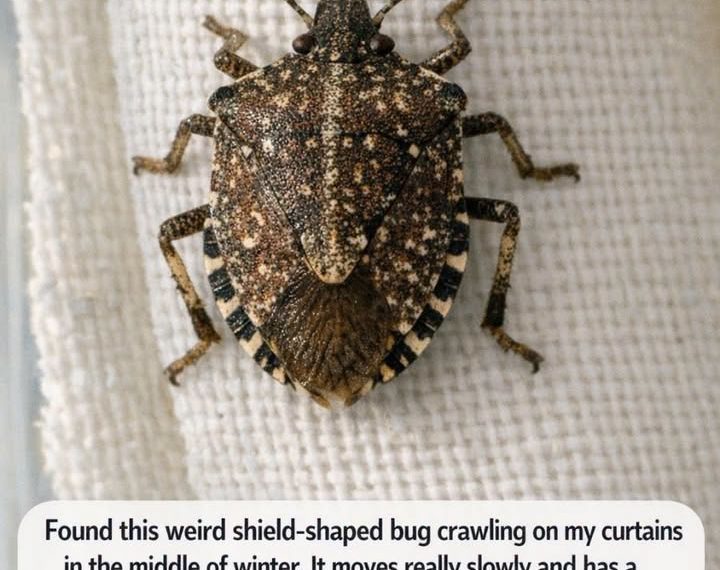
Although the insect in your photograph resembles a brown marmorated stink bug, several species have a similar shield-shaped body.
Look closely at these features:
| Feature | Brown marmorated stink bug |
|---|---|
| Body shape | Broad, shield-shaped |
| Main color | Mottled brown or gray-brown |
| Antennae | Distinctive pale bands on dark sections |
| Abdomen edges | Alternating light and dark markings |
| Typical adult size | Approximately 12–17 mm |
| Winter behavior | May shelter inside buildings |
These features are useful for identification, but local species can differ. The University of Minnesota Extension provides an illustrated identification guide and information about look-alike species.
The species is invasive in many regions, but its presence and distribution vary by country. Therefore, the identification should remain provisional unless the insect is examined more closely or confirmed by a local expert.
9. What If You Keep Finding Them Every Winter?

Repeated sightings deserve a little more attention, even though the insects are not generally dangerous.
If you find several over a period of days or weeks, consider the following steps:
- Record where you find each insect, especially whether they cluster around the same window or wall.
- Inspect window frames, exterior door seals, and other potential entry points.
- Remove visible insects rather than crushing them.
- Seal accessible gaps before the next autumn.
- If large numbers repeatedly appear from wall cavities or inaccessible areas, contact a qualified pest-control professional.
A recurring problem may mean that the building has convenient overwintering spaces or entry points. It does not necessarily mean the insects are reproducing inside the living areas.
If you are in a region where this species is uncommon, a local agricultural extension service, university entomology department, or pest-identification specialist may also help confirm what you have found.
10. Frequently Asked Questions
Can a stink bug crawl into my bed while I sleep?
It is possible for an insect to wander into a bedroom, but stink bugs do not seek out sleeping people to feed on them. They do not feed on blood, and they are not bed bugs.
Should I be worried if I find only one?
Generally, no. One insect may have entered through a small gap or emerged from a sheltered place. Remove it and inspect the nearest window or door if you are concerned.
Can stink bugs lay eggs on my curtains?
They normally lay their eggs outdoors on plant leaves. A single adult on a curtain during winter is not evidence of eggs or an indoor breeding colony.
Why does it move so slowly?
Cool temperatures can reduce insect activity. A stink bug emerging from a sheltered winter resting place may also move around slowly until its body warms.
Will it disappear on its own?
It may retreat into a hidden space, but it could also remain visible or become active again when indoor temperatures rise. Removing it is the simplest way to resolve the immediate problem.
Does it mean my house is dirty?
No. Stink bugs enter buildings through gaps and openings while seeking shelter. Their presence is not a reliable indicator of poor household hygiene.
Final verdict: Is this bug dangerous?

The insect in your photograph appears to be a brown marmorated stink bug, although confirmation would require closer identification.
The reassuring news is that it is unlikely to bite you, does not feed on your clothing or furniture, and does not normally reproduce inside your home during winter. Its principal drawback is that it can release an unpleasant smell when crushed or disturbed.
If you find one on your curtains, gently capture it and remove it. If you begin finding several, check your windows, doors, and other possible entry points.
There is no need to panic over a single visitor. A little careful removal and prevention can help keep your home comfortable without unnecessary chemicals.