Finding small, dark, unusual objects on your bed can be unsettling—especially when they look like tiny eggs, insects, or something that might have come from a pest.
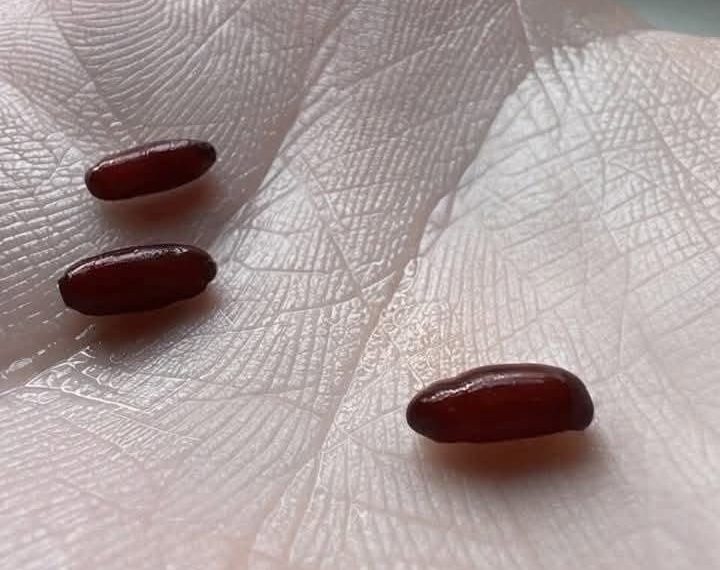
The objects shown in the photograph are small, smooth, reddish-brown, and elongated. At first glance, they could easily be mistaken for insect eggs or pieces of an insect.
However, the photograph alone is not enough to identify them with certainty. Their appearance does not closely match the typical appearance of bed bug eggs, which are normally tiny, pale or pearly white rather than dark red or brown.
So what could they be?
Let’s take a closer look at the possibilities and, more importantly, what you should do if you discover something similar on your bed.
What Are These Little Brown Objects?
The objects in the photograph look like small, hard, seed-like or capsule-like pieces.
They have several noticeable characteristics:
- They are reddish-brown to dark brown.
- They appear smooth and shiny.
- They are elongated rather than perfectly round.
- They appear relatively solid.
- There are several of them together.
- They are lying directly on a person’s hand in the photograph.
Their appearance alone doesn’t establish that they are insects or insect eggs.
In fact, several common household pest signs look very different from these objects.
Are They Bed Bug Eggs?
This is probably the first thing many people will think of when they discover something strange on their bed.
Probably not.
Bed bug eggs have a very distinctive appearance.
They are generally:
- extremely small;
- whitish or translucent;
- approximately 1 mm long;
- oval-shaped;
- sometimes attached to surfaces with a sticky substance.
Newly laid bed bug eggs are not normally dark red, shiny, and elongated like the objects in this photograph.
What do bed bugs actually leave behind?
If you are concerned about bed bugs, look for a combination of signs, rather than one mysterious object.
Common signs include:
- live bed bugs;
- tiny pale eggs;
- shed skins;
- small pale nymphs;
- dark fecal spots;
- rusty or reddish stains on sheets;
- insects hiding around mattress seams;
- insects or evidence around the bed frame.
Dark spots on bedding can sometimes be associated with bed bug feces, but these usually look more like small stains or dots, rather than three-dimensional capsules.
Could They Be Cockroach Eggs?
Another possibility people often consider is a cockroach egg case.
Cockroaches produce structures called oothecae, which contain multiple eggs.
But again, the objects in the photograph don’t look like a typical cockroach ootheca.
A cockroach egg case is generally:
- larger than an individual insect egg;
- capsule-like;
- brown or dark brown;
- relatively hard;
- often has a noticeable ridge or seam along one side.
Importantly, a cockroach ootheca contains multiple eggs inside one protective case.
The smooth, individual objects shown in the photograph don’t provide enough evidence to conclude that they are cockroach egg cases.
Could They Be Fly Pupae?
Fly pupae can sometimes look surprisingly creepy.
After a maggot reaches the pupal stage, it can form a hardened outer covering that becomes brown or reddish-brown.
Depending on the species, a fly pupa may look somewhat like a small brown capsule.
However, fly pupae are typically associated with places where flies have developed, such as:
- decaying organic material;
- garbage;
- animal waste;
- compost;
- food waste;
- dead animals.
Finding several objects on a clean bed would not automatically indicate a fly infestation.
Their exact size and shape would also be important for identification.
Could They Be Seeds?
This possibility is easy to overlook.
Some plant seeds can look remarkably similar to insect eggs or pupae.
Seeds may be:
- dark red;
- brown;
- black;
- glossy;
- oval;
- elongated;
- smooth.
If someone recently ate fruit, used dried plants, opened a package of seeds, handled gardening materials, or brought outdoor items into the bedroom, a few seeds could potentially end up on bedding.
This is particularly worth considering if there are no other signs of insects around the bed.
Could They Be Something From Food?
Small food particles can also become surprisingly difficult to identify once they have dried.
For example, pieces of:
TO CONTINUE READING THE ARTICLE PLEASE SEE PAGE 2