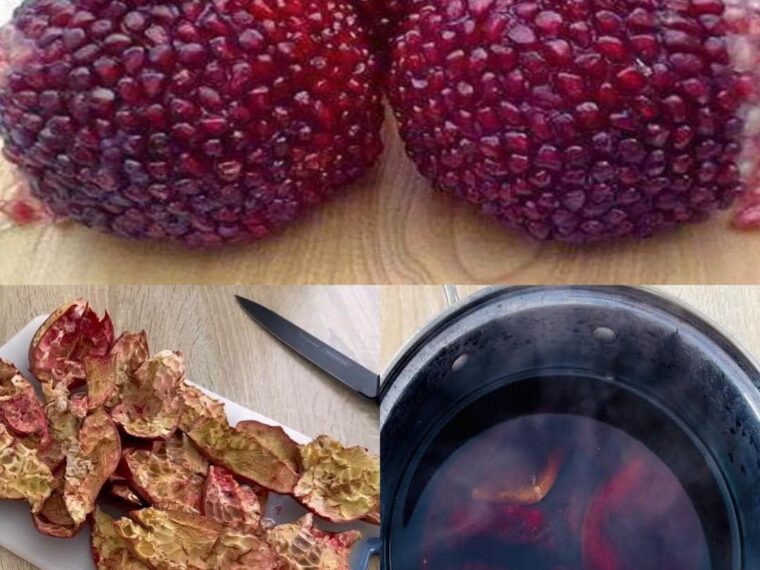
When most people eat a pomegranate, they carefully remove the juicy arils, enjoy their sweet-tart flavor, and throw the thick red-and-yellow peel into the trash.
But that peel may deserve a second look.
Researchers have found that pomegranate peel contains a remarkably concentrated mixture of polyphenols, tannins, flavonoids and other bioactive compounds. In fact, several studies suggest that the peel can contain substantial amounts of compounds associated with antioxidant and antimicrobial activity.
That does not mean pomegranate peel is a miracle cure or that eating large quantities is automatically beneficial. Much of the research has been performed on extracts, laboratory models or food applications rather than on people eating homemade pomegranate-peel preparations.
Still, the science surrounding this often-discarded part of the fruit is fascinating.
Here are 10 things you probably didn’t know about pomegranate peels.
1. Pomegranate peel can represent almost half of the fruit
One of the most surprising facts is just how much of a pomegranate is actually discarded.
Reviews report that the peel and associated outer portions can account for around 50% of the fresh fruit’s mass. This means that a large proportion of the fruit becomes a by-product during processing.
Think about what happens when thousands or millions of pomegranates are processed for juice or food products. Huge quantities of peel are generated.
For a long time, this material was largely treated as agricultural waste.
Researchers are now interested in turning it into something useful.
The peel is being investigated as a potential source of:
- natural antioxidants;
- phenolic compounds;
- tannins;
- natural antimicrobial ingredients;
- food additives;
- functional-food ingredients;
- cosmetic and biomedical materials.
This is part of a much broader scientific movement toward upcycling food waste rather than simply throwing potentially valuable plant material away.
2. The peel can be richer in certain polyphenols than the juicy part
The edible arils are undoubtedly nutritious, but the peel has a very different chemical profile.
Research has identified substantial quantities of polyphenols, tannins and flavonoids in pomegranate peel. Important compounds discussed in the scientific literature include punicalagins, ellagic acid and gallic acid.
One study analyzing Jordanian pomegranate peels found particularly high levels of hydrolyzable tannins and phenolic compounds, although the exact concentrations varied according to the extraction method.
This is an important point:
The peel is not simply an inactive protective shell. It is chemically active plant tissue.
Plants produce many of these compounds as part of their natural defense systems.
That may help explain why researchers have become interested in pomegranate peel extracts.
3. Pomegranate peel has impressive antioxidant activity in laboratory tests
One of the most frequently studied properties of pomegranate peel is its antioxidant capacity.
Antioxidants are substances that can interact with reactive molecules known as free radicals and other reactive species.
Researchers use laboratory tests such as:
- DPPH;
- ABTS;
- FRAP;
to evaluate antioxidant activity.
Studies of pomegranate peel extracts have repeatedly demonstrated antioxidant activity in these experimental systems. However, different extraction methods can produce very different results because they extract different compounds and quantities of compounds.
This distinction is important.
A laboratory test showing strong antioxidant activity does not automatically prove that eating the peel will produce the same effect in the human body.
Digestion, absorption, metabolism and dose all matter.
So it is more accurate to say:
Pomegranate peel contains compounds with significant antioxidant activity in laboratory studies, rather than claiming that eating the peel prevents disease.
4. Its astringent taste comes from powerful plant compounds
Have you ever wondered why pomegranate peel tastes so unpleasant compared with the juicy seeds?
The answer is partly related to its high concentration of tannins and other phenolic compounds.
Tannins are responsible for much of the dry, puckering or astringent sensation associated with certain plants and foods.
This explains why simply biting into a fresh pomegranate peel isn’t exactly a pleasant culinary experience.
The same chemical characteristics that make the peel interesting to researchers also create challenges for turning it into a conventional food ingredient.
Scientific reviews note the peel’s astringency and potential antinutritional characteristics as factors that need to be considered when developing food products from it.
Researchers therefore investigate extraction, drying and processing techniques to obtain useful compounds without necessarily requiring people to eat the raw peel.
5. Pomegranate peel is being studied for antimicrobial properties
This is one of the most interesting areas of research.
TO CONTINUE READING THE ARTICLE PLEASE SEE PAGE 2