This is one of the most interesting areas of research.
Laboratory studies have found that certain pomegranate peel extracts can inhibit the growth of various microorganisms.
For example, a 2024 study investigated extracts against bacteria associated with food spoilage, including Escherichia coli, Salmonella, Listeria monocytogenes and Staphylococcus aureus. Different extracts produced different effects depending on the microorganism and extraction method.
Another study investigated pomegranate peel extracts against bacteria associated with the so-called ESKAPE group of difficult-to-treat pathogens and reported antimicrobial activity under experimental conditions.
These findings are promising for researchers looking for natural antimicrobial ingredients.
But there is an important distinction:
Laboratory antimicrobial activity ≠ home antibiotic
Pomegranate peel extract should not be used as a substitute for prescribed antibiotics or medical treatment.
The research is primarily exploring the compounds as potential future ingredients in food preservation, pharmaceutical research and other applications.
6. The peel may have potential as a natural food preservative
Here’s a fascinating use that has little to do with drinking pomegranate peel tea.
Scientists are investigating pomegranate peel extracts as possible natural food additives and preservatives.
Why?
Because some of the compounds found in the peel have both antioxidant and antimicrobial properties.
That combination could potentially help slow:
- oxidation of fats;
- certain forms of food deterioration;
- microbial growth.
A review in Food Chemistry and related literature describes potential applications of pomegranate peel extracts in products ranging from bakery and dairy foods to meat, fish and edible oils.
The advantage is particularly interesting from a sustainability perspective.
Instead of viewing the peel as garbage, the food industry could potentially transform it into a useful ingredient.
7. Not all pomegranate peels are chemically identical
This is a detail that is often overlooked in viral health posts.
You cannot assume that every pomegranate peel contains exactly the same concentration of beneficial compounds.
The chemical composition can vary according to:
- cultivar or variety;
- growing region;
- climate;
- maturity;
- agricultural conditions;
- storage;
- processing;
- extraction method.
A study of Jordanian pomegranate peels, for example, found considerable differences between extracts depending on the solvent used. Water, ethanol and methanol extracts did not produce identical chemical profiles or antioxidant and antimicrobial results.
This means that saying:
“Pomegranate peel contains X amount of antioxidant compounds”
without specifying the variety and extraction method can be misleading.
The preparation method matters enormously.
8. Scientists are exploring pomegranate peel beyond food
Pomegranate peel research isn’t limited to nutrition.
Scientists are investigating extracts for potential applications in:
- biomaterials;
- antimicrobial coatings;
- tissue-engineering materials;
- hydrogels;
- food packaging;
- natural preservatives;
- pharmaceutical research.
A recent comprehensive review describes research into pomegranate peel extracts in biomedical materials, including hydrogels, nanomaterial-related applications and tissue-engineering scaffolds.
This is particularly interesting because it demonstrates that researchers aren’t necessarily trying to turn the peel into something people eat.
Instead, they are asking:
What useful molecules can we extract from this agricultural by-product?
That approach could eventually create higher-value uses for material that would otherwise be discarded.
9. Pomegranate peel is being studied for oral-health applications
Here’s another lesser-known area of research.
Because pomegranate peel extracts have demonstrated antimicrobial activity in laboratory studies, researchers have begun investigating their potential applications in oral health.
A recent study involving Moroccan pomegranate peel extract reported antioxidant and antimicrobial activity against certain oral microorganisms under experimental conditions. The researchers also investigated aspects such as cytotoxicity and biological compatibility.
This is particularly interesting because it shows that research on pomegranate peel isn’t restricted to distant laboratory models.
However, even promising laboratory results do not automatically mean that homemade pomegranate-peel preparations are proven treatments for gum disease, cavities or other oral conditions.
Clinical research in humans is needed before making therapeutic claims.
10. “Natural” does not automatically mean “safe in unlimited amounts”
This may be the most important thing to remember.
Pomegranate peel contains biologically active compounds. That is precisely why scientists are interested in it.
But biologically active does not automatically mean harmless at every dose.
The peel is also highly astringent, and scientific reviews have pointed out concerns related to its tannin content and potential antinutritional effects. Researchers have specifically called for additional toxicological and sensory research before widespread use as a food supplement.
There is another practical issue:
Pesticide residues
Unlike the juicy arils, the peel is the outer surface of the fruit and can be exposed to agricultural chemicals.
If someone intends to experiment with culinary use of peel, it is sensible to:
- wash the fruit thoroughly;
- use fruit from a reliable source;
- avoid visibly damaged or moldy fruit;
- avoid using peel that has been treated with substances not intended for consumption;
- avoid assuming that “natural” automatically means safe.
And if you are considering concentrated pomegranate peel extracts or supplements, especially regularly or in large quantities, it is better to discuss this with a healthcare professional.
Can you actually eat pomegranate peel?
Technically, pomegranate peel contains compounds that can be incorporated into food products, and researchers have explored dried peel powders and extracts.
But fresh pomegranate peel is not comparable to eating the juicy arils.
It is:
- tough;
- bitter;
- strongly astringent;
- rich in tannins;
- difficult to digest in its whole form.
This is why research tends to focus on processed peel, powders or extracts rather than encouraging people to chew large pieces of raw peel.
If you see social-media claims recommending large quantities of raw peel every day, treat them cautiously.
What about pomegranate peel tea?
Pomegranate-peel tea is a traditional-style preparation that has become increasingly popular online.
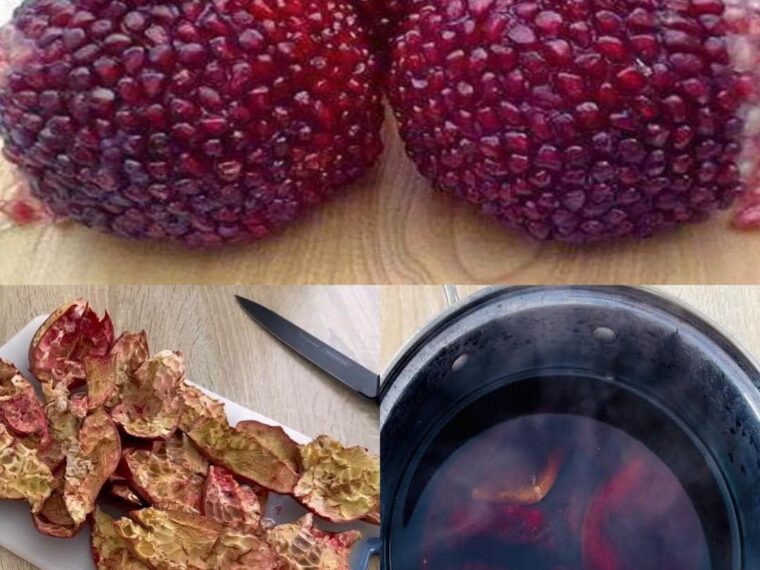
People may prepare it by drying pieces of peel and steeping them in hot water.
The idea is attractive because it uses something that would otherwise become food waste.
However, it is important to distinguish traditional use from clinically proven treatment.
Research has shown that water-based pomegranate peel extracts can contain bioactive compounds and can demonstrate antioxidant or antimicrobial activity in laboratory testing.
But that does not establish that drinking homemade peel tea:
- cures infections;
- treats diabetes;
- prevents cancer;
- detoxifies the body;
- melts belly fat;
- replaces medication.
Those claims go beyond the available evidence.
What compounds make pomegranate peel so interesting?
Researchers have identified several important classes of compounds.
Punicalagins
These are large hydrolyzable tannins that are particularly associated with pomegranate.
They have attracted considerable scientific interest because of their antioxidant properties.
Ellagic acid
Ellagic acid is another phenolic compound associated with pomegranate and other plant foods.
Researchers have studied its antioxidant and other biological activities.
Gallic acid
Gallic acid is another phenolic compound found in pomegranate peel.
Flavonoids
Pomegranate peel also contains various flavonoid compounds.
Together, these compounds contribute to the complex biological activity observed in peel extracts.
Why extraction method matters so much
Imagine taking the same pomegranate peel and preparing it three different ways:
Water extraction
Ethanol extraction
Methanol extraction
You would not necessarily obtain the same chemical mixture.
Different solvents dissolve different compounds.
This is exactly what researchers observe in experimental studies. A 2023 study of Jordanian pomegranate peels found substantial differences in phenolic compounds, tannins and antioxidant activity between different extracts.
This explains why one study may report very strong antioxidant activity while another reports a different result.
The researchers may not actually be testing the same preparation.
Can pomegranate peel prevent cancer?
This is where online articles often go too far.
Pomegranate peel extracts have demonstrated anticancer-related effects in some laboratory experiments, including effects on certain cultured cancer cells. A 2024 study, for example, investigated cytotoxic activity of several pomegranate peel extracts against different cancer cell lines.
But this does not mean that eating pomegranate peel prevents or cures cancer in humans.
There is a major difference between:
“This extract affected cancer cells in a laboratory experiment.”
and
“Eating this food prevents cancer.”
The second statement requires strong clinical evidence in humans.
Therefore, pomegranate peel should be viewed as an interesting subject of cancer research—not as a cancer treatment.
Can pomegranate peel help with inflammation?
Pomegranate peel contains compounds with anti-inflammatory activity in experimental research, and reviews have identified anti-inflammatory effects among the biological properties being investigated.
Again, however, much of the evidence comes from:
- laboratory experiments;
- animal studies;
- isolated compounds;
- concentrated extracts.
These results are useful for generating scientific hypotheses, but they should not automatically be translated into medical advice.
The environmental benefit may be just as interesting as the health research
Perhaps the biggest overlooked advantage of pomegranate peel is not medical at all.
It is sustainability.
If approximately half of the fresh fruit becomes peel and related by-product, then processing facilities can generate enormous quantities of material.
Instead of treating all of this material as waste, scientists are exploring ways to turn it into:
- natural preservatives;
- antioxidant ingredients;
- food packaging components;
- cosmetic ingredients;
- agricultural products;
- biomedical materials.
This is an example of the circular-economy concept:
waste → extraction → useful compound → new product.
A simple way to use the peel without making exaggerated health claims
If you want to experiment with pomegranate peel from a culinary perspective, the safest approach is to think of it as a food ingredient, not a medicine.
One possibility is to thoroughly wash the fruit, remove the peel, dry it appropriately, and use a small amount of properly prepared peel powder in a recipe where its strong flavor is acceptable.
For example, tiny quantities could potentially be incorporated into:
- spice blends;
- certain baked products;
- herbal-style beverages;
- homemade culinary preparations.
But because the peel is intensely bitter and astringent, a little can go a long way.
And homemade preparation is not equivalent to the standardized extracts used in scientific research.
10 surprising facts at a glance
| # | What you may not know | What the research suggests |
|---|---|---|
| 1 | The peel is a huge part of the fruit | It can account for roughly half of fresh fruit mass |
| 2 | The peel is chemically rich | It contains polyphenols, tannins and flavonoids |
| 3 | It has strong antioxidant activity | Demonstrated in several laboratory assays |
| 4 | Its bitterness has a scientific explanation | Tannins contribute to its strong astringency |
| 5 | It can inhibit some microbes | Extracts show antimicrobial activity in laboratory studies |
| 6 | It could help preserve food | Researchers are studying it as a natural additive |
| 7 | Every peel isn’t chemically identical | Variety, location and extraction method matter |
| 8 | It’s being investigated beyond nutrition | Applications include biomaterials and packaging |
| 9 | Researchers are studying oral-health uses | Some extracts show activity against oral microorganisms |
| 10 | Natural doesn’t mean unlimited or risk-free | More safety and clinical research is needed |
Pomegranate peel: fascinating, but not a miracle cure
Pomegranate peel is a perfect example of why food waste can sometimes contain valuable compounds.
Research has demonstrated that the peel is rich in polyphenols, tannins and flavonoids, and laboratory studies have repeatedly identified antioxidant and antimicrobial activity. Scientists are also exploring its potential applications in food preservation, oral-health products, biomaterials and other fields.
But there is an important line between promising research and proven health benefits.
The strongest evidence currently concerns the chemical composition and laboratory properties of pomegranate peel and its extracts. Many popular claims about drinking peel tea or consuming large amounts of peel have not been established through high-quality human clinical trials.
So the most scientifically accurate takeaway is this:
Don’t think of pomegranate peel as a miracle medicine. Think of it as an unusually rich plant by-product that scientists are discovering how to use.
And perhaps the next time you cut open a pomegranate, you won’t look at that thick peel as ordinary kitchen waste.
You may be looking at a surprisingly valuable source of natural compounds.
Important note
If you are considering concentrated pomegranate-peel extracts, powders or supplements for a specific health condition, speak with a healthcare professional first. The composition of homemade preparations can vary substantially, and research on pomegranate peel does not establish it as a replacement for medical treatment.