What About Salt?
You’ll often see advice online recommending large amounts of salt for maggot-infested bins.
Salt can help dry out small larvae because of its ability to draw water from biological tissues.
However, salt isn’t the most important part of preventing a maggot infestation.
If flies still have access to food waste, eliminating the larvae you can see doesn’t necessarily solve the underlying problem.
There may still be eggs or additional larvae elsewhere in the garbage.
So rather than relying on salt as your primary strategy, concentrate on:
- Removing or sealing food sources.
- Keeping the bin closed.
- Keeping the bin clean.
- Reducing moisture.
- Taking out garbage regularly.
What About Boiling Water?
Boiling or very hot water is sometimes suggested as a way to kill maggots and clean the inside of a garbage bin.
Hot water can kill insects on contact, but you should be careful.
Do not pour boiling water into a plastic bin without checking that the material can safely tolerate it.
Very high temperatures can damage or deform some plastics.
If you’re cleaning a garbage bin, ordinary hot water combined with an appropriate household cleaning product is often a more practical approach.
Always follow the cleaner’s label instructions, and never mix bleach with ammonia, acids, or other incompatible cleaning products.
Cleaning the Trash Bin Makes a Big Difference
Even after you’ve removed the garbage, food residue can remain inside the bin.
A small amount of meat juice, fish liquid, sauce, or decomposing food stuck to the bottom can continue attracting insects.
After emptying the bin:
- Remove any remaining solid waste.
- Rinse the interior.
- Wash it with an appropriate detergent or household cleaner.
- Scrub areas where food residue has accumulated.
- Rinse thoroughly.
- Allow the bin to dry completely before putting new garbage inside.
The drying step is particularly useful.
A clean, dry bin is much less inviting than one containing old food residue and standing liquid.
Don’t Forget the Bin Lid
The lid can be one of the dirtiest parts of the container.
Food residue and liquids can get onto the underside when bags are removed or when the bin is overfilled.
Flies don’t necessarily need access to the bottom of the bin.
If food residue is sitting around the lid or rim, insects may still be attracted to the container.
During cleaning, pay attention to:
- The underside of the lid
- The rim
- Handles
- Hinges
- Corners
- The bottom of the container
These areas are easy to ignore but can accumulate organic residue.
What If You Already Have Maggots?
Don’t panic.
Seeing maggots doesn’t mean your entire garbage bin is permanently contaminated.
The first step is to remove the source.
Step 1: Empty the bin
Get the garbage removed as soon as practical.
Step 2: Identify leaking waste
Look for food residue or liquid that may have leaked from a bag.
Step 3: Clean the bin
Wash and scrub the inside thoroughly.
Step 4: Rinse it
Remove detergent and loosened residue.
Step 5: Let it dry
Allow the bin to dry before replacing the garbage bag.
Step 6: Prevent another cycle
Going forward, seal wet food waste and keep the lid closed.
The final step is crucial.
Cleaning today’s maggots without changing how food waste is handled can simply lead to another infestation.
A Simple Routine That Takes Almost No Extra Time
You don’t need a complicated cleaning schedule.
Try this simple routine:
Every day
Put wet food waste into a sealed bag or container.
When possible
Keep particularly attractive waste—such as fish and meat scraps—in the freezer until collection day.
Every time you use the bin
Make sure the lid closes completely.
Before collection
Tie garbage bags securely.
After collection
Check whether any food or liquid has leaked into the bin.
Occasionally
Wash the bin and let it dry completely.
That’s it.
The biggest improvement often comes from changing what goes into the bin, rather than constantly treating the bin after maggots appear.
Why This Method Works Better Than Constantly Spraying the Bin
It’s tempting to reach for insecticide when you see maggots.
But killing visible larvae doesn’t necessarily address the reason they appeared.
Think of the situation as a cycle:
Food waste → flies attracted → eggs laid → larvae hatch → more flies
Your goal is to interrupt that cycle.
Sealing food waste makes the first stage much harder.
Keeping the lid closed makes access more difficult.
Cleaning the bin removes leftover food.
Regular collection reduces the amount of time waste remains available.
Together, these measures attack the problem at several points.
What Should You Do With Fruit and Vegetable Scraps?
Not all food waste needs exactly the same treatment.
Fruit and vegetable scraps can also attract flies, especially as they become very ripe.
If you compost, these materials may belong in your compost system rather than your general trash.
If you don’t compost, keep wet food waste contained according to your local waste-collection rules.
Some municipalities have separate organic-waste collections, so the correct solution depends on where you live.
Pet Food Can Also Attract Flies
People often focus on meat scraps and forget about pet food.
Wet cat and dog food can become highly attractive to insects when left exposed.
If you throw away leftover wet pet food, seal it inside a bag or suitable container rather than leaving it exposed in an indoor or outdoor garbage bin.
Also clean pet-food bowls regularly instead of allowing residue to accumulate.
What About Essential Oils and Strong Scents?
You’ll find many online suggestions involving peppermint, eucalyptus, lavender, vinegar, or other strong-smelling substances.
Some scents may discourage certain insects temporarily, but they shouldn’t be considered a reliable substitute for proper waste management.
If the trash contains exposed, decomposing food, simply making the bin smell different doesn’t remove the food source.
The most dependable approach is still:
seal the waste + close the bin + clean the bin + reduce moisture.
A Few Mistakes That Can Make Maggots More Likely
Leaving the lid open
Even for convenience, an open lid gives flies easy access.
Throwing loose meat scraps directly into the bin
This creates an accessible food source.
Allowing garbage bags to leak
Liquid food waste at the bottom of the bin can attract insects.
Overfilling the bin
An overfilled container may prevent the lid from closing.
Ignoring the underside of the lid
Food residue there can remain unnoticed.
Leaving garbage in direct sunlight
Heat can accelerate decomposition and intensify odors.
Waiting too long to clean spills
A small food leak can become a persistent source of odors and insect attraction.
The Easiest Habit to Start Today
If you only change one thing, make it this:
Seal wet, food-rich waste before putting it in the garbage bin.
You don’t need a special chemical.
You don’t need an expensive insect trap.
You don’t need to scrub the bin every day.
Simply prevent flies from having easy access to the food that attracts them.
For especially problematic waste such as fish or meat, freezing the sealed scraps until collection day can provide an additional layer of protection.
Final Thoughts
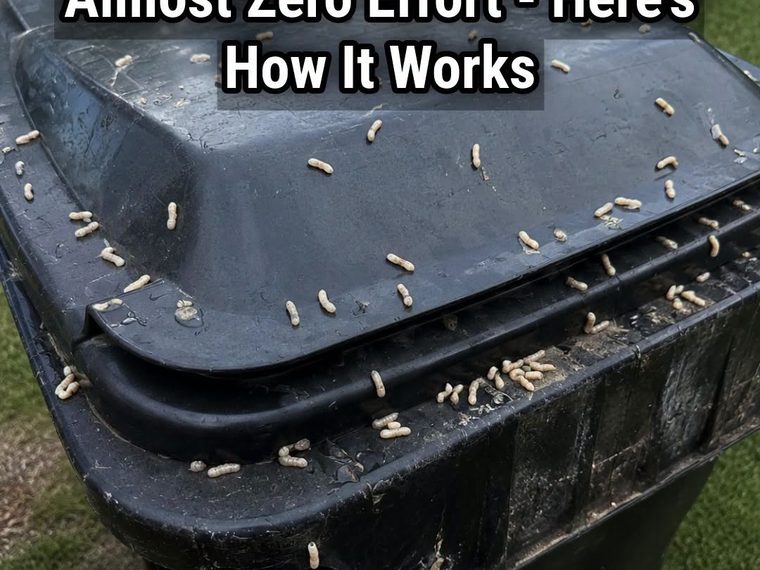
Maggots in a trash bin are unpleasant, but they’re usually a symptom of a very ordinary process: flies have found accessible food and suitable conditions for laying eggs.
The easiest solution isn’t necessarily a powerful product.
It’s prevention.
Keep food waste sealed. Keep the garbage bin closed. Avoid leaks. Keep the container clean and dry. And when possible, keep particularly attractive scraps cold until collection day.
That small change can make a surprisingly noticeable difference, especially during warm weather.
So the next time someone suggests that you need an elaborate collection of sprays and chemicals to deal with maggots, remember the simplest principle:
If flies can’t easily reach the food, they have far fewer opportunities to turn your trash bin into a nursery.
And that is a household trick that costs almost nothing and takes only a few seconds to put into practice.