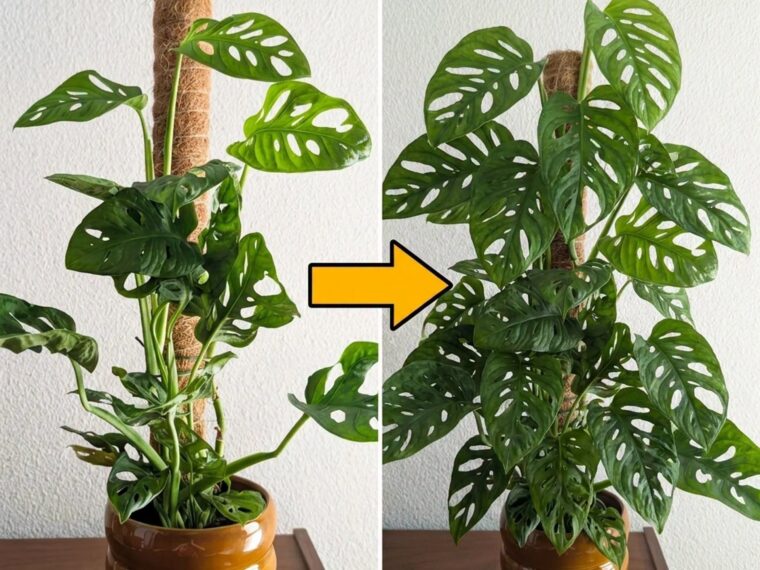
9. Why Are the Leaves Losing Their Holes?
Those beautiful holes are one of the main reasons people love Monstera adansonii.
If your plant is producing young leaves with fewer or no fenestrations, don’t immediately assume that something is seriously wrong.
Several factors can influence leaf development, particularly:
- Plant maturity
- Light availability
- Growing conditions
- Support and climbing behavior
- Overall plant health
Young leaves may naturally look different from mature leaves.
If the plant is healthy but the newest leaves aren’t as fenestrated as expected, improving light and providing a climbing support may help over time.
10. Watch for Yellow Leaves
A yellow leaf doesn’t automatically mean that your plant is dying.
One older leaf occasionally turning yellow can simply be part of the plant’s natural aging process.
However, multiple leaves turning yellow at the same time deserve investigation.
Possible causes include:
- Excessive watering
- Poor drainage
- Insufficient light
- Root problems
- Environmental stress
- Nutrient issues
Start by checking the soil rather than immediately adding fertilizer.
If the soil remains wet for a long time, the problem may be related to moisture rather than nutrition.
11. Brown or Crispy Leaf Edges
Brown edges can have several causes.
Common possibilities include:
Dry conditions
Low humidity or inconsistent watering can contribute to crispy edges.
Too much direct sunlight
Strong sunlight can scorch exposed foliage.
Salt accumulation
Mineral buildup from water or fertilizer can sometimes affect sensitive plants.
Root stress
If roots aren’t functioning properly, leaves may not receive enough water even when the soil appears moist.
The important thing is to look at the whole plant and its environment rather than treating one symptom in isolation.
12. Check Regularly for Pests
Monstera adansonii can be affected by common houseplant pests such as:
- Spider mites
- Thrips
- Mealybugs
- Scale
- Aphids
Inspect both sides of the leaves, particularly around leaf joints and new growth.
Look for:
- Tiny insects
- Sticky residue
- Fine webbing
- Speckled leaves
- Distorted new growth
- Small bumps on stems or leaves
Catching an infestation early makes management much easier.
13. Feed During Active Growth
A healthy Monstera adansonii can benefit from appropriate fertilization during its active growing period.
Use a balanced houseplant fertilizer according to the manufacturer’s directions.
Avoid assuming that more fertilizer means faster growth.
Overfertilization can damage roots and create additional problems.
If your plant is growing slowly, first check its light, watering, roots, and temperature before simply increasing fertilizer.
14. Keep the Leaves Clean
Large leaves collect dust surprisingly quickly.
A layer of dust can make the plant look dull and may interfere with the leaves’ ability to function efficiently.
Every so often, gently wipe the leaves with a clean, damp cloth.
Support the leaf underneath while cleaning so you don’t accidentally damage the delicate foliage.
Avoid using household oils, mayonnaise, or other homemade “leaf-shine” products.
The goal is simply to keep the foliage clean and healthy.
15. Give It Time to Adjust
If you recently bought a Monstera adansonii, don’t panic if it doesn’t immediately look perfect.
Moving from a greenhouse or plant shop into a home represents a major environmental change.
The plant suddenly experiences different:
- Light
- Temperature
- Humidity
- Watering patterns
- Air circulation
Some adjustment is normal.
Give it stable conditions instead of constantly moving it from one location to another.
A Simple Monstera Adansonii Care Routine
If you’re unsure where to start, keep things simple.
☀️ Light
Bright, indirect light.
💧 Water
Water when the upper portion of the soil has dried rather than following a rigid calendar.
🌱 Soil
Use a loose, airy, well-draining mix.
🪴 Pot
Always use adequate drainage.
🌿 Support
Provide a moss pole or trellis if you want it to climb.
✂️ Pruning
Remove damaged growth and prune strategically to encourage a fuller shape.
💦 Humidity
Moderate to high humidity is beneficial, particularly in very dry homes.
🌱 Fertilizer
Feed appropriately during active growth without overdoing it.
The Biggest Mistake to Avoid
If there’s one lesson to remember, it’s this:
Don’t try to fix every problem by adding more water.
Yellow leaves, drooping foliage, slow growth, and brown leaves can have many different causes.
Before watering, check the soil.
Before fertilizing, check the light.
Before repotting, inspect the roots and drainage.
And before assuming the plant is dying, look at the overall pattern of growth.
Sometimes a small environmental adjustment is all your Monstera needs.
Final Thoughts
A struggling Monstera adansonii doesn’t necessarily need complicated treatment. In most cases, the key is to recreate a few of the conditions it naturally prefers: bright filtered light, well-draining soil, appropriate moisture, warmth, humidity, and something to climb.
Give the plant stable conditions, avoid overwatering, monitor for pests, and be patient with new growth.
With a little attention, that struggling vine can eventually become a lush, climbing houseplant with beautiful fenestrated leaves—the kind that makes everyone who visits your home ask:
“How did you get your Monstera to look like that?”