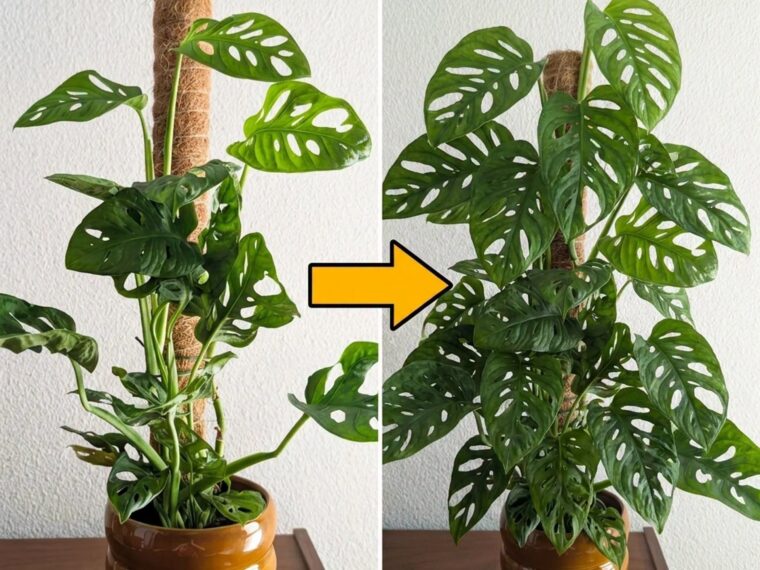
The Monstera adansonii, often called the Swiss cheese plant, is one of the most beautiful tropical houseplants you can grow indoors. Its distinctive leaves, covered with natural holes and openings, make it a favorite among plant lovers.


But despite its exotic appearance, it can sometimes be surprisingly difficult to keep happy. Yellow leaves, curling foliage, brown edges, slow growth, and a lack of those characteristic holes can all be signs that something in its environment needs adjusting.
The good news is that most Monstera adansonii problems are relatively easy to correct.
Here are some simple tips to help your plant grow healthier, fuller, and more vigorous.
1. Give Your Monstera Adansonii the Right Light
Light is one of the most important factors in successful Monstera adansonii care.
In its natural tropical environment, this plant grows beneath a forest canopy where it receives plenty of bright but filtered light.
At home, place it near a bright window where it receives plenty of indirect sunlight.
Avoid two extremes
Too little light:
The plant may become leggy, produce smaller leaves, and grow slowly. The characteristic fenestrations may also be less pronounced.
Too much direct sunlight:
Strong sunlight, especially through a hot window, can scorch the foliage and create pale, brown, or crispy patches.
A few hours of gentle morning sunlight can be beneficial, while intense afternoon sun may need to be filtered through a curtain.
2. Don’t Water on a Strict Schedule
One of the most common mistakes with Monstera adansonii is watering automatically every few days.
Instead, check the soil.
Insert your finger approximately 2–5 cm into the top layer of soil. If it feels dry, it’s generally time to consider watering. If it is still noticeably moist, wait a little longer.
The exact frequency depends on:
- Temperature
- Humidity
- Pot size
- Soil mixture
- Light levels
- Season
- Plant size
When you water
Water thoroughly until some water flows from the drainage holes.
Then allow excess water to drain away completely.
Don’t leave the pot sitting in a saucer full of water for extended periods.
3. Make Sure the Pot Drains Properly
Even a perfect watering routine won’t help much if the container holds water around the roots.
Your Monstera adansonii needs a pot with adequate drainage holes.
If water remains trapped around the roots, the plant can become stressed and may eventually develop root problems.
A decorative outer pot without drainage can be used as a cover pot, but remove the nursery pot when watering and allow it to drain before returning it.
4. Use an Airy, Well-Draining Soil Mix
Monstera adansonii isn’t happiest in dense, compact soil.
Its roots benefit from a mixture that holds some moisture while still allowing air to circulate.
A suitable homemade mix might contain:
- Quality indoor potting mix
- Orchid bark
- Perlite or pumice
- A small amount of coco coir if needed
The goal is a mixture that doesn’t remain waterlogged.
If your current soil becomes hard and compact after watering, repotting into a more open mix may make a significant difference.
5. Increase Humidity When the Air Is Very Dry
Because Monstera adansonii comes from tropical regions, it generally appreciates moderate to high humidity.
Dry indoor air can contribute to:
- Brown leaf edges
- Crispy patches
- Curling leaves
- Slower growth
You don’t necessarily need to turn your entire home into a tropical greenhouse.
Instead, consider placing the plant in a naturally humid room, such as a bright bathroom, provided it receives enough light.
A humidifier can also help if your indoor air is consistently dry.
What about misting?
Misting may temporarily increase moisture around the leaves, but it isn’t a reliable way to maintain high humidity throughout the day.
Good overall room humidity and proper watering are more important.
6. Give It Something to Climb
This is one of the best ways to improve the appearance of a Monstera adansonii.
In nature, it is a climbing plant. Indoors, it can be allowed to trail, but it often looks especially impressive when given a support such as:
- Moss pole
- Coir pole
- Trellis
- Wooden stake
- Other sturdy plant support
As the plant climbs, it can produce larger foliage and develop a more structured appearance.
A climbing support also allows you to recreate some of the conditions the plant experiences in its natural habitat.
7. Don’t Be Afraid to Prune Long, Bare Stems
If your Monstera has become long and sparse, don’t assume that you need to throw it away.
Strategic pruning can encourage a fuller appearance.
Look for healthy stems with visible nodes. A node is the point where leaves and aerial roots can emerge.
You can prune above an appropriate node and use healthy cuttings for propagation.
Instead of having one long, bare vine, you can eventually create a much bushier plant.
8. Propagate the Cuttings
One of the most enjoyable things about Monstera adansonii is how easily healthy stem cuttings can often be propagated.
Take a cutting containing at least one healthy node.
You can root it in:
- Water
- Moist sphagnum moss
- Perlite
- A suitable propagation medium
If propagating in water, make sure the node is submerged while keeping most of the leaf above the water.
Once a good root system develops, the cutting can be transferred to an appropriate potting mix.
Important
A leaf without a node generally cannot produce a new growing vine.
The node is the critical part.
9. Why Are the Leaves Losing Their Holes?
TO CONTINUE READING THE ARTICLE PLEASE SEE PAGE 2