Why Did It Appear in the Lawn?
A healthy-looking lawn doesn’t necessarily mean the soil underneath is dry.
Crayfish are particularly attracted to locations where the ground provides access to moist soil or groundwater. Lawns may actually provide excellent conditions because they are often watered regularly and can retain moisture beneath the grass.
You may be more likely to notice crayfish chimneys:
- After periods of heavy rain
- In low-lying areas
- Near ponds, streams or drainage areas
- Where the soil is naturally wet
- In lawns with a relatively high water table
- In areas that receive regular irrigation
Sometimes the chimney seems to appear almost overnight because much of the excavation happens underground.
Is It a Molehill?
No.
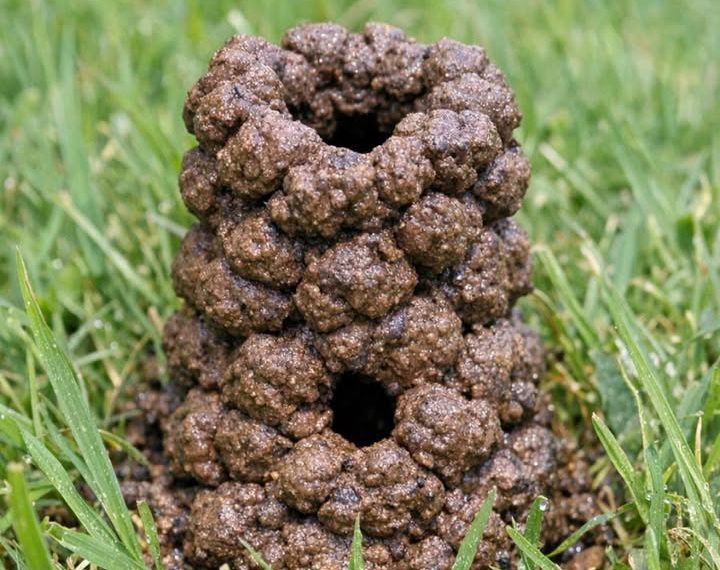
At first glance, a strange mound in the lawn might make you think of moles or other burrowing animals. But a distinctive tower of mud pellets surrounding a central opening is much more consistent with a crayfish burrow.
Moles generally leave raised ridges, soil mounds or surface tunnels rather than constructing a chimney from individual mud balls.
The structure in the photograph has another important clue: the clearly defined opening through the center.
Is It a Wasp or Insect Nest?
Probably not.
Some insects can create impressive structures from mud, but the location and appearance are important.
Mud daubers, for example, construct mud nests above ground, often on buildings, sheltered structures or other surfaces. The structure shown here is sitting directly on the soil and appears to be connected to an underground burrow.
That makes a burrowing crayfish a much stronger possibility.
Does Finding One Mean You Have a Wet Lawn?
It can be a clue.
A crayfish chimney may indicate that the soil beneath part of your property remains considerably wetter than it appears at the surface.
The animal may be accessing groundwater through its underground tunnel.
This doesn’t necessarily mean your lawn has a drainage problem. In some locations, groundwater naturally occurs relatively close to the surface.
However, if you suddenly discover numerous chimneys throughout the yard, it may be worth paying attention to drainage, standing water and soil moisture.
Are Crayfish Dangerous to Your Lawn?
Usually, a single crayfish chimney isn’t a major cause for concern.
Crayfish aren’t generally interested in eating your grass or destroying plants. Their main activity is digging and maintaining their burrow.
However, large numbers of burrows can sometimes become noticeable in lawns and may disturb the soil around their entrances.
You might see:
- Small areas of disturbed soil
- Mud deposits
- Holes in the lawn
- Raised chimneys
- Slightly uneven ground
In most situations, the presence of one or a few chimneys isn’t something that requires immediate action.
Should You Destroy the Chimney?
If you don’t have a specific reason to remove it, there’s usually no need to immediately destroy the structure.
Knocking down the visible chimney doesn’t necessarily solve anything because the animal is living below the surface.
The crayfish may simply rebuild the entrance and continue excavating.
If you are concerned about a large number of burrows, lawn damage or drainage problems, identifying the species and understanding why the crayfish are present is a better first step than repeatedly removing the mud.
What Happens After You Knock It Down?
You may be surprised by how quickly the structure returns.
If the crayfish is still occupying the burrow, it can continue moving soil toward the surface. A flattened chimney may therefore reappear.
This is one reason these structures are such fascinating examples of animal engineering: the visible mound is only the small part of a much larger underground system.
What Is Living Under the Lawn?
The animal responsible may spend surprisingly little time above ground.
Depending on the species and environmental conditions, crayfish can use their burrows as protection from predators, temperature changes and periods when surface water conditions aren’t ideal.
The underground environment can provide a more stable place to survive.
In some cases, what looks like an ordinary patch of grass may actually conceal an extensive network of tunnels.
A Fascinating Sign of Wildlife
Although a mud chimney can initially look alarming, it is actually a fascinating reminder that your lawn is part of a much larger ecosystem.
Beneath the grass there may be earthworms, insects, microorganisms and other animals interacting with the soil. A crayfish chimney is simply one of the more visible signs that something is happening underground.
So if you discover a 4-inch tower of mud balls with a hole running through the middle, don’t assume that someone has been playing a strange prank in your yard.
There is a good chance that a small underground engineer has been busy.
The Bottom Line
The structure shown in the image is most likely a crayfish chimney, created when a burrowing crayfish excavates wet soil from its underground burrow and deposits it around the entrance.
The combination of mud pellets, a raised chimney-like mound and a central opening is characteristic of these fascinating burrowing crustaceans.
And perhaps the strangest part is that the structure you can see above the grass may represent only a tiny glimpse of the underground world beneath your feet.