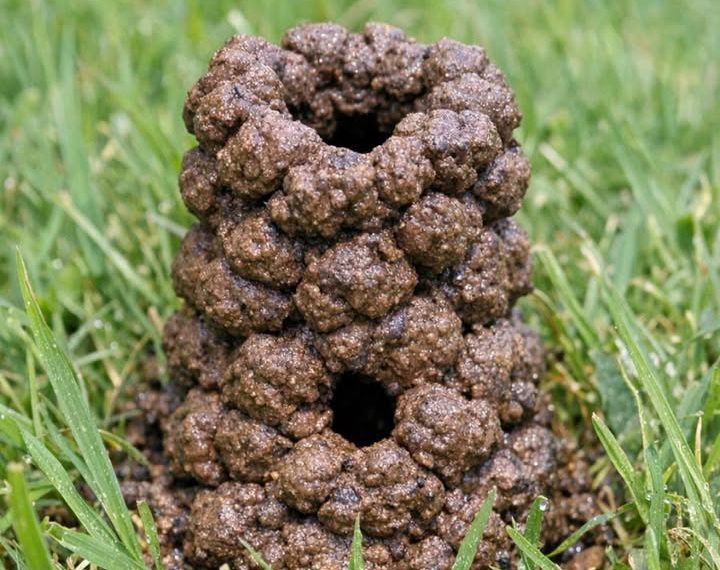
If you walked across your lawn one morning and discovered a strange tower of small mud balls with a hole in the center, you might wonder whether an animal has suddenly moved into your yard.
The unusual structure in the image is most likely a crayfish chimney, sometimes called a crayfish mound or mud chimney. These fascinating structures are created by crayfish that live underground, particularly in areas where the soil stays moist or where the water table is relatively close to the surface.
A mound several inches high can look surprisingly architectural, almost as if someone carefully built it from dozens of little balls of mud.
What Made This Strange Mud Tower?
The most likely builder is a burrowing crayfish.
Crayfish are freshwater crustaceans related to lobsters and crabs. While many people associate them with streams, ponds and rivers, certain species spend much of their lives inside underground burrows.
When a crayfish digs through wet soil, it has to move large quantities of mud out of its tunnel. Rather than simply scattering the soil around the entrance, the animal pushes it upward and deposits it around the opening.
As the excavation continues, the crayfish can gradually create a distinctive chimney-like structure made of mud pellets.
The hole in the middle provides an important clue: it is essentially the entrance to the animal’s underground home.
Why Does the Crayfish Build a Chimney?
The chimney isn’t just decoration.
A crayfish burrow can extend surprisingly deep beneath the ground. Depending on the species and local conditions, the tunnel may reach areas where the soil remains damp or where groundwater is available.
The mud surrounding the entrance can help create a more stable opening and may also reduce the chance that loose soil collapses back into the tunnel.
The crayfish essentially excavates its home from below and uses the removed soil to construct the mound above ground.
Why Are the Mud Balls So Round?
This is one of the most interesting details.
As the crayfish digs, it gathers wet soil and pushes or carries it toward the surface. The resulting pieces often become rounded or pellet-like, especially when the soil is wet and sticky.
One pellet after another can accumulate around the entrance.
Over time, these individual pieces can form a structure that looks almost like a miniature stone tower.
That’s why the mound may appear to have been deliberately constructed from dozens or even hundreds of small mud balls.
Why Did It Appear in the Lawn?
TO CONTINUE READING THE ARTICLE PLEASE SEE PAGE 2