7. Seven Additional Tricks to Dry Clothes Faster
Beyond the ERS method, these simple habits can make a noticeable difference in your laundry routine.
Trick 1: Use a Dry Towel to Absorb Excess Water
For particularly heavy garments, lay a clean, dry towel on a flat surface and place the garment on top.
Roll the towel and garment together, then gently press to transfer some moisture into the towel.
This can be useful for delicate garments that cannot tolerate strong spinning.
Trick 2: Avoid Overloading the Drying Rack
Putting too many clothes on one rack may seem convenient, but it can actually slow the drying process.
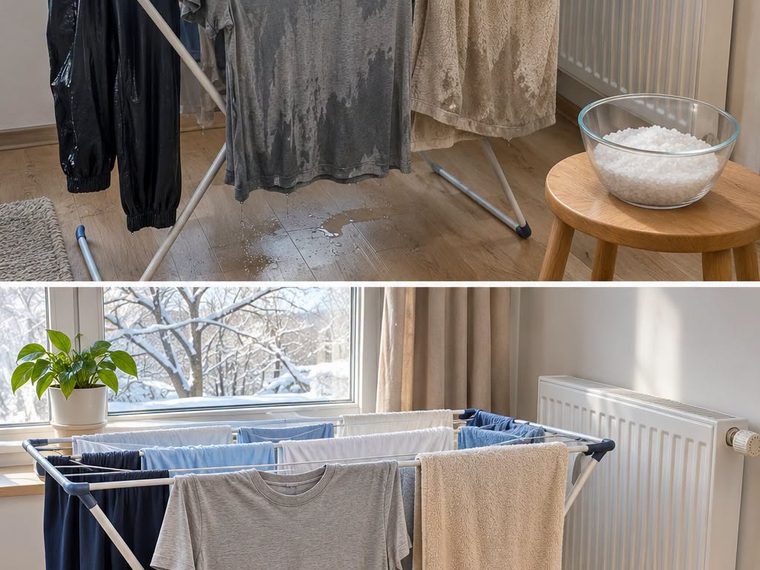
When garments overlap, air cannot circulate freely.
Instead, leave small spaces between clothes and use an additional rack when necessary.
Trick 3: Hang Heavy Clothes Separately
Jeans, towels, and sweatshirts generally take longer to dry than thin shirts.
Hang heavier garments where they have plenty of space and turn them over periodically.
You can also reposition thick waistbands, pockets, and sleeves to expose damp areas to moving air.
Trick 4: Take Advantage of Natural Sunlight
Even during winter, sunlight can help warm clothes and the surrounding air.
If you have a sunny window or balcony, take advantage of dry weather whenever possible.
Natural sunlight costs nothing and can make a difference when combined with good airflow.
Trick 5: Use a Dehumidifier
If you regularly dry clothes indoors, a dehumidifier may be one of the most useful household appliances to consider.
Unlike a bowl of salt, it is designed to remove substantial quantities of moisture from the air.
Some models even include a dedicated laundry mode.
It can help reduce condensation while creating conditions that allow clothes to dry more efficiently.
Trick 6: Clean Your Washing Machine Regularly
Sometimes unpleasant laundry smells are not caused by slow drying alone.
Detergent residue, dirt, and moisture inside the washing machine can contribute to unpleasant odours.
Clean the detergent drawer, rubber seal, and washing machine drum regularly according to the manufacturer’s instructions.
Remember to leave the door open after washing when appropriate to allow the drum to dry.
Trick 7: Remove Clothes as Soon as They Are Dry
Once your clothes are completely dry, remove them from the rack.
This creates more space for the remaining garments and prevents unnecessary exposure to moisture.
Fold and store clothes only when they are completely dry.
8. Common Laundry Drying Mistakes to Avoid
Even with the best intentions, certain habits can make indoor drying less effective.
| Common mistake | Better solution |
|---|---|
| Putting clothes directly on radiators | Use a separate drying rack |
| Hanging clothes too close together | Leave spaces for airflow |
| Drying laundry in a closed room | Improve ventilation |
| Using excessive heat | Use gentle warmth |
| Ignoring condensation | Ventilate and control humidity |
| Depending only on salt | Consider a proper dehumidifier |
According to a National Energy Action report, higher temperatures, air movement, and lower humidity all help clothes dry through evaporation. The report also recommends keeping drying racks away from radiators rather than covering them. National Energy Action (NEA)+1
9. Is the ERS Method Really Economical?
One reason this method attracts attention is that it encourages people to reduce their dependence on electric tumble dryers.
Air-drying clothes naturally requires no tumble-dryer electricity. However, the actual savings depend on your existing heating system, ventilation, drying time, and whether you use an electric fan or dehumidifier.
Here is a simple comparison:
| Drying method | Electricity consumption |
|---|---|
| Traditional drying rack | No additional electricity |
| Drying rack with natural airflow | No additional electricity |
| Drying rack with electric fan | Low additional consumption |
| Drying rack with dehumidifier | Additional electricity |
| Electric tumble dryer | Generally higher consumption, depending on model |
A heat-pump tumble dryer can be considerably more energy-efficient than older conventional models, so the cheapest option depends on the equipment you already own.
The best economical approach is to remove excess water during spinning, use natural airflow whenever possible, and avoid unnecessarily increasing your home’s heating temperature.
10. Frequently Asked Questions
Can I use ordinary table salt instead of coarse salt?
Yes. Both can attract moisture under suitable conditions. However, neither should be considered a substitute for proper humidity control.
How long does it take to dry clothes using the ERS method?
There is no guaranteed drying time. Thin garments may dry within several hours, while jeans, towels, and thick sweatshirts can take considerably longer. Room temperature, airflow, humidity, and fabric thickness all matter.
Can I put my drying rack directly beside a radiator?
You can position it nearby, provided there is sufficient clearance and the radiator manufacturer’s safety instructions are followed. Never cover the radiator with wet clothes.
Does a bowl of salt really absorb moisture?
Yes, salt can absorb some moisture under appropriate conditions, but its capacity is limited. It will not meaningfully dehumidify an entire room filled with damp laundry.
Is it safe to dry clothes indoors every day?
It can be safe if you manage the additional moisture through adequate ventilation or dehumidification. Persistent condensation and dampness should not be ignored.
Can a fan make clothes dry faster?
Yes. Moving air helps remove water vapour from around the fabric, encouraging further evaporation.
Final Thoughts: Make Laundry Drying Easier Without Spending More
Drying clothes indoors does not have to be expensive or complicated.
The ERS method brings together three familiar household ideas: removing excess water during the spin cycle, making use of gentle warmth, and trying coarse salt as an additional moisture-absorbing aid.
However, the real secret to faster drying is not the salt itself. It is the combination of effective spinning, good air circulation, suitable room conditions, and proper humidity control.
By following these simple recommendations, you can reduce unnecessary energy consumption, keep your laundry fresher, and make everyday household chores easier.
Sometimes, the most effective household improvements come from changing a few small habits rather than purchasing another expensive appliance.