2. Why Would Something Like This Appear on Your Bed?
If these objects really are seeds, insect remains, or another type of capsule, there are several ways they could have reached your bed.


They may have come from clothing or bags
Small objects can become trapped in clothing, pockets, handbags, backpacks, or blankets and fall out later.
If you recently spent time outdoors, handled plants, or brought secondhand items into your home, check those belongings first.
They may have come from nearby furniture
Small insects and their remains can occasionally appear around bed frames, bedside tables, wardrobes, and storage boxes.
Inspect the area around the bed, especially joints, cracks, and places where dust accumulates.
They may have been transferred from another object
Packages, used furniture, decorative items, pet bedding, and stored textiles can introduce unfamiliar material into a room.
This does not mean that any of these items necessarily brought pests into your home. They are simply reasonable places to investigate if you continue finding similar objects.
3. What Should You Do Immediately After Finding Them?
You do not need to panic or throw away your mattress. Start with a few straightforward precautions.


Step 1: Do not crush or discard the objects yet
Use a piece of paper, tweezers, or gloves to place them in a small, clear, sealed container.
This will preserve their shape and allow you to examine them more closely. If identification becomes necessary, a pest-control professional or local entomologist may be able to help.
Step 2: Take clear photographs
Photograph the objects from above and from the side. Include a ruler or another familiar object for scale.
If possible, take a close-up that shows their surface, ends, and any seams or markings.
These details are much more useful for identification than color alone.
Step 3: Inspect the mattress and bed frame
Use a flashlight to examine:
- The seams and piping around the mattress.
- The underside and corners of the mattress.
- The joints of the bed frame and headboard.
- Cracks around bedside furniture.
- Nearby upholstered furniture.
Look for live insects, shed skins, eggs, or dark spotting. Do not assume that every small speck is a pest.
Step 4: Wash bedding if appropriate
If the bedding is visibly dirty or you suspect that insects may be present, wash it according to its care label and dry it thoroughly.
If bedbugs are a genuine concern, follow established bedbug-control guidance for laundering and handling textiles. Avoid carrying potentially infested bedding through the house uncovered.
Step 5: Avoid spraying random chemicals
Do not spray insecticides, bleach, alcohol, or household cleaning mixtures onto your mattress simply because you found an unidentified object.
These substances may damage fabrics, create health risks, or fail to address the actual source.
If you find additional evidence of pests, identify the likely species before choosing a treatment.
4. How Can You Tell Whether It Is an Insect or Something Harmless?
A few physical characteristics can help narrow down the possibilities, although none is conclusive on its own.
| Feature | What to look for |
|---|---|
| Visible legs or antennae | Suggests an insect if clearly present. |
| A ridged seam | May be consistent with certain insect egg cases. |
| A pale, whitish color | More consistent with typical bedbug eggs than the dark objects shown. |
| A hard, uniform surface | Could be a seed or another non-insect object, but does not prove it. |
| Repeated discoveries | Make it more important to inspect the surrounding area and identify the source. |
| Nearby dark spots or shed skins | May justify a closer inspection for household pests. |
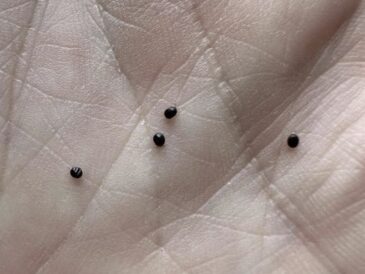
The objects in your photograph appear to have a relatively uniform shape and a glossy reddish-brown surface. Those features are useful observations, but they are not enough to identify a species.
5. When Should You Be Concerned About Bedbugs?
Finding one unidentified object is not the same as finding a bedbug infestation.
Concern becomes more justified when you discover multiple independent signs, such as live bedbugs, characteristic shed skins, or eggs that can be identified by their appearance and location.


If you suspect bedbugs:
- Inspect the mattress and bed frame carefully.
- Keep potentially affected bedding contained when moving it.
- Avoid moving furniture or belongings into other rooms unnecessarily.
- Do not rely on homemade sprays or bug bombs as a solution.
- Contact a qualified pest-control professional if you find convincing evidence.
Bedbugs are not a sign that a home is dirty. They can be introduced into clean homes through luggage, furniture, clothing, and other belongings.
Also, do not use skin marks alone to diagnose bedbugs. Many other things can cause bites or irritation, and some people have no obvious skin reaction to bedbug bites.
6. Frequently Asked Questions
Are the objects in the photograph bedbug eggs?
They do not resemble typical bedbug eggs, which are tiny and whitish. However, the image does not provide enough information to identify the objects conclusively.
Could they be cockroach eggs?
Cockroach egg cases are generally brown and often have visible ridges. The smooth, elongated appearance of these objects is not enough to confirm that they are cockroach egg cases.
Should I throw away my mattress?
No. There is no reason to discard a mattress based solely on this photograph. First, identify the objects and inspect the surrounding area.
Can these objects hatch into insects?
That depends entirely on what they are. Some insect egg cases or pupae may contain developing insects, whereas seeds and many other objects will not. Their appearance alone cannot establish whether they are alive or capable of hatching.
What is the best way to identify them?
Keep one object in a sealed container, photograph it beside a ruler, and seek an identification from a qualified pest professional or entomologist if needed. A sharper macro photograph showing the ends and surface details may also help.
Final Thoughts: Don’t Panic, but Don’t Ignore the Evidence
Finding three strange, reddish-brown capsules on your bed would understandably make you uneasy. But the photograph does not establish that these objects are bedbugs, cockroach eggs, or any other particular pest.
Their smooth, glossy appearance means that several explanations remain possible, including non-insect objects. The best next step is to preserve one, photograph it clearly, and inspect the mattress seams and bed frame for additional signs.
If you can provide a close-up photograph of one object beside a ruler, especially showing both ends and its surface, it may be possible to narrow down the possibilities considerably.
The goal is not to assume the worst. It is to identify what you found before deciding whether any action is necessary.