Crabgrass is one of those plants that many gardeners immediately recognize as an unwanted invader. It appears in lawns, cracks in paving stones, garden beds, and disturbed soil, often spreading quickly during warm weather. But there is more to this humble grass than its reputation as a nuisance.
The plant commonly called large or hairy crabgrass is Digitaria sanguinalis, an annual grass in the family Poaceae. Kew’s Plants of the World Online records it as a recognized species with a native range extending from the Mediterranean region through Central Asia and into parts of Malesia. It is also documented as having food, animal-feed, and medicinal uses.
🌿 What Is Crabgrass?
“Crabgrass” is a common name used for several species of the genus Digitaria. Two widespread examples are large crabgrass (Digitaria sanguinalis) and smooth crabgrass (Digitaria ischaemum).
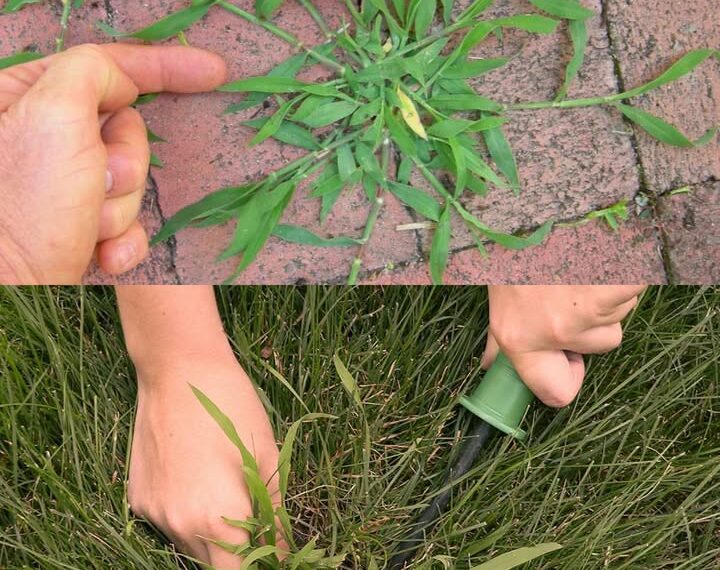
The plant shown in the images appears consistent with the general appearance of crabgrass, but a photograph alone is not enough to make a definitive species identification.
Large crabgrass can be recognized by several characteristics:
- A low, spreading growth habit
- Flat, relatively broad grass blades
- Hairy leaves and leaf sheaths
- Fibrous roots
- A short membranous ligule
- Seed heads with several slender, finger-like branches
These characteristics are particularly useful for distinguishing large crabgrass from other grasses.
🌱 Why Does It Spread So Easily?
One reason gardeners find crabgrass frustrating is its ability to establish itself in disturbed or open areas.
It is an annual plant, meaning it completes its life cycle within one growing season. It reproduces primarily through seeds. Once mature plants produce seeds, those seeds can remain in the environment and contribute to future populations.
Crabgrass is particularly successful where soil is exposed, lawns are thin, or vegetation is stressed. This is why you may notice it appearing along paths, between paving stones, or in bare patches of lawn.
🌾 But Is Crabgrass Actually Useful?
This is where the story becomes more interesting.
Although crabgrass is usually treated as a weed, Digitaria sanguinalis has documented traditional and practical uses.
Kew lists the species as being used for food, animal feed, and medicine.
Historically, the seeds of certain crabgrass species have been used as a grain. In parts of Europe, Digitaria sanguinalis was cultivated for its edible seed, and historical sources describe its use in foods such as porridges and soups.
This gives the plant a very different perspective: what one person sees as an annoying lawn weed has, in other settings, been regarded as a useful grass.
🌾 The Seeds Are Particularly Interesting
The mature seeds are tiny, but they have historically been collected and used as a grain or ground into flour.
This was not necessarily an easy food to harvest. Because the plant can produce seeds over an extended period rather than all at once, harvesting traditionally required considerable manual effort.
That explains why crabgrass never became a mainstream modern cereal crop despite having a history of human use.
Today, its greater practical importance is often related to forage and ecological uses, rather than human food.
🐄 A Source of Animal Feed
Crabgrass can also serve as forage.
Kew documents Digitaria sanguinalis as animal food, while other botanical references describe its use as fodder and forage.
This is one reason the plant can sometimes be valuable in agricultural environments, even though the same plant may be undesirable in a carefully maintained ornamental lawn.
Its value therefore depends greatly on where it is growing and what the land is being used for.
🌿 What About Its Medicinal Reputation?
This is an area where it is important to separate traditional use from scientifically established medical treatment.
Historical herbal sources describe preparations of Digitaria sanguinalis being used for various traditional remedies. However, these historical claims should not be interpreted as proof that the plant can treat diseases.
For example, some traditional sources mention medicinal preparations for conditions such as eye problems and other ailments, but there is not enough high-quality clinical evidence to recommend crabgrass as a treatment.
In other words:
Traditional use ≠ proven medical treatment.
Anyone considering a wild plant for medicinal purposes should consult a qualified healthcare professional rather than replacing established medical treatment with herbal preparations.
⚠️ Should You Eat Crabgrass?
TO CONTINUE READING THE ARTICLE PLEASE SEE PAGE 2