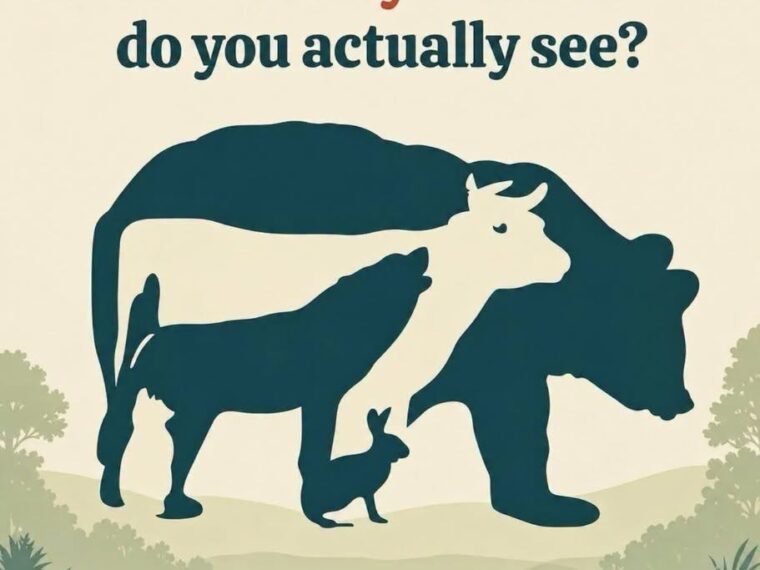
At first glance, this image looks like a simple illustration of a few animals standing together in a peaceful countryside. But look a little longer and something surprising happens: different parts of the picture begin to form different animals.
The image is an example of an ambiguous visual puzzle, where the brain has to decide which shapes belong to an animal and which shapes are simply background or empty space. This type of illusion is closely related to the psychological concept of figure-ground perception—the way our brain separates an object from everything surrounding it.
And that is exactly what makes this puzzle so entertaining.
But before we get into the possible answers, there’s one important clarification:
There is no scientific evidence that the first animal you notice predicts your luck, personality, future, or destiny.
The “luck” part of the title is best understood as a fun social-media interpretation, not a psychological or scientific test.
So What’s the Answer?
A reasonable reading of the illustration identifies about five animal figures, although the exact count can vary depending on how the ambiguous silhouettes are interpreted.
The clearest figures are:
- 🐄 Cow
- 🐻 Bear
- 🐇 Rabbit
- 🐕 Dog/wolf-like figure
- 🐈 Small cat-like figure
Because several shapes share boundaries, there isn’t necessarily one scientifically “correct” answer.
That’s what makes this type of puzzle different from a conventional spot-the-object game.
Why Do People See Different Animals?
The secret is in the way the human visual system organizes information.
When you look at the picture, your eyes don’t simply send a perfect photograph to your brain.
Your brain actively interprets the visual information.
It asks questions such as:
Where does one object end?
Where does another object begin?
Which area is the foreground?
Which area is the background?
Do these lines belong to the same object?
This process is called perceptual organization.
Gestalt psychology has studied these principles extensively. One of the most important concepts is the figure-ground relationship, where the visual system separates a perceived figure from its surrounding ground.
The Same Shape Can Become Two Different Things
This is the most fascinating part.
Imagine looking at the large dark region.
At first, you may think:
“That’s just the background.”
But once someone tells you that there is a bear hidden there, your brain may suddenly recognize a head, muzzle and body.
Nothing in the image has changed.
Your interpretation has changed.
This phenomenon is related to what psychologists call perceptual ambiguity or multistability, in which the same physical stimulus can support more than one perceptual interpretation.
Famous examples include images that can be perceived as either a vase or two faces, or the classic rabbit-duck illusion.
Why Does the Brain Do This?
Your brain is constantly trying to turn incomplete visual information into meaningful objects.
Imagine walking through a forest at dusk.
You see something moving behind a tree.
You don’t initially know whether it is:
- a person;
- an animal;
- a branch;
- or simply a shadow.
Your visual system has to make a rapid interpretation based on incomplete information.
Recognizing shapes and boundaries quickly can be extremely useful.
Research into visual illusions shows that perception is an active process, not simply a passive recording of the outside world.
Why Animals Are So Easy to Find in Optical Illusions
Interestingly, animals are particularly common in visual puzzles.
Our brains are extremely good at detecting biologically meaningful shapes.
A recent study of pareidolia—seeing recognizable objects or patterns in ambiguous images—found that animals were the most commonly perceived category among participants in the study.
That doesn’t mean every person will see exactly the same animal.
Instead, it demonstrates how strongly our brains try to organize ambiguous information into familiar and meaningful categories.
What Does Your First Animal “Say” About You?
This is where the fun part begins.
Although these interpretations aren’t scientifically validated personality tests, you can use them as a lighthearted game.
🐄 If You Saw the Cow First
You may have been drawn immediately to the large central figure.
In the playful interpretation of this puzzle, cow-seers are sometimes described as people who:
- notice obvious details quickly;
- prefer clarity;
- focus on the big picture;
- don’t overcomplicate things.
Your “luck” message:
Your luck comes from staying grounded and focusing on what is directly in front of you.
Again, this is entertainment—not a scientifically established prediction.
🐻 If You Saw the Bear First
If the dark silhouette immediately looked like a bear, you may have been paying more attention to the overall outline rather than the lighter figure inside it.
The playful interpretation associates this with:
TO CONTINUE READING THE ARTICLE PLEASE SEE PAGE 2