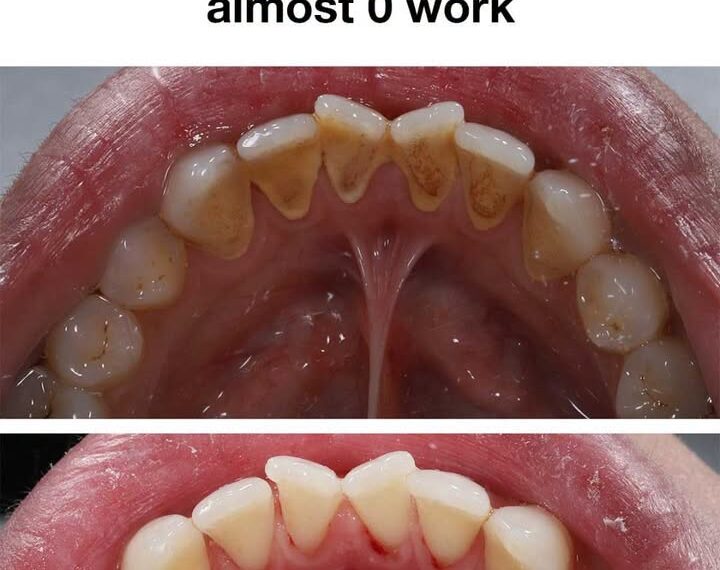
The image shows a dramatic before-and-after transformation of tartar buildup behind the lower front teeth. While the result looks impressive, it also raises an important question: Can tartar really be removed with simple home hacks, or does it require professional treatment?
The short answer is that tartar (also called calculus) cannot usually be removed completely at home once it has hardened on the teeth. However, there are several scientifically supported methods that can help prevent tartar formation, reduce plaque buildup, and keep your teeth cleaner between dental visits.
Let’s separate fact from fiction and explore what dental research says about tartar removal and prevention.
What Is Tartar?
Tartar, known medically as dental calculus, forms when plaque is left on teeth long enough to harden.
Plaque is a sticky film containing:
- Bacteria
- Food particles
- Saliva proteins
When plaque remains on teeth for 24–72 hours, minerals from saliva begin to harden it into tartar.
Unlike soft plaque, tartar attaches firmly to tooth surfaces and often develops:
- Behind lower front teeth
- Along the gumline
- Between teeth
- Near salivary gland openings
Once tartar forms, it creates a rough surface that attracts even more plaque and bacteria.
Why Tartar Is More Than a Cosmetic Problem
Many people worry about tartar because of its yellow or brown appearance.
The bigger concern is what happens underneath it.
Numerous studies have linked tartar accumulation to:
- Gum inflammation (gingivitis)
- Periodontal disease
- Bad breath
- Gum recession
- Increased tooth loss risk
Research published in dental journals consistently shows that calculus acts as a reservoir for harmful bacteria that trigger chronic gum inflammation.
Understanding the Image
The top image shows significant tartar deposits on the back surfaces of the lower front teeth.
The bottom image appears to show those deposits removed.
The smooth, cleaner appearance is typically what dentists achieve through:
- Professional scaling
- Ultrasonic cleaning
- Hand instrumentation
Such dramatic results usually cannot be produced safely with household tools.
Hack #1: Brush With a Tartar-Control Toothpaste
One of the easiest evidence-based approaches is using a toothpaste specifically formulated to control tartar.
These products often contain ingredients such as:
- Pyrophosphates
- Zinc citrate
- Stannous fluoride
Research has shown that these compounds help slow the mineralization process that turns plaque into tartar.
While they won’t remove existing tartar, they can significantly reduce future buildup.
Hack #2: Use an Electric Toothbrush
Multiple clinical studies have found that electric toothbrushes remove more plaque than manual brushes.
The rotating and oscillating movements reach difficult areas and improve cleaning efficiency.
Benefits include:
- Better plaque removal
- Reduced gingivitis
- Improved gum health
- Less tartar formation over time
Many dental professionals recommend electric toothbrushes for patients prone to calculus buildup.
Hack #3: Floss Every Day
Flossing remains one of the most effective ways to prevent tartar.
Plaque often accumulates in areas toothbrush bristles cannot reach.
Daily flossing helps:
- Remove trapped food
- Reduce bacterial growth
- Prevent plaque hardening
According to dental research, interdental cleaning significantly improves overall oral health when combined with brushing.
Hack #4: Use an Antimicrobial Mouthwash
Certain mouthwashes contain active ingredients designed to reduce bacterial populations.
Examples include:
TO CONTINUE READING THE ARTICLE PLEASE SEE PAGE 2