6. How to Remove Ripples From Jeans You Have Already Washed

The good news is that some ripples can be reduced without replacing your jeans. The best approach depends on whether you are dealing with ordinary creases or more persistent fabric distortion.
Method 1: Re-shape the Jeans While They Are Damp
This is a good first step because it requires no special equipment.
- Lightly dampen the rippled area with clean water.
- Lay the jeans flat on a clean, dry surface.
- Gently smooth the fabric outward with your hands, following the direction of the weave.
- Carefully straighten the seams and reshape the surrounding material.
- Allow the jeans to air-dry flat or hang them straight, away from direct heat.
Avoid pulling aggressively on the fabric. Excessive stretching may distort the jeans further, especially if they contain elastane.
Method 2: Use Steam to Relax the Fabric
Steam can help loosen ordinary wrinkles and make the denim look smoother.
Hang the jeans securely and use a garment steamer according to the appliance instructions. Move the steamer evenly over the affected area, keeping the appropriate distance from the fabric.
Gently smooth the material as it relaxes.
If you do not own a steamer, an iron may also help. Check the care label first, select a suitable temperature, and use a pressing cloth if recommended.
Do not apply excessive heat directly to stretch denim, decorative finishes, or delicate areas.
Remember that steam can improve the appearance of wrinkles, but it cannot reliably repair damaged elastic fibers or correct every manufacturing defect.
Method 3: Try a Gentle Rewash
If the ripples appear to be ordinary washing creases, another wash may sometimes help redistribute the fabric and relax the folds.
Use cold water, a gentle cycle, and an appropriate amount of detergent. Avoid overloading the machine.
When the cycle ends, remove the jeans immediately, smooth the material by hand, and allow them to air-dry.
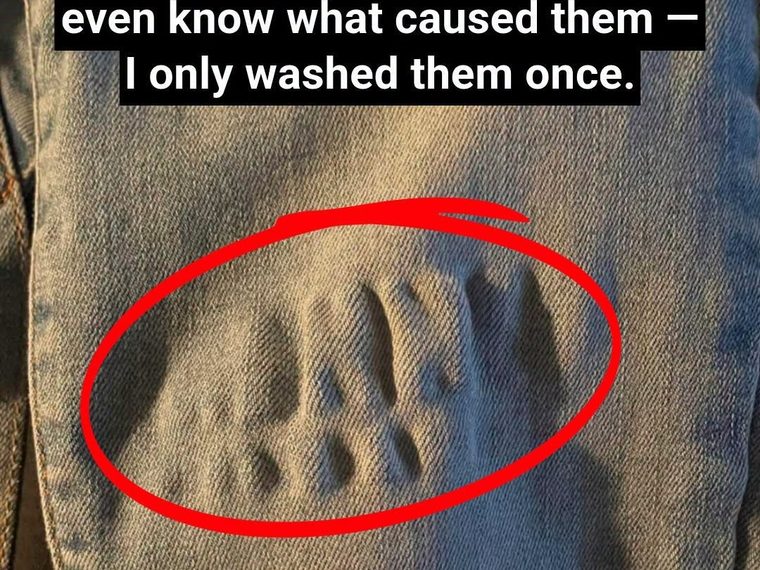
However, if the ripples appeared after the very first wash and look like deep puckering rather than ordinary wrinkles, repeated washing may not solve the problem. In that case, it is better to contact the seller before attempting further treatments.
7. How to Prevent the Problem With Future Washes

A few simple habits can help preserve the appearance and shape of your jeans.
| What to do | Why it helps |
|---|---|
| Turn jeans inside out | Reduces rubbing and helps protect the visible surface. |
| Use cold water when permitted | Reduces exposure to heat that may contribute to shrinkage. |
| Choose a gentle cycle | Limits unnecessary mechanical stress. |
| Avoid overloading the machine | Gives garments more room to move freely. |
| Remove jeans promptly | Prevents them from remaining tightly crumpled while wet. |
| Smooth the fabric before drying | Helps reduce folds and uneven creasing. |
| Air-dry when possible | Avoids the high temperatures associated with some tumble-drying methods. |
| Follow the care label | Matches the washing method to the garment’s actual materials. |
You should also avoid using bleach unless the care instructions specifically permit it. Fabric softener is not necessary for every pair of jeans, and it should only be used when appropriate for the fabric and manufacturer’s instructions.
There is no need to wash jeans after every single wear unless they are dirty, sweaty, or require cleaning for another reason. Washing them when necessary can help reduce unnecessary wear.
8. When Should You Return the Jeans to the Store?

If your jeans were new, looked smooth before washing, and developed pronounced ripples after following the care instructions, you may have a legitimate reason to contact the retailer.
Before attempting to repair them, take the following steps:
- Photograph the affected areas in good lighting.
- Keep your purchase receipt and packaging, if available.
- Check the garment’s care label.
- Compare the affected areas with the same sections on the second pair.
- Contact the seller and explain that the problem appeared after the first wash.
You can send a message like this:
Hello, I recently purchased these jeans, and after washing them just once according to the care instructions, I noticed unusual ripples and puckering in the fabric. The same issue has appeared on both pairs. Could you please advise whether this may be a manufacturing defect and whether an exchange or refund is possible? I can provide photographs and proof of purchase. Thank you.
Do not assume that every ripple qualifies as a manufacturing defect. However, if the fabric has become visibly distorted after a single correctly performed wash, it is reasonable to ask the retailer to investigate.
9. How to Tell Whether the Ripples Are Permanent
Before deciding what to do next, examine the jeans carefully.

Signs of temporary wrinkles
- The folds become less visible when the fabric is smoothed.
- The material looks flatter after air-drying or steaming.
- The fabric retains its normal texture and elasticity.

Signs of persistent distortion
- The same raised folds remain after the jeans are completely dry.
- The fabric repeatedly returns to the same rippled shape.
- The stitching appears to pull the surrounding material into waves.
- The area looks distorted rather than simply creased.
These are useful clues, not a definitive test. Some types of puckering can be reduced by professional pressing or alterations, while other forms of fabric distortion may be difficult or impossible to reverse completely.
For more information about the issue, you can read these related guides:
- Why Do My Jeans Get Ripples After Washing? — Dry Cleaners Cambridge
- Why Do My Jeans Have Ripples? — Sewing Is Cool
- How Jeans Are Made: Pre-Washing and Pre-Distressing — Denim Hunters
Final Thoughts: Your Jeans May Not Be Ruined
Strange ripples in denim can be frustrating, particularly when you have just purchased two new pairs and washed them only once. Fortunately, not every case means the jeans are permanently damaged.
The most likely explanations include uneven shrinkage, ordinary washing creases, differences in fabric construction, stitching tension, or problems affecting stretch fibers.
The key is to examine the pattern of the ripples, check the care label, and try gentle reshaping before deciding that the jeans are beyond repair.
If the folds are pronounced, appeared after the first wash, and affect both pairs, do not immediately blame yourself or assume you washed them incorrectly. The material or manufacturing process may be part of the problem.
My recommendation: Photograph the ripples, check the washing instructions, and contact the seller before repeatedly washing, ironing, or applying heat to the jeans. If they are new and the distortion is substantial, an exchange may be a better solution than trying to repair them yourself.
After all, buying a new pair of jeans should be an enjoyable experience—not a frustrating battle with unexpected wrinkles.