The Weight Test: Pick Up the Watermelon
Once you’ve identified a watermelon with a promising field spot, pick it up.
A ripe watermelon should feel heavy for its size.
Why?
Watermelon is made up of roughly 92% water, so a heavier fruit relative to similarly sized melons may contain more water and be particularly juicy.
Imagine you’re comparing two watermelons that look almost identical.
If one feels noticeably heavier, that one may be the better choice.
The trick is to compare—not just judge by absolute weight.
A huge watermelon will naturally weigh more than a small one.
Instead, compare watermelons of approximately the same size.
Heavy for its size = a good sign.
Look at the Rind
The outside of the watermelon can provide another clue.
A ripe watermelon often has a duller, less glossy appearance.
An extremely shiny rind can sometimes indicate that the watermelon hasn’t reached full maturity.
North Carolina Cooperative Extension recommends looking for a dull appearance, while University of Missouri Extension also recommends a dull green rind rather than a shiny one.
However, this characteristic can vary somewhat between varieties, so it should not be used by itself.
Should You Knock on the Watermelon?
You’ve probably seen people tapping watermelons in grocery stores.
The traditional idea is simple:
Tap it and listen to the sound.
A mature watermelon is often described as producing a deeper, more resonant sound.
However, there’s an important caveat: the sound test isn’t considered as reliable as many people believe.
University of Missouri Extension describes the sound test as the least trustworthy of the common selection methods.
Other extension sources describe a deep or hollow sound as a possible indicator of ripeness, while noting that sound can be difficult to interpret consistently.
So don’t reject a watermelon simply because you don’t like the sound it makes.
Instead, prioritize:
- The field spot
- Weight
- Overall rind appearance
- Other signs of maturity
Then use the sound as an additional clue.
What If the Watermelon Is Still Growing on the Vine?
If you’re growing watermelons yourself, you have access to another useful clue that shoppers don’t normally have.
Look at the curly tendril closest to the watermelon.
As the fruit reaches maturity, this tendril can change from green to brown and dry.
A green, flexible tendril may indicate that the fruit is still developing, whereas a dried brown tendril is a useful maturity signal.
This is particularly useful for gardeners because you can examine the fruit while it’s still attached to the plant.
Does a Watermelon Become Sweeter After You Pick It?
This is a very important point.
Unlike fruits such as bananas, watermelons are considered non-climacteric, meaning they don’t continue the same kind of ripening process after harvest.
In other words, you shouldn’t expect a watermelon that was picked too early to become significantly sweeter while sitting on your kitchen counter.
The University of Minnesota Extension notes that watermelons do not ripen after harvest and should ideally remain on the vine until they are mature.
That’s why choosing a watermelon that was harvested at the right stage matters so much.
The Biggest Mistake People Make
One of the biggest mistakes is judging a watermelon entirely by its size.
Bigger doesn’t automatically mean better.
A huge watermelon can still be underripe.
Instead of asking:
“Which one is the biggest?”
ask:
“Which one has the best combination of maturity signs?”
Look for a developed yellow field spot, a heavy feel for its size, a suitable rind appearance, and—if you’re picking directly from the vine—a dry brown tendril.
A Simple Watermelon-Picking Checklist
The next time you’re at a market or grocery store, use this quick checklist.
✅ 1. Find the field spot
Look underneath the watermelon.
Best: large creamy yellow or yellow-orange patch.
Less encouraging: small white or very pale patch.
✅ 2. Pick it up
Compare it with similarly sized melons.
Best: feels heavy for its size.
✅ 3. Examine the rind
Look for a firm, relatively dull rind rather than an unusually shiny one.
✅ 4. Check for damage
Avoid melons with deep cuts, soft rotten areas, severe bruising, or other obvious damage.
✅ 5. Use the sound test as an extra clue
Tap gently.
A deeper sound can be consistent with maturity, but don’t rely on this test alone.
✅ 6. If it’s on the vine, inspect the tendril
A brown, dry tendril close to the fruit is a useful maturity indicator.
So, Which Watermelon Would I Choose?
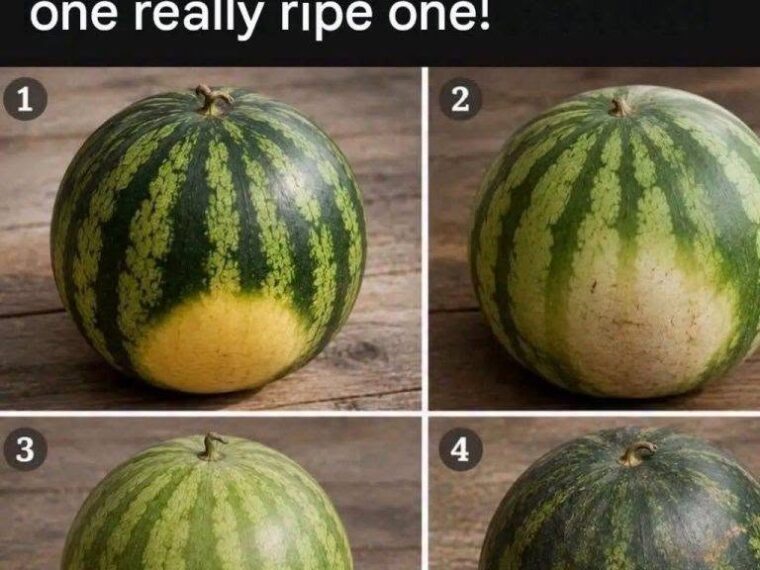
Number 1.
Based on the photograph alone, #1 has the most convincing visible field spot, with a strong yellow-orange color.
That is exactly the kind of feature experts recommend looking for when selecting a mature watermelon.
But remember: the field spot is an indicator, not a guarantee.
The best approach is to combine several signs:
Large yellow field spot + heavy for its size + firm, dull rind + no obvious damage = a much better bet.
And if you’re picking directly from the vine, add another clue:
Brown, dried tendril near the fruit = another strong sign that it’s ready.
Final Verdict
If these four watermelons were sitting in front of me and I had to choose one without cutting them open, I’d reach for #1 first.
Its prominent yellow-orange field spot gives it the strongest visual indication of maturity among the choices shown.
So the next time you’re faced with a pile of watermelons, don’t just grab the biggest one. Turn it over and look at its belly.
That little yellow patch could be one of the best clues you have.
The watermelon with the biggest, richest-looking yellow field spot deserves your attention first.