Choosing a watermelon can sometimes feel like a guessing game. They may all look similar from the outside, but one can be sweet, juicy, and perfectly ripe while another is bland, watery, or picked too early.
The good news is that you don’t have to cut open every watermelon to find the best one. There are several clues that can help you judge ripeness before you buy.
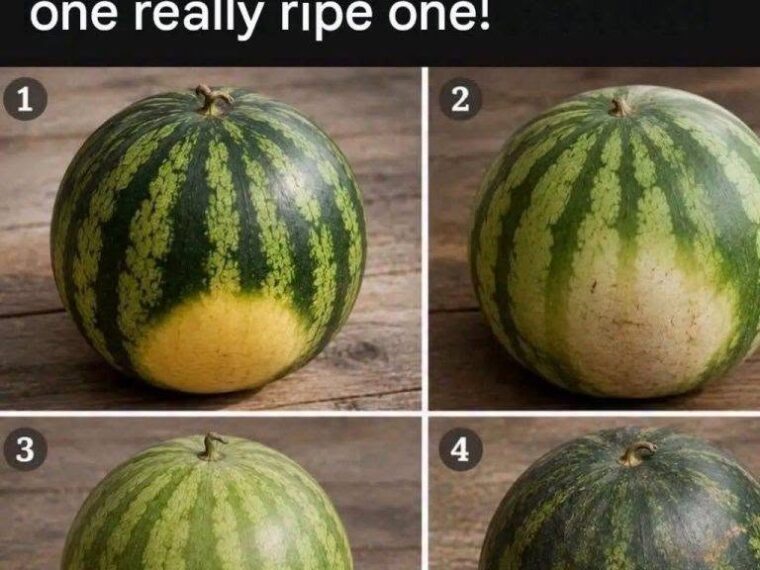
Looking at the four watermelons in the image, Watermelon #1 appears to be the strongest choice, mainly because of its prominent yellow-orange field spot. But what exactly does that spot tell us?

6
The Most Important Clue: Look at the Yellow Spot
One of the best visual indicators of watermelon maturity is the field spot, sometimes called the “ground spot” or “yellow belly.”
This is the area of the watermelon that rested directly on the ground while the fruit was growing on the vine. Because that part of the rind didn’t receive sunlight, it develops a different color from the rest of the fruit.
As the watermelon matures, this area generally changes from pale white or light green toward yellow or creamy yellow.
According to North Carolina Cooperative Extension, a ripe watermelon typically has a large, creamy-yellow field spot, while a small or mostly white spot can indicate that the melon was harvested earlier.
That’s why the watermelon with the most developed yellow-orange patch in the photograph stands out.
Why does the yellow spot matter?
A well-developed yellow field spot suggests that the watermelon spent enough time developing on the vine before harvest.
It doesn’t mean that every watermelon with a yellow spot will automatically be sweet, but it is one of the most useful clues available when you’re shopping for an uncut melon.
University extension guidance consistently recommends looking for a large yellow or creamy-colored ground spot rather than a small white or pale area.
Why Watermelon #1 Looks Like the Best Choice
If I had to choose one of the four watermelons based only on the visible characteristics in the photograph, I would choose #1.
The main reason is the pronounced yellow-orange area on its underside.
Compared with a watermelon showing a very pale or white field spot, a more developed yellow patch is generally a better indication of maturity.
That doesn’t mean we can guarantee exactly how sweet #1 will taste without cutting it open. External appearance can never provide absolute certainty. However, when you’re standing in a supermarket or fruit market with several whole watermelons in front of you, the field spot is one of the first things worth checking.
University of Georgia Extension also recommends a bright yellow ground spot as an important sign when selecting a ripe watermelon.
What About Watermelon #2?
Watermelon #2 has a noticeably lighter-looking field spot.
A pale or whitish field spot isn’t necessarily proof that the watermelon is bad. Different varieties, growing conditions, and handling can affect the appearance.
However, when comparing similar watermelons, a larger, more yellow field spot generally gives the advantage to the melon that had more time to mature.
University of Missouri Extension specifically notes that a white or pale green field spot can be a sign that a watermelon was harvested too early.
So if #1 and #2 were similar in size and appearance, #1 would be my choice.
What About Watermelon #3?
Watermelon #3 also appears to have a relatively pale field spot.
Again, this doesn’t automatically mean that it will taste bad.
The important point is that we’re comparing the visible signs of maturity.
A creamy yellow field spot is generally more encouraging than a white or very pale one. The larger and more developed the spot, the more confidence you can have that the fruit spent adequate time developing before harvest.
Therefore, #3 wouldn’t be my first choice from this particular group.
And What About Watermelon #4?
Watermelon #4 may also be a perfectly good watermelon, but the photograph doesn’t give us enough information to guarantee that it is more mature than #1.
This is an important lesson when choosing fruit:
No single test is perfect.
Experts recommend combining several clues rather than relying on one characteristic alone. University of Georgia and University of Georgia Extension materials emphasize using the field spot together with other indicators such as weight, rind appearance, and sound.
So although #1 appears to have the strongest visual evidence of ripeness, I would still check its weight and overall condition before buying it.
The Weight Test: Pick Up the Watermelon
TO CONTINUE READING THE ARTICLE PLEASE SEE PAGE 2