4. Kiwi Peel May Have Interesting Potential for Gut Health
One of the newer areas of research involves the relationship between kiwi-peel fiber and the microorganisms living in the colon.
A 2026 laboratory study investigated kiwi-peel dietary fiber and its bound phenolic compounds during simulated digestion and fermentation.
The researchers observed that some compounds were released during colonic fermentation and that the kiwi-peel material influenced the growth of several bacterial groups in the laboratory model.
This is interesting because dietary fiber and plant compounds can interact with the gut microbiota.
But there is an important limitation: this was an in-vitro study, meaning it was conducted under laboratory conditions rather than demonstrating a health effect in people.
More human research is needed before making strong claims about kiwi peel and gut health.
5. Don’t Forget Actinidin
Kiwifruit contains a naturally occurring enzyme called actinidin.
This enzyme belongs to a family of proteases, meaning it can break down certain proteins.
Researchers have investigated its ability to break down different types of proteins, including proteins involved in simulated digestion. One study found that actinidin can enhance the breakdown of gluten proteins under simulated gastrointestinal conditions.
This is one reason kiwi has attracted interest in food science.
However, the presence of actinidin should not be interpreted as meaning that eating kiwi can treat gluten intolerance or celiac disease. People with medically diagnosed celiac disease should continue following appropriate dietary guidance.
6. You Can Use More of the Fruit Instead of Throwing It Away
Perhaps the simplest advantage of using kiwi peel is sustainability.
Fruit peels are often discarded even though they contain fiber and other compounds.
Researchers have specifically investigated ways of recovering useful components from kiwi peels, including dietary fiber, polyphenols and carotenoids.
This opens interesting possibilities for the food industry.
Kiwi peel can potentially be processed into powders, extracts or fiber-rich ingredients rather than simply becoming food waste.
At home, however, you don’t need complicated processing equipment to make better use of the fruit.
7. How Can You Eat Kiwi With the Skin?
If you enjoy the texture, the simplest method is to wash the whole kiwi thoroughly and eat it as it is.
The fuzzy texture can take some getting used to.
Some people prefer to slice the kiwi very thinly, which makes the skin less noticeable.
Another option is to blend the whole fruit into a smoothie.
When blended with ingredients such as banana, yogurt, milk or other fruit, the texture of the peel becomes much less obvious.
You can also chop the whole kiwi and add it to a fruit salad.
8. What About the Kiwi Peel in the Image?
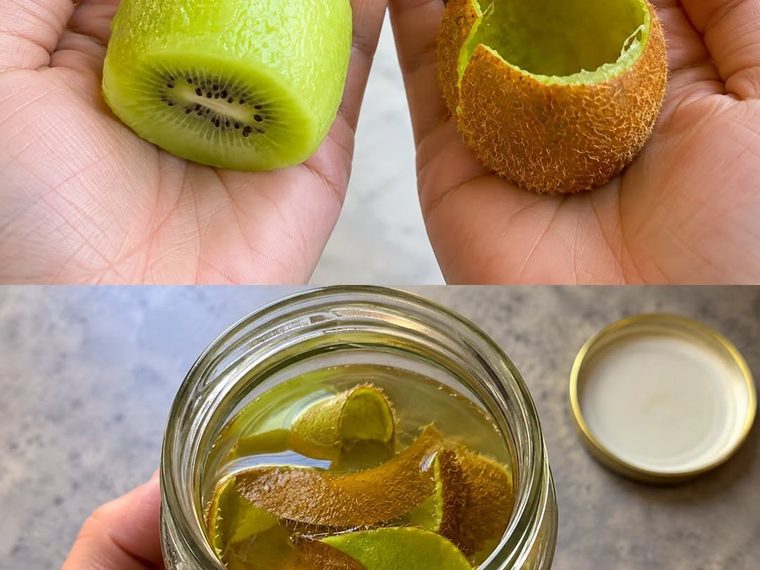
The image shows kiwi flesh alongside the removed skin and a jar containing kiwi-peel pieces.
This highlights an interesting idea: the peel doesn’t necessarily have to go straight into the garbage.
If you don’t enjoy eating the skin, there are still culinary possibilities for using cleaned peel in certain preparations.
For example, small amounts can potentially be incorporated into smoothies or blended fruit preparations.
However, homemade kiwi-peel infusions or mixtures should not be presented as medicinal treatments. There is currently no good basis for claiming that drinking kiwi-peel water “detoxes” the body or treats a disease.
9. Wash the Fruit Properly
If you’re planning to eat the peel, washing becomes particularly important because the skin is the part of the fruit exposed to the outside environment.
Rinse the kiwi thoroughly under running water and rub the surface gently with clean hands.
You don’t need to use harsh chemicals or household cleaning products on fruit.
If the fruit is visibly damaged, moldy, or spoiled, discard it rather than trying to salvage the peel.
10. Some People May Not Tolerate Kiwi Well
Although kiwi is a nutritious fruit for many people, it isn’t suitable for everyone.
Kiwi can cause allergic reactions in susceptible individuals. People who already know they are allergic to kiwi should avoid the fruit, including its peel.
The fruit can also cause mouth irritation in some people, particularly when eaten in larger quantities.
If eating kiwi consistently causes itching, swelling, burning, digestive symptoms, or other concerning reactions, stop eating it and seek appropriate medical advice.
A Simple Kiwi-Peel Smoothie Idea
If you want to experiment with eating the entire fruit, a smoothie is probably one of the easiest options.
Ingredients
- 1 ripe kiwi, thoroughly washed
- 1 banana
- ½ cup plain yogurt
- A small amount of water or milk
- A few ice cubes, if desired
Preparation
Cut the washed kiwi into pieces without removing the skin.
Place everything into a blender and blend until smooth.
The banana and yogurt help balance the tartness of the kiwi while making the peel’s texture much less noticeable.
The Bigger Lesson: Don’t Underestimate Food Scraps
Kiwi peel is a good example of a broader idea in nutrition: the parts we routinely throw away can sometimes contain useful nutrients and plant compounds.
Similar research has examined the potential value of apple skins, citrus peels, grape skins and other fruit by-products.
The goal isn’t to suggest that every peel should automatically be eaten.
Rather, it is worth understanding that fruits are complex foods, and valuable compounds aren’t always concentrated in the part we consider the most delicious.
Final Thoughts
The humble kiwi peel is much more interesting than it looks.
Research has identified fiber, polyphenols, flavonoids, carotenoids and other bioactive compounds in kiwifruit peel, while laboratory studies have demonstrated antioxidant activity and potential interactions with gut microorganisms.
That doesn’t make kiwi skin a miracle cure, but it does provide a good reason to reconsider throwing it away automatically.
If you enjoy the texture and tolerate kiwi well, washing the fruit and eating it whole is the simplest way to make use of the peel. If you don’t like the fuzzy texture, blending the whole fruit into a smoothie is another practical option.
Sometimes, the part of a fruit we instinctively discard is precisely the part worth taking a second look at.